
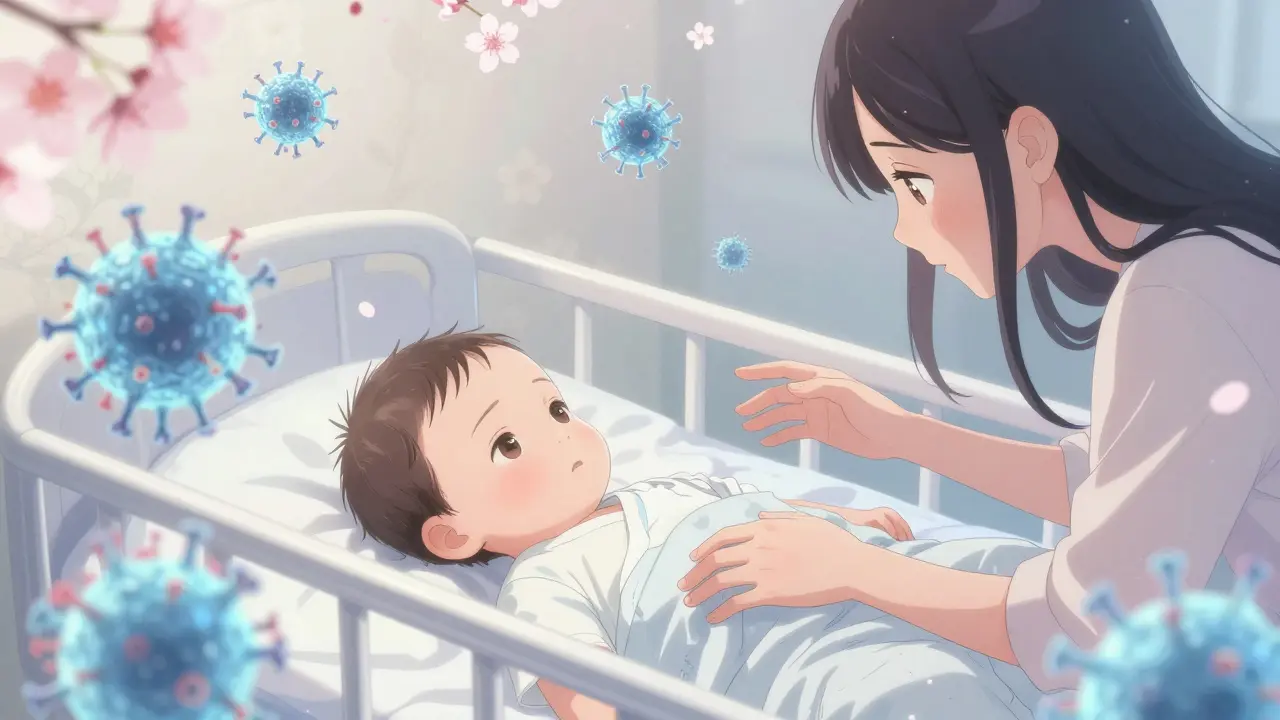
Every year, as the weather turns cooler, a quiet but powerful virus begins to spread-RSV. It doesn’t make headlines like flu or COVID-19, but for babies and older adults, it can be deadly. Respiratory Syncytial Virus, or RSV, is the most common cause of bronchiolitis and pneumonia in infants under one year old. It’s also a major reason older adults end up in the hospital. And while many people think of it as just a bad cold, the reality is far more serious-especially for those most vulnerable.
What RSV Actually Does to the Body
RSV doesn’t just give you a runny nose. It attacks the small airways in the lungs, causing them to swell and fill with mucus. In healthy adults, this might mean a few days of coughing and fatigue. But for babies, whose airways are tiny and still developing, even a little swelling can block breathing. In older adults, especially those with heart or lung disease, RSV can push already weak systems past their limit.
The virus spreads easily. It lives on doorknobs, toys, and countertops for up to 10 hours. A single sneeze can send droplets flying several feet. And unlike the flu, people can spread RSV before they even feel sick. That’s why it’s so hard to stop-it moves through homes, daycare centers, and nursing homes without warning.
Why Infants Are at Highest Risk
Almost every child gets RSV by age two. But for some, it’s not just a cold-it’s a medical emergency. About 2 to 3% of infants under six months end up in the hospital each year because of RSV. In the U.S., that’s 58,000 to 80,000 hospitalizations annually for kids under five. Globally, RSV kills over 100,000 children under five every year, with nearly all of those deaths happening in places where oxygen, IV fluids, and hospital care aren’t easy to get.
Some babies are at even greater risk:
- Those born before 29 weeks of pregnancy
- Babies with congenital heart disease
- Children with chronic lung disease from prematurity
These kids aren’t just more likely to get sick-they’re more likely to die. A premature baby can be three to five times more likely to be hospitalized with RSV. A child with heart disease? Up to 25 times more likely.
Signs you need to act fast: rapid, shallow breathing (more than 60 breaths per minute), chest muscles pulling in with each breath, refusing to feed, or turning unusually quiet and sluggish. If you see any of these, don’t wait. Go to the ER.
The Hidden Dangers for Older Adults
Most people assume RSV is just a child’s illness. But in adults over 65, it’s a silent killer. Each year in the U.S., RSV sends 60,000 to 160,000 older adults to the hospital and causes 6,000 to 14,000 deaths. That’s more than the flu kills in this age group.
Why? Because aging weakens the immune system. And if you already have COPD, heart failure, or diabetes, RSV doesn’t just make you sick-it makes your existing condition spiral out of control. One study found that 78% of hospitalized older adults with RSV saw their heart or lung disease get worse. Nearly one in three needed intensive care.
And the damage doesn’t end when you leave the hospital. Nearly half of those over 65 who survive a serious RSV infection struggle with new problems-like not being able to bathe or dress themselves. About one in four need to move to a rehab center or nursing home. That’s not just health-it’s independence lost.
How RSV Spreads-And How to Stop It
RSV doesn’t need fancy conditions to spread. It just needs people. A handshake. A kiss on the cheek. A sneeze in a crowded room. The virus survives on hard surfaces like stainless steel for nearly 10 hours. That’s why cleaning isn’t optional-it’s lifesaving.
Here’s what actually works:
- Wash hands with soap for at least 20 seconds-before touching a baby, after using the bathroom, and when you come home from outside.
- Don’t let anyone kiss a baby on the face if they have a sniffle, cough, or even just a sore throat.
- Disinfect high-touch surfaces daily: door handles, light switches, phones, toys, and crib rails.
- Avoid crowded places during peak RSV season (late fall to early winter).
- If you’re sick, stay home. Even if you think it’s "just a cold."
These aren’t suggestions. They’re the difference between a mild illness and a trip to the ICU.
The New Tools: Vaccines and Monoclonal Antibodies
For the first time ever, we have real tools to fight RSV-not just hope.
For babies: In 2023, the FDA approved nirsevimab (brand name Beyfortus™). It’s a single shot given before RSV season starts. It protects infants for about five months-the critical window when they’re most vulnerable. Studies show it cuts the risk of hospitalization by 75%. The CDC now recommends it for all babies under 8 months entering their first RSV season. High-risk babies between 8 and 19 months should get it too.
For older adults: Two RSV vaccines were approved in May 2023: Arexvy by GSK and Abrysvo by Pfizer. Arexvy reduced severe RSV disease by 82.6%. Abrysvo cut it by 66.7%. Both are given as one shot. The CDC says adults 60 and older should talk to their doctor about getting vaccinated, especially if they have heart or lung disease, live in a nursing home, or have other health issues.
And here’s something powerful: Abrysvo is also approved for use in pregnant people between 32 and 36 weeks. The vaccine passes protection to the baby before birth. In trials, it cut severe RSV in newborns by over 80%.
These aren’t just medical breakthroughs. They’re game-changers.
The Global Inequality in RSV Care
While wealthy countries now have vaccines and monoclonal antibodies, most of the world doesn’t. In low- and middle-income countries, 97% of all RSV deaths in children under five happen. Why? Because the tools we have cost too much. Arexvy costs $295 per dose in the U.S. For a family in rural Kenya or Papua New Guinea, that’s months of income. And monoclonal antibodies like nirsevimab? They require cold chain storage and trained staff-things many clinics don’t have.
RSV isn’t just a virus. It’s a mirror. It shows us who gets protected-and who gets left behind.
Long-Term Effects No One Talks About
Even after recovery, RSV leaves a mark. Children who were hospitalized with RSV bronchiolitis before age two are more than four times as likely to develop asthma by age seven. Studies tracking kids for decades show their lung function never fully catches up. By their teens, they’re still breathing 8-12% less air than peers who never had RSV.
For older adults, the damage is just as real. One study found that those who had a severe RSV infection were more likely to need help with daily tasks-even three months after being discharged. That’s not just recovery. That’s permanent change.
What You Can Do Right Now
You don’t need to wait for a vaccine. Protection starts today.
- If you’re pregnant and between 32 and 36 weeks, ask your doctor about Abrysvo.
- If you’re over 60, talk to your provider about the RSV vaccine.
- If you have a newborn, insist that anyone who holds them washes their hands first.
- Keep surfaces clean. Especially in homes with babies or older adults.
- Stay home if you’re sick. Even if it’s "just a cold."
RSV is predictable. It comes every year. And now, for the first time, we have the tools to stop it. But tools only work if they’re used.
Man RSV is just another reason we need to stop letting people bring their sick kids to daycare. My cousin’s kid got hospitalized last year and it was all because some mom thought a sniffle was fine. Stay home if you’re sick. Simple.
I appreciate the data here. The stats on older adults are staggering. 78% of hospitalized cases saw underlying conditions worsen? That’s not just a respiratory virus-it’s a systemic threat. We need public health campaigns that don’t treat this like a minor cold.
I’m just so tired of how we treat this like it’s ‘just a virus’ like it’s not destroying lives left and right. I lost my grandmother to RSV last winter. She was 72, had COPD, and they told her it was ‘just a bad flu.’ She didn’t even make it to Christmas. And now we have vaccines and still people are too lazy to get them? It’s not just medical-it’s moral.
Vaccines for babies? Really? So now we’re injecting 2-month-olds with biotech magic? What’s in it? Who funded the trials? I’ve seen what happens when Big Pharma gets involved. It’s not protection-it’s profit.
This post hit different. I work in pediatrics and every year we get the same cycle-parents come in like it’s a cold, then panic when their baby’s breathing 80 times a minute. We’ve got the tools. We’ve got the science. What we’re missing is the cultural shift. Stop kissing babies if you’ve got a sniffle. That’s not being rude-that’s being responsible.
I got the RSV shot last month and my doctor was like ‘oh wow you’re one of the first’ like I’m some kinda pioneer. I’m just a 64 year old who doesn’t wanna end up in a hospital on a ventilator because some kid sneezed on my coffee cup. It’s not rocket science.
Let’s be real-the whole RSV narrative is being pushed because the vaccines are profitable. The real issue is healthcare inequality. Why are we vaccinating rich kids in the US while 100k kids die globally? This isn’t science-it’s capitalism with a Band-Aid. And don’t even get me started on monoclonal antibodies requiring cold storage in places with no electricity.
I’ve been a nurse for 22 years. I’ve seen RSV take babies. I’ve seen it take grandparents. I’ve seen families fall apart over it. The vaccine for pregnant people? That’s the most beautiful thing I’ve seen in medicine in a decade. It’s not just about saving lives-it’s about giving parents peace.
So let me get this straight-we’re giving a shot to pregnant women so the baby gets passive immunity, but we’re not giving it to the 8-month-olds who still can’t get it? Sounds like a loophole designed by someone who’s never changed a diaper at 3am.
I’ve been reading up on this because my sister’s baby is 5 months old and I’m terrified. I didn’t know RSV could cause long-term lung damage. Like, permanently? That’s insane. My niece had bronchiolitis and now at 10 she still gets winded running up stairs. I thought it was just asthma. Turns out it’s RSV’s ghost haunting her lungs. I’m getting the shot. I’m disinfecting every doorknob in my house. I’m not taking chances. Not again.
I read somewhere that RSV vaccines were tested on kids who had never had RSV before. That’s unethical. And what about the mercury? Wait no-there’s no mercury. But what about the aluminum? And the mRNA? Oh wait it’s not mRNA. Then what is it? I’m just saying… if it’s too good to be true… it probably is. Also I heard the CDC is hiding data. I saw it on a forum.
I got my RSV shot last week and I’m so proud of myself! 🥳 My grandma’s in her 80s and I’m finally doing something right. We’re all just trying to keep our people safe 💙 Don’t let fear stop you. Get the shot. Wash your hands. Stay home. Love you all!
I know people think I’m crazy but I’ve been tracking RSV since 2019. They say it’s natural but I think it was engineered. Look at the timing-right after COVID. Why now? Why suddenly vaccines? Who owns the patents? Why is the CDC pushing this so hard? I’ve got a spreadsheet. I’ll send it. 🤫
The tragic irony of our modern healthcare system is that we have developed, with unprecedented scientific rigor, a suite of interventions capable of obliterating the mortality burden of RSV-yet we allow logistical inertia, socioeconomic stratification, and bureaucratic apathy to render these tools inaccessible to those who need them most. The moral calculus is not merely flawed-it is grotesque. We have the means. We have the knowledge. We have the capacity. What we lack, unequivocally, is the collective will to act with the urgency that a child’s life demands.
I’m from India and we don’t even have access to the vaccine. My nephew got RSV last year. We had to drive 3 hours to a hospital. No oxygen. No IV. Just prayer. We lost him. This isn’t science. This is injustice.