
Statin Muscle Pain Risk Calculator
This tool helps you understand your personal risk for statin-induced muscle pain based on key factors. Remember: this is for informational purposes only and does not replace medical advice. Always consult your doctor before making any changes to your medication.
Millions of people take statins every year to lower cholesterol and protect their hearts. But for a lot of them, the price feels too high: constant muscle aches, soreness, or weakness that makes walking, climbing stairs, or even getting out of bed a struggle. If you’re one of those people, you’re not alone. And you’re not imagining it. But here’s the thing - statin muscle pain isn’t always what it seems.
How Common Is Statin Muscle Pain?
Official studies say about 5% of people on statins get muscle pain. But if you talk to real patients - the ones posting on Reddit, leaving reviews on Drugs.com, or complaining to their doctors - the number feels way higher. Around 15% to 20% report it in real life. Some even say up to 30%. Why the gap?
Part of it is the nocebo effect. That’s when you expect something bad to happen, so your brain starts sensing it - even if the drug isn’t the cause. One study showed people who were told statins cause muscle pain were 40% more likely to report it, even when they were just taking a sugar pill. Your mind can trick your body.
But that doesn’t mean the pain isn’t real. For some people, statins really do trigger muscle issues. The key is figuring out if it’s the drug, or something else.
What Does Statin Muscle Pain Actually Feel Like?
It’s not a sharp, sudden pain. It’s more like a deep, constant soreness - like you’ve been working out hard for days, even if you haven’t moved much. It usually hits both sides of your body equally: both thighs, both calves, both shoulders. It doesn’t come and go with movement. It just hangs there.
Most people notice it within the first few months of starting the medication - or after a dose increase. It’s not just discomfort. It can make you feel weak, tired, or clumsy. Some say they trip more often. Others can’t lift their arms to brush their hair.
There’s a rare but serious condition called rhabdomyolysis - where muscle tissue breaks down and floods your bloodstream with toxins. It happens in fewer than 1 in 10,000 people taking statins. Signs? Dark urine, extreme weakness, fever, nausea. If you have these, stop the statin and go to the ER immediately.
Who’s More Likely to Get It?
Some people are just more vulnerable. Age is a big one. If you’re over 80, your risk jumps by about 30%. Women report muscle pain more often than men - partly because they’re often older when they start statins, smaller in body size, and more likely to have other conditions like hypothyroidism, which can make side effects worse.
Having kidney disease, liver problems, or an underactive thyroid doubles your risk. So does taking other meds at the same time - especially fibrates (like fenofibrate), certain antibiotics (like clarithromycin), or cyclosporine. Even grapefruit juice can interfere with how your body breaks down some statins.
And dosage matters. High-intensity statins - like atorvastatin 40-80 mg or rosuvastatin 20-40 mg - carry a 15% higher chance of muscle issues than moderate doses. If you’re on the highest dose and having trouble, lowering it might help.
What Should You Do If You Have Muscle Pain?
Don’t just quit. Stopping statins without talking to your doctor can raise your risk of a heart attack or stroke by 25-50% within two years. That’s not a gamble you want to take.
Here’s what to do instead:
- Get your creatine kinase (CK) tested. This blood test checks for muscle damage. If your CK is more than 10 times the normal level, your doctor will likely tell you to stop the statin right away.
- Take a break. Your doctor may suggest stopping the statin for 4-6 weeks. If your pain fades during that time, it’s a strong clue the drug was involved.
- Try a different statin. Not all statins are the same. Pravastatin and fluvastatin are less likely to cause muscle pain. Switching to one of these works for about 60% of people who had trouble before.
- Lower the dose. Sometimes, cutting the dose in half reduces pain without losing much of the heart protection.
- Check for other causes. Are you overtraining? Dehydrated? Low on vitamin D? Have you started a new supplement? These can all cause muscle soreness too.
CoQ10 Supplements - Do They Help?
You’ve probably heard that Coenzyme Q10 (CoQ10) can fix statin muscle pain. It makes sense - statins lower CoQ10 in your body, and CoQ10 helps your muscles produce energy. So, logically, taking it should help.
But the science is mixed. A big review in the Journal of the American College of Cardiology found no real benefit over placebo. Another study showed 30% of people felt better, but only 45% of them took it. That’s not strong evidence.
It’s not harmful, so if you want to try it, go ahead. But don’t expect miracles. And don’t use it as a reason to keep taking a statin that’s making you miserable without checking in with your doctor first.

What If You Can’t Tolerate Any Statin?
If you’ve tried switching statins, lowering the dose, and still can’t handle the pain, there are other options.
Ezetimibe is a non-statin pill that blocks cholesterol absorption in your gut. It lowers LDL by about 15-20%. It’s cheap - often under $20 a month - and rarely causes muscle issues.
PCSK9 inhibitors like alirocumab and evolocumab are injectables that slash LDL by 50-60%. They’re powerful, and they don’t cause muscle pain. But they cost about $5,000 a year - unless your insurance covers them. Most insurers require you to fail statins first before approving them.
Some people also do better with lifestyle changes: a Mediterranean diet, daily walking, losing excess weight, and cutting out sugar and processed carbs. These won’t replace statins for high-risk patients, but they can help reduce the dose you need.
The Bottom Line
Statins save lives. For people with heart disease, diabetes, or high cholesterol, they’re one of the most effective tools we have. But they’re not perfect. Muscle pain is real for some people - and often overblown for others.
The goal isn’t to avoid statins at all costs. It’s to find the right balance: enough protection, without unnecessary suffering. Work with your doctor. Get tested. Try alternatives. Don’t assume your pain is just "in your head." But also don’t assume every ache means you need to quit.
Most people who take the time to sort this out - with testing, switching, or dose adjustments - end up back on a statin, feeling better, and safer. You can too.
Can statins cause muscle pain even if my blood tests are normal?
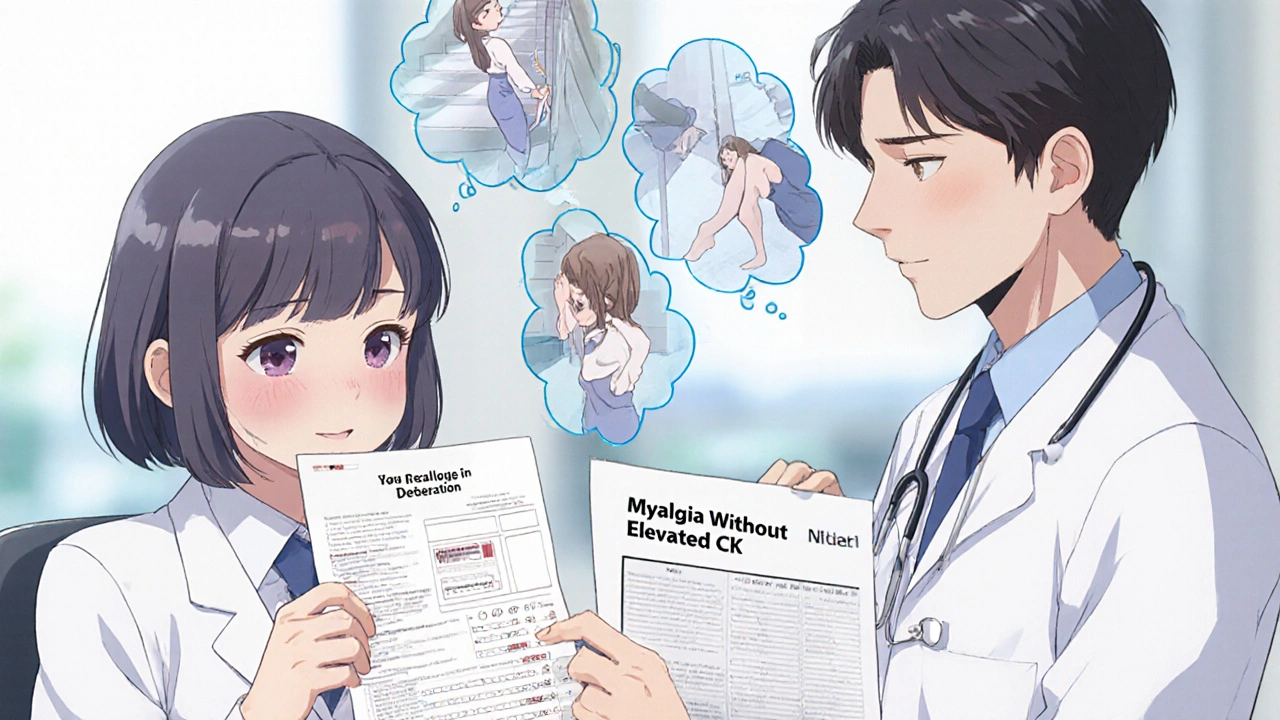
Yes. Muscle pain from statins doesn’t always show up in blood tests. The most common form, called myalgia, involves discomfort without elevated creatine kinase (CK). Many people feel sore or weak even when their CK is within normal range. That’s why doctors often recommend a trial stoppage - stopping the statin for 4-6 weeks to see if symptoms improve - even if blood work looks fine.
How long does it take for muscle pain to go away after stopping statins?
For most people, muscle pain starts fading within 1-2 weeks after stopping statins. In many cases, symptoms disappear completely within 4-6 weeks. But if the pain lingers beyond that, it may be due to another cause - like arthritis, nerve issues, or vitamin deficiency - and should be evaluated further.
Are some statins less likely to cause muscle pain than others?
Yes. Pravastatin and fluvastatin are associated with the lowest risk of muscle side effects. Rosuvastatin and atorvastatin carry higher risk, especially at high doses. If you’ve had muscle pain with one statin, switching to pravastatin or fluvastatin gives you about a 60% chance of tolerating a statin again. Lower-intensity versions of any statin also reduce risk.
Is it safe to take statins every other day?
For some people, yes. Studies like the 2023 STRENGTH trial show that intermittent dosing (like taking statins every other day or 3 times a week) can reduce muscle pain by up to 40% while still lowering LDL cholesterol significantly. This approach works best with longer-acting statins like atorvastatin or rosuvastatin. Always do this under medical supervision - it’s not a DIY solution.
Can I stop statins if I feel fine but have muscle aches?
No - not without talking to your doctor. Feeling "fine" doesn’t mean your cholesterol is under control. Statins reduce your risk of heart attack and stroke by 25-35%. Stopping them abruptly can undo that protection. Muscle pain is frustrating, but it’s rarely a reason to quit cold turkey. Work with your doctor to find a solution that keeps your heart safe without making you miserable.
I took statins for 3 months and felt like my legs were made of concrete 😩 No gym, no hiking, just... dragging. Switched to pravastatin and boom - I can climb stairs again. 🙌
I get what you're saying... but, honestly? I think a lot of this is just aging combined with laziness. I'm 72, take a low-dose statin, and I still walk 5 miles a day. Muscle soreness? Maybe you're not moving enough.
Statins are a Big Pharma scam to keep you dependent. They lower cholesterol but wreck your mitochondria. You think your pain is 'normal'? It's your body screaming. And they don't test for CoQ10 levels because they don't want you to know. 🕵️♀️💊
You people are so gullible. 'Oh my muscles hurt, must be the statin!' Newsflash: 90% of you are sedentary, eat garbage, and blame the pill. I’ve been on atorvastatin for 12 years. My CK is normal, I lift weights, and I don’t whine. Get a grip.
Ah yes, the classic 'I feel weak so it's the statin' narrative. Let me guess - you also think your WiFi is spying on you? 😏 The real issue? You didn't get your vitamin D checked. Or your thyroid. Or your magnesium. But sure, blame the $2 pill. #FirstWorldProblems
Hey everyone - I was in the same boat. Muscle pain, tired all the time, thought I was dying. 😔 Switched to fluvastatin 20mg, started walking 20 mins a day, and took a basic multivitamin. Within 3 weeks, I felt like myself again. You’re not broken. You just need to tweak. 💪 You got this.
I had the exact same issue. Stopped statin for 6 weeks, pain vanished. Went back on a lower dose - no problems. My doc said it’s common. Just don’t quit cold turkey. Talk to someone who gets it.
It's important to remember that statins prevent heart attacks and strokes - especially in high-risk patients. Muscle pain is frustrating, but it's rarely life-threatening. Always consult your physician before making changes. Your heart deserves care, not assumptions.
coq10 is a joke. the body makes it. statins dont 'deplete' it like some magic spell. its all placebo and wellness cults. also, who the hell has time to test every muscle ache? maybe you just need to stop sitting on your ass all day. 🤷♂️
I've seen this pattern for decades. Patients come in with vague symptoms, doctors panic and lower the dose, then the patient’s LDL skyrockets. They die of a heart attack at 58. And then the family blames the 'system'. It’s not the statin. It’s the avoidance. Don’t be one of them.
Okay but - what if you’re a woman over 65, on a low dose, and your pain is real but your CK is normal? Do you just suffer? I tried every statin. Even the 'gentle' ones. I switched to ezetimibe. My legs don’t ache anymore. My cholesterol? Still under control. So yes - there’s life after statins. And you’re not weak for needing it.