
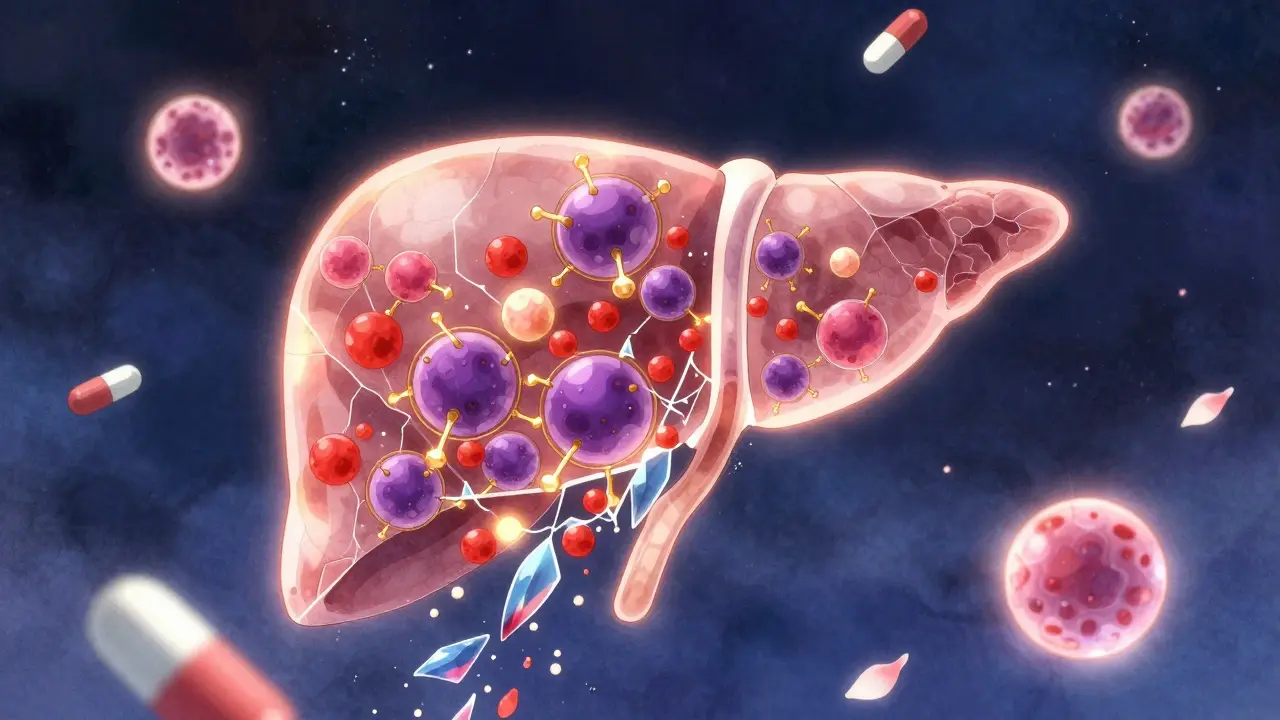
When doctors prescribe lopinavir/ritonavir (LPV/r), they’re not just giving two drugs-they’re activating a powerful, unpredictable chemical switch that can alter how dozens of other medications work in the body. This isn’t theoretical. It’s life-or-death pharmacology. Ritonavir, at just 100 mg, doesn’t fight HIV. It shuts down the liver’s main drug-processing engine-CYP3A4-to force lopinavir to stay in the bloodstream longer. But in doing so, it turns the entire metabolic system into a minefield.
How Ritonavir Turns the Liver Into a Drug Trap
Lopinavir alone would vanish from your system in under seven hours. Without ritonavir, you’d need to take it three times a day to keep HIV suppressed. Ritonavir changes that. It doesn’t just block CYP3A4-it destroys it. Unlike most inhibitors that temporarily bind to the enzyme, ritonavir physically breaks it down. It latches onto the heme group in CYP3A4, wrecks the enzyme’s structure, and even sticks reactive pieces of itself onto the protein. This isn’t a pause button. It’s a demolition job.
The result? Lopinavir’s half-life jumps from 7 hours to over 20. That’s why it’s dosed twice daily instead of three. But here’s the catch: ritonavir doesn’t just target CYP3A4. It also blocks CYP2D6, induces CYP1A2, CYP2B6, CYP2C9, and CYP2C19, and even affects drug transporters like P-glycoprotein. This isn’t a clean, precise tool. It’s a sledgehammer in a clock shop.
The 1,247 Interactions No One Talks About
The Liverpool HIV Interactions Database lists 1,247 drugs that can dangerously interact with LPV/r. That’s more than double the number for newer boosted regimens like darunavir/cobicistat. Why? Because ritonavir doesn’t just boost-it disrupts. Take warfarin: ritonavir induces CYP2C9, which breaks down warfarin faster. Patients on both drugs can suddenly develop clots because their INR drops without warning. Now consider midazolam, a sedative used in surgery. Ritonavir can make its levels spike by 500%. A normal dose becomes an overdose. Anesthesiologists in Sydney, Toronto, and Johannesburg now routinely reduce midazolam doses by 60-80% for patients on LPV/r.
Then there’s tacrolimus, the immunosuppressant used after transplants. Ritonavir can make tacrolimus levels climb so high they cause kidney failure. Dose reductions of 75% are standard. Rivaroxaban? Contraindicated. Methadone? Its metabolism speeds up, so doses often need to be increased by 20-33% to avoid withdrawal. Even common statins like simvastatin become risky-muscle damage can happen at normal doses.
And don’t forget hormonal birth control. Ritonavir cuts estrogen levels by half. Women on LPV/r can get pregnant even if they take their pill religiously. Backup contraception isn’t optional-it’s mandatory.
Why This Still Matters in 2026
In the U.S., LPV/r is barely used anymore. Integrase inhibitors like dolutegravir are safer, simpler, and don’t wreck your drug metabolism. But globally, it’s still a backbone of HIV treatment. In low- and middle-income countries, it’s the most affordable option-just $68 per person per year through PEPFAR programs. Dolutegravir? $287. That price gap keeps LPV/r alive in places where alternatives aren’t available.
But here’s the problem: the same patients who rely on LPV/r are often managing multiple chronic conditions-tuberculosis, hepatitis, hypertension. Rifampicin, used for TB, is a CYP3A4 inducer. When taken with LPV/r, lopinavir levels crash by 76%. That’s not just treatment failure-it’s drug resistance waiting to happen. And the liver toxicity risk? It jumps from 11% to 33%.

What Happens When You Skip the Check
A 2022 study in Clinical Infectious Diseases found that LPV/r regimens had 37% higher discontinuation rates than newer HIV drugs. Why? Not because of the virus. Because of side effects from drug interactions. One patient in Cape Town developed rhabdomyolysis after starting simvastatin. Another in Nairobi had a seizure because phenytoin levels dropped after starting LPV/r. These aren’t rare. They’re predictable.
Doctors don’t always catch them. A 2021 audit in South Africa showed that 41% of patients on LPV/r had at least one high-risk interaction that wasn’t flagged. Why? Because checking interactions takes time. You need to pull up the Liverpool database, cross-reference every medication, and think about whether the patient’s other drugs are substrates, inhibitors, or inducers. It’s not a 2-minute check. It’s a 15-20 minute process.
The Paxlovid Paradox
Now consider Paxlovid-the COVID-19 antiviral that uses the same ritonavir boosting trick. It’s brilliant. Ritonavir boosts nirmatrelvir 15-fold, making it effective against SARS-CoV-2. But here’s the twist: after 5 days of Paxlovid, ritonavir clears from the body faster than nirmatrelvir. That’s when CYP3A4 starts rebuilding. If a patient restarts a statin or a blood thinner too soon, their levels can spike dangerously. That’s the “Paxlovid rebound” phenomenon-not because the virus came back, but because the liver’s enzymes woke up and suddenly started processing drugs again.
Same mechanism. Same risks. Just a different disease.

What You Need to Do Right Now
If you’re on LPV/r-or prescribing it-here’s your non-negotiable checklist:
- Run every medication-prescription, OTC, herbal-through the Liverpool HIV Interactions Database. Yes, even aspirin and St. John’s wort.
- Check for CYP3A4 substrates: statins, benzodiazepines, immunosuppressants, anticoagulants.
- Watch for inducers: rifampicin, carbamazepine, phenytoin, St. John’s wort. They can make LPV/r useless.
- For women: confirm backup contraception is in place. Hormonal birth control alone is not safe.
- Monitor liver enzymes monthly for the first 3 months. Hepatotoxicity risk is real.
- If you’re scheduling surgery: alert the anesthesiologist. Midazolam, fentanyl, and propofol all need drastic dose reductions.
And if you’re a pharmacist? Don’t just dispense. Ask. Every time. “Are you on any HIV meds?” isn’t enough. Ask: “Are you on lopinavir/ritonavir?” Most patients won’t know the name. But they’ll know it’s the big blue pill they take twice a day.
The Future: A Dying Tool, But Not Yet Obsolete
LPV/r is fading in rich countries. But it’s not gone. In rural clinics in Malawi, Uganda, and Cambodia, it’s still the only option. And until dolutegravir becomes truly universal, ritonavir boosting will remain a necessary evil. The science behind it is brilliant. The risks? They’re brutal. But they’re avoidable-if you treat this like the high-stakes interaction it is.
There’s no shortcut. No app that auto-checks everything. No magic button. Just careful, slow, deliberate work. Because when you use ritonavir to boost lopinavir, you’re not just changing one drug’s life-you’re changing the fate of every other drug in the body.
Can I take ibuprofen with lopinavir/ritonavir?
Yes, ibuprofen is generally safe with LPV/r. It’s not metabolized by CYP3A4, so there’s no major interaction. But always check with your pharmacist if you’re taking other NSAIDs or have kidney issues, since both LPV/r and ibuprofen can stress the kidneys.
Why is ritonavir still used if it has so many interactions?
Ritonavir is still used because it’s cheap, effective, and widely available. In low-income countries, it’s often the only affordable way to deliver effective HIV treatment. Newer boosting agents like cobicistat have fewer interactions, but they cost 4-5 times more. For programs like PEPFAR, cost determines access.
Does ritonavir affect birth control pills?
Yes. Ritonavir reduces estrogen levels by about 50%, making hormonal birth control unreliable. Even perfect use won’t prevent pregnancy. Women on LPV/r must use a non-hormonal method like an IUD or condoms. Backup is not optional-it’s required.
Can I take statins while on lopinavir/ritonavir?
Some statins are dangerous. Simvastatin and lovastatin are contraindicated-they can cause life-threatening muscle damage. Atorvastatin can be used at low doses (max 20 mg daily), and pravastatin or rosuvastatin are safer choices. Always start low and monitor for muscle pain or dark urine.
What should I do before surgery if I’m on LPV/r?
Tell your surgeon and anesthesiologist you’re on lopinavir/ritonavir. Common drugs like midazolam, fentanyl, and propofol can become dangerously potent. Doses often need to be cut by 60-80%. Do not stop your HIV meds before surgery-this can trigger resistance. Work with your HIV provider to adjust anesthesia safely.
Is lopinavir/ritonavir still recommended for HIV treatment?
In high-income countries, no. Guidelines since 2015 favor integrase inhibitors like dolutegravir because they’re simpler, safer, and have fewer interactions. But in many low-income countries, LPV/r remains a first-line option due to cost and availability. It’s not ideal-but it’s life-saving where alternatives don’t exist.
Final Thought: It’s Not About the Drug-It’s About the System
Lopinavir/ritonavir isn’t a bad drug. It’s a brilliant hack that saved millions of lives. But its power comes with a price: complexity. Every time it’s prescribed, it forces a cascade of decisions-about other medications, about monitoring, about patient education. It’s a reminder that in medicine, the most powerful tools are often the most dangerous if used without deep understanding. The goal isn’t to avoid LPV/r. It’s to use it with eyes wide open.
Just wanted to say thank you for writing this. I’m a nurse in Mumbai and we use LPV/r every day. Patients don’t always know what they’re on, but they know the big blue pill. I’ve had to explain to a mom that her birth control won’t work, and she cried because she thought she was being careful. This post? It’s the kind of thing that saves lives. Keep doing this.
So let me get this straight - we’re still using a drug that turns your liver into a chemical warzone because it’s cheaper than a latte? Brilliant. Next up: prescribing dynamite for headaches because it’s 3 cents a dose. At least ritonavir’s got style. It doesn’t just kill enzymes - it murders them with prejudice.
Yup. The ritonavir boost is basically a pharmacokinetic nuke. CYP3A4 inhibition + induction + transporter effects = metabolic chaos. And the Liverpool DB? Absolute gospel. I’ve seen residents try to prescribe simvastatin with LPV/r like it’s nothing. Then they panic when CK hits 20k. Lesson learned: if it’s metabolized by CYP3A4, assume it’s a grenade until proven otherwise.
Just wanted to add something real quick - if you’re managing someone on LPV/r and they’re on rifampicin for TB, you’re not just adjusting doses. You’re playing Russian roulette with resistance. The 76% drop in lopinavir levels isn’t a suggestion - it’s a clinical emergency. I’ve seen patients develop multi-drug resistant HIV because the TB clinic didn’t talk to the HIV clinic. Communication isn’t optional. It’s the only thing keeping people alive.
Bro, this is why I love medicine - it’s like chess with organs. Ritonavir doesn’t just block CYP3A4, it *executes* it. Like a ninja with a flamethrower. And the fact that we still use this in rural India and Africa? That’s not a flaw - that’s heroism. A 68-dollar/year drug saving millions while rich folks sip their dolutegravir lattes. We ain’t perfect, but we ain’t giving up.
I used to think drugs were just chemicals. Then I worked in a clinic in Kentucky where a guy on LPV/r got a knee replacement and the anesthesiologist gave him a normal dose of midazolam. He slept for 36 hours. Woke up confused, terrified, and asked if he’d died. That’s not side effects. That’s a near-death experience caused by a 100mg pill that doesn’t even treat HIV. We owe these patients better. Not just care - respect.
LPV/r is a legacy system. Think of it like Windows XP in a Kubernetes world. Still runs. Still critical for legacy infrastructure. But nobody in DevOps wants to touch it. Cobicistat is the modern replacement - cleaner, more predictable. But cost? Yeah. That’s the real bottleneck. Not science. Not medicine. Money. Always money.
So basically, if you’re on this drug, you can’t take anything else without risking death? Cool. So why isn’t this banned?
Wow. So you’re saying we’re using a drug that’s basically poison because it’s cheap? That’s not medicine. That’s capitalism. If this was a cancer drug, we’d be screaming. But it’s HIV? Eh. Poor people can deal with it. Classic.
bro i just got prescribed this and i thought it was just for hiv but now im scared to take ibuprofen or even tylenol lmao
It is of paramount importance to acknowledge that the pharmacokinetic modulation engendered by ritonavir constitutes a profound perturbation of hepatic xenobiotic metabolism, thereby necessitating meticulous polypharmacy reconciliation to avert potentially catastrophic clinical sequelae.
How is this still in use? Any physician prescribing this without a clinical pharmacology fellowship should be stripped of their license. The fact that this is considered ‘first-line’ anywhere in the 21st century is a national embarrassment. This isn’t medicine. It’s triage with a side of hubris.
My uncle’s on this in Ohio. He’s got diabetes, high BP, and takes fish oil and turmeric. His doctor didn’t even ask about his HIV meds until I called. Now he’s on pravastatin and no more statins. Just saying - people don’t know. We gotta help them.
just a heads up - if you’re on lpv/r and you get surgery, tell the anesthesiologist. not just your doctor. the anesthesiologist. i saw a guy get put under with a normal dose of fentanyl and he stopped breathing for 5 minutes. they had to intubate him. it was scary. your meds matter. even if you think they’re just ‘hiv pills’