
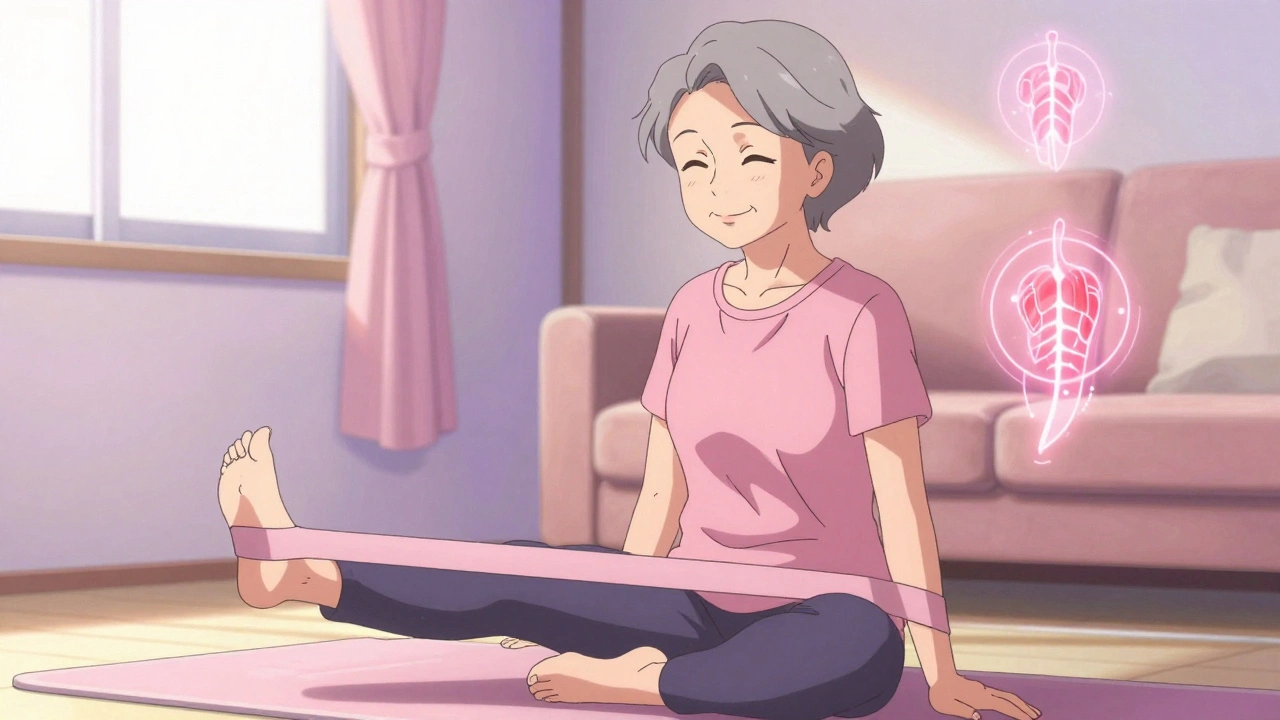
By your 40s, you might notice it’s harder to carry groceries, climb stairs, or get up from a chair without using your hands. It’s not just getting older-it’s sarcopenia, a slow, silent loss of muscle mass and strength that starts decades before most people realize it’s happening. Unlike a broken bone or a sudden illness, sarcopenia creeps in over time, quietly reducing your independence. But here’s the good news: you can fight it. Strength training isn’t just for bodybuilders-it’s the most proven, powerful tool we have to keep your muscles strong as you age.
What Exactly Is Sarcopenia?
Sarcopenia isn’t just feeling weaker. It’s a medical condition defined by a real, measurable drop in skeletal muscle mass, strength, and physical function. First named in 1989 by Dr. Irwin Rosenberg, it was officially diagnosed using clear standards in 2010 and updated again in 2023 by the European Working Group on Sarcopenia in Older People (EWGSOP3). To be diagnosed, you need to show both low muscle mass and poor physical performance-like walking slower than 0.8 meters per second or having a handgrip strength below 27kg for men or 16kg for women.
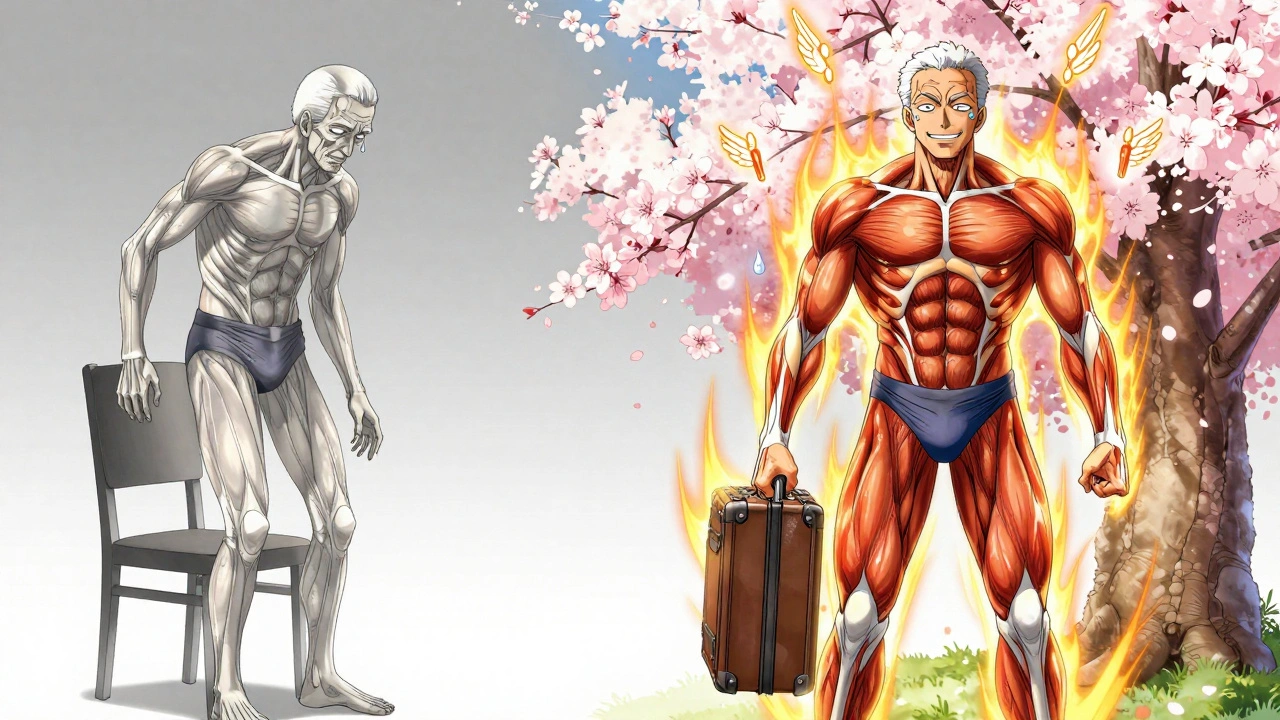
This isn’t something that only hits people in their 70s. Muscle loss begins as early as your 30s and 40s, with a steady decline of about 1-2% per year. After age 65, that rate accelerates to around 8% per decade. By the time you’re 80, you may have lost 30-40% of your fast-twitch muscle fibers-the ones responsible for power and quick movements. That’s why lifting a suitcase or standing up from the couch suddenly feels like a workout.
Why Does This Happen?
Your muscles don’t just fade away randomly. There’s a biological reason behind the decline. As you age, your body loses motor neurons-the nerve cells that tell your muscles to move. After 60, you lose 3-5% of these every year. Fewer signals mean fewer muscle contractions, and over time, unused muscle shrinks.
At the same time, your body becomes less efficient at building new muscle. Protein synthesis drops by 20-25%, meaning even if you eat enough protein, your muscles don’t repair and grow as easily. Satellite cells, which help regenerate muscle tissue, also decline by 50-60% by age 70. Then there’s inflammation: levels of IL-6 and TNF-alpha-markers of chronic low-grade inflammation-rise by 30-50% in older adults, which further blocks muscle growth.
And it’s not just about the muscles themselves. The connection between your nerves and muscles-the neuromuscular junction-weakens by 25-30% between ages 50 and 80. Think of it like a frayed wire: even if the muscle is still there, the signal to use it gets weaker.
Sarcopenia vs. Other Muscle Problems
Not all muscle loss is the same. Sarcopenia is often confused with other conditions, but they’re different.
- General muscle atrophy happens when you’re inactive-like after a long hospital stay. You can lose 1-1.5% of muscle per day in bed rest. This is reversible with movement.
- Cachexia is linked to serious illness like cancer or heart failure. It causes rapid weight loss, not just muscle, and involves severe metabolic changes.
- Dynapenia means losing strength without losing muscle mass. Sarcopenia includes both.
- Sarcopenic obesity is when you have low muscle mass and high body fat. It affects 15-20% of older adults and is especially dangerous because the fat increases inflammation, making muscle loss worse.
Knowing the difference matters because treatment isn’t one-size-fits-all. Sarcopenia responds best to resistance training-something that won’t fix cachexia or severe illness-related muscle loss.
Strength Training: The Proven Solution
If you’re wondering what actually works, the answer is simple: strength training. It’s not just helpful-it’s the only intervention with strong, consistent evidence across decades of research.
Studies show that older adults who start resistance training can gain 1-2kg of muscle mass and increase strength by 25-30% in just 12 to 16 weeks. That’s not a small gain-it means being able to lift your grandchild, open a jar, or walk without a cane.
One 2022 survey of over 3,200 older adults found that 75% of those who trained twice a week kept their independence in daily tasks like bathing and dressing. Only 58% of those who didn’t train could say the same.
And the benefits go beyond strength. Strength training improves gait speed by 0.1-0.2 meters per second, which reduces fall risk by 30-40%. Falls are the leading cause of injury in seniors. Preventing even one fall can save thousands in medical costs and prevent a lifetime of reduced mobility.
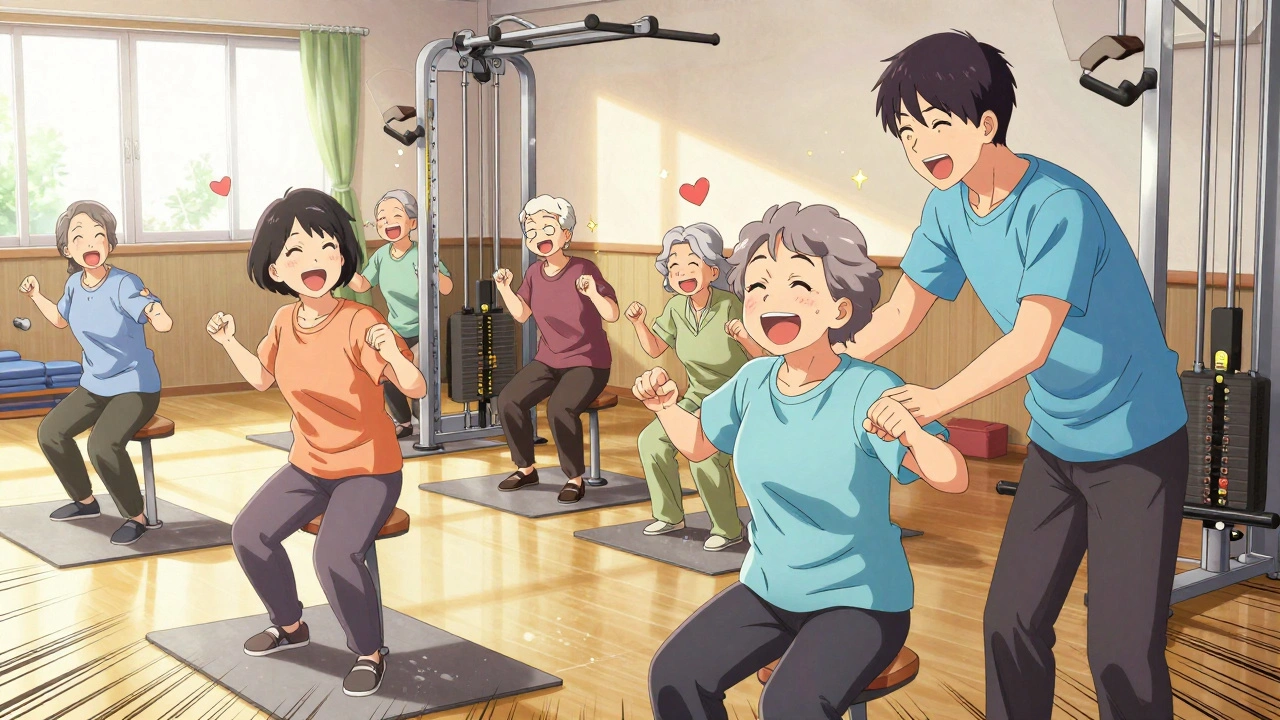
What Does Effective Training Look Like?
You don’t need to lift heavy weights or join a gym. The American College of Sports Medicine recommends:
- 2-3 sessions per week
- 1-3 sets of 8-12 repetitions per exercise
- Weight at 60-80% of your one-rep maximum (1RM)
- At least 48 hours rest between sessions for the same muscle group
For beginners, start with bodyweight exercises:
- Chair squats (sit down and stand up slowly)
- Wall push-ups (lean against a wall and push away)
- Seated leg extensions (straighten one leg at a time while sitting)
- Standing calf raises (hold onto a counter for balance)
Once you’re comfortable, move to resistance bands (TheraBand levels 1-5) or weight machines. Machines are great because they guide your movement, reducing injury risk and helping you focus on form.
Progression is key. Every week, try to increase the weight or resistance by 2.5-5%. If you can do 12 reps easily, it’s time to make it harder. That’s called progressive overload-and it’s how muscles grow.
Common Barriers and How to Overcome Them
Many older adults want to train but don’t know how to start-or they’ve tried and quit. Here’s what gets in the way, and how to fix it.
- Joint pain: 35-40% of seniors report discomfort. Use machines with reduced range of motion, avoid deep squats if knees hurt, and try seated exercises. A physical therapist can help modify movements.
- Balance issues: Start seated. Use a sturdy chair. Don’t rush. Balance improves with time and training.
- Motivation: People who train in groups stick with it 35-40% longer. Look for SilverSneakers, local senior centers, or community classes. Social support makes a huge difference.
- Cost: Programs can run $50-$75/month. But many Medicare Advantage plans cover SilverSneakers for free. Check your plan. If not, YouTube has free senior strength programs from certified trainers.
- Soreness: Mild soreness is normal. Sharp pain is not. If you’re sore, take a day off. Don’t skip workouts entirely-just adjust intensity.
One 68-year-old man on MyFitnessPal shared: “After six months of twice-weekly training, my handgrip went from 18kg to 24kg. I could open jars again.” That’s the kind of change that restores dignity.
Protein and Recovery
Strength training alone isn’t enough. Your muscles need fuel. The International Society of Sports Nutrition recommends 20-30 grams of high-quality protein within 45 minutes after exercising. That’s about:
- One large chicken breast
- Two eggs plus a cup of Greek yogurt
- One scoop of whey protein powder
- Three-quarters of a cup of lentils
Spreading protein across meals (25-30g per meal) is more effective than loading it all at dinner. Aim for 1.2-1.6 grams of protein per kilogram of body weight daily. For a 70kg person, that’s 84-112 grams per day.
Don’t forget hydration and sleep. Muscles repair during rest. If you’re not sleeping well, your gains will stall.
What’s New in Sarcopenia Research?
The science is moving fast. In 2023, the FDA approved RT001 for clinical trials-a drug targeting mitochondrial dysfunction, one of the root causes of muscle loss. Researchers are also testing blood biomarkers like myostatin and GDF-15 to detect sarcopenia before symptoms appear.
AI-powered programs like Exer AI are showing promise. They give real-time feedback on form and adjust workouts based on how you’re feeling. In trials, users stuck with these programs 25% longer than those using standard routines.
And telehealth is helping. A 2022 study in JAMA Internal Medicine found virtual strength coaching was 85% as effective as in-person training. For people in rural areas or with mobility issues, this is a game-changer.
Why This Matters Now More Than Ever
By 2030, over 72 million Americans will be over 65. Globally, 1 in 6 people will be. Yet there are only 12,500 certified geriatric physical therapists in the U.S. The system isn’t ready.
That’s why individual action matters. If you’re 50, 60, or 70, and you start strength training now, you’re not just building muscle-you’re buying years of independence. You’re reducing your risk of falls, hospitalizations, and nursing home stays. You’re lowering healthcare costs-not just for yourself, but for the system.
Sarcopenia isn’t inevitable. It’s not something you just have to live with. It’s a condition you can slow, stop, and even reverse-with the right tools, and the right mindset.
Can sarcopenia be reversed?
Yes, sarcopenia can be reversed-at least partially. Studies show that older adults who start strength training can gain 1-2kg of muscle and increase strength by 25-30% in just 3-4 months. Even people in their 80s and 90s have shown measurable gains. The key is consistency: training at least twice a week, using progressive overload, and eating enough protein.
Is it too late to start strength training if I’m over 70?
Absolutely not. Research shows that people in their 70s, 80s, and even 90s benefit from resistance training. One study found that frail seniors who trained for 12 weeks improved their walking speed, balance, and ability to stand from a chair. Age doesn’t limit your ability to build muscle-it just means you need to start slowly and focus on safety. Begin with bodyweight exercises or resistance bands, and work with a trainer if possible.
Do I need to lift heavy weights to fight sarcopenia?
No. You don’t need to lift heavy weights like a bodybuilder. What matters is challenging your muscles enough to stimulate growth. Using resistance bands, weight machines, or even your own body weight can be enough if you do the right number of repetitions and gradually increase the difficulty. Aim for 8-12 reps per set until the last few feel hard. That’s enough to trigger muscle adaptation.
How often should I train to prevent muscle loss?
Twice a week is the minimum recommended by the American College of Sports Medicine. Three times is ideal if your body allows it. The key is to target all major muscle groups-legs, back, chest, shoulders, arms, and core. Don’t train the same muscle group two days in a row. Allow at least 48 hours of rest between sessions for recovery.
Can diet alone prevent sarcopenia?
Diet helps, but it’s not enough. Eating enough protein is critical-20-30g per meal-but without resistance training, your body won’t use that protein to build muscle. You might maintain muscle mass slightly better, but you won’t gain strength or improve function. Strength training and protein work together. One without the other gives limited results.
Are there any risks to strength training for older adults?
When done correctly, strength training is very safe. The biggest risk is doing too much too soon. Start with light resistance, focus on form, and avoid jerky movements. If you have joint problems, heart conditions, or balance issues, talk to your doctor or a physical therapist before starting. Machines and seated exercises reduce injury risk. Never push through sharp pain.
Next Steps: How to Get Started Today
Here’s a simple 7-day plan to begin:
- Day 1: Do 10 chair squats, 10 wall push-ups, and 10 seated leg extensions. Rest 60 seconds between sets. Repeat once.
- Day 2: Walk for 20 minutes.
- Day 3: Rest or stretch.
- Day 4: Repeat Day 1, add resistance bands if possible.
- Day 5: Walk again.
- Day 6: Do calf raises (hold onto a counter), shoulder presses with light dumbbells or water bottles, and seated rows with a resistance band.
- Day 7: Rest.
After two weeks, increase reps to 12-15. After four weeks, add a little more resistance. Keep a small notebook: write down what you did, how it felt, and if you got stronger. Progress isn’t always visible-it’s felt in small wins: easier stairs, less back pain, standing up without help.
You don’t need to be perfect. You just need to start. And keep going. Because the muscle you build today is the independence you’ll have tomorrow.
Man, I never thought about muscle loss being this silent. I just figured I was getting lazy. Turns out my body’s been quietly betraying me since my 30s. Feels weird to think that lifting groceries isn’t just about being out of shape-it’s a biological countdown. But hey, if I can start with chair squats and open jars again? Sign me up. No gym membership needed. Just me, my living room, and a little stubbornness.
Also, I’m stealing that 7-day plan. No excuses this time.
My dad started this at 72 after he fell in the bathroom. Two years later, he’s hiking with his grandkids. No fancy gear, just bands and consistency. It’s not about looking strong-it’s about feeling like you still own your body. Seriously, if you’re 50+ and haven’t tried this yet, you’re not old-you’re just behind.
Start small. Stay steady. You’ll thank yourself later.
OMG YES THIS!! 🙌 I’m 61 and started with 1lb water bottles. Now I can lift my dog like he’s a sack of potatoes. Also, I cry when I open jars now 😭😭😭 not from pain-from joy. Strength training is the best midlife upgrade you didn’t know you needed.
There’s a critical distinction here that’s often overlooked: sarcopenia is not synonymous with general frailty. The distinction between dynapenia and sarcopenic obesity is clinically significant, and the 2023 EWGSOP3 criteria now emphasize physical performance over mass alone. This means even individuals with normal BMI can be sarcopenic if their gait speed or grip strength falls below thresholds.
Moreover, the 20-30g protein post-exercise window isn’t just a suggestion-it’s a metabolic imperative. Leucine-rich sources like whey, eggs, or dairy trigger mTOR more effectively than plant proteins alone. For vegans, combining legumes with soy or hemp is essential.
And yes, machines are ideal for beginners. Free weights require neuromuscular coordination that deteriorates with age. Safety first, gains second.
So now we’re telling old people to lift weights instead of just accepting they’re done? How convenient. The system doesn’t fund physical therapy, but hey-here’s a YouTube video. Meanwhile, Medicare won’t cover a damn thing unless you’re in a wheelchair. This isn’t empowerment-it’s victim-blaming wrapped in a resistance band.
My auntie in Alabama started this at 78 with a chair and a rubber band. Now she’s gardening like she’s 30 again. No fancy gear, no trainers, just grit and peanut butter sandwiches after her workouts 😄
Protein? She eats eggs like candy. And sleeps like a log. No supplements. No apps. Just life. You don’t need a PhD to fight aging-you just need to move. And maybe eat some cheese.
PS: I cried reading the jar story. I’m gonna start tomorrow. Promise.
Wow. So the secret to not becoming a wrinkly sack of regret is… doing stuff? Groundbreaking. I’m sure the pharmaceutical industry is weeping into their stock options right now. Next up: ‘The Miracle Cure for Dying: Breathe Occasionally.’
But seriously, I’ve seen people in their 80s doing squats. It’s weirdly beautiful. Like watching a dinosaur learn to dance. I’m not doing it. But I’ll clap from the couch.
Everyone’s acting like this is some miracle fix. What about the people who can’t move? Who have arthritis, heart disease, or no money? You think a 75-year-old on fixed income is gonna buy resistance bands and whey protein? This isn’t motivation-it’s privilege wrapped in a fitness influencer’s smile. And don’t get me started on ‘progressive overload’ when your knees sound like popcorn.
It’s easy to preach when you’re healthy.
Interesting how this post ignores the fact that most seniors are on 10+ medications that actively cause muscle wasting. Beta-blockers, statins, corticosteroids-none of these are mentioned. And now we’re blaming the victim for not lifting weights? What a convenient narrative.
Also, ‘just do chair squats’? Try doing that when your hips are fused and your doctor says ‘no exertion.’ This feels like a wellness cult pamphlet.
I’m 67 and started this after my granddaughter asked why I couldn’t pick her up. I thought I was too old to change. Turns out I was just too scared.
Now I do my 2x a week with a group of ladies from the church basement. We laugh, we groan, we eat cookies after. I didn’t just get stronger-I got my joy back.
You don’t need perfect form. You don’t need a gym. You just need to show up. Even if it’s just one rep. Even if you’re shaking. Even if you cry. That’s the real win.
And hey-if you’re reading this and thinking ‘I’m too late’? You’re not. You’re right on time.