
When a life-saving medication disappears from the pharmacy shelf, patients don’t just lose a pill-they lose stability, trust, and sometimes hope. Drug shortages aren’t rare glitches anymore. In 2023, nearly 300 medications were in short supply across the U.S., with heart drugs and cancer treatments leading the list. And when this happens, the burden doesn’t fall on manufacturers or regulators alone. Provider communication becomes the critical line between confusion and calm.
It’s Not Just About Telling Patients
Telling a patient, “We don’t have your medication,” is the bare minimum. That’s not communication-it’s notification. Real communication means explaining why the drug is gone, what’s safe to use instead, and when things might return. The European Medicines Agency’s 2022 guidelines say it clearly: patients need four things-exact product details (brand and generic names, strength, form), how severe the shortage is, how long it’ll last, and what alternatives exist with clinical backing. Too often, patients are handed a new prescription with no context. One Reddit user described getting a different heart medication with no explanation. They spent days researching online, terrified they were being switched to something dangerous. That’s not an isolated case. Studies show 72% of patients feel anxious when providers don’t explain the change. And anxiety doesn’t just hurt emotionally-it hurts physically. Patients are more likely to skip doses, stop treatment entirely, or end up in the ER when they don’t understand what’s happening.What Providers Are Legally and Ethically Required to Do
In the U.S., the FDA Safety and Innovation Act of 2012 requires drugmakers to report potential shortages six months in advance. That’s not just for regulators-it’s a head start for providers. If a manufacturer says a drug will be unavailable in 90 days, the provider has a responsibility to prepare. Waiting until the patient walks in for a refill is too late. The Joint Commission, which accredits hospitals and clinics, made it official in 2024: all facilities must have structured, empathetic communication processes for drug shortages by January 2025. Failure to comply could mean losing accreditation. That’s not a suggestion. It’s a rule. Providers must also follow health literacy standards. The CDC says all written materials must be written at a 6th to 8th grade reading level. No jargon. No Latin terms. No “therapeutic substitution” language. Say “we’re switching you to this pill because your usual one isn’t available,” not “we’re initiating an alternative pharmacologic agent.”The Right Way to Talk About Alternatives
Not all alternatives are equal. Some are close matches. Others are compromises. Patients need to know which is which. For example, if a patient takes metoprolol tartrate for high blood pressure and it’s in short supply, switching to metoprolol succinate might be fine-it’s the same drug, just a different release form. But switching to a completely different class of drug, like a calcium channel blocker, is a bigger change. The provider needs to explain why they’re choosing one over the other. Was it based on the patient’s history? Side effect profile? Cost? Evidence? A 2021 study in the Journal of Managed Care & Specialty Pharmacy found that when providers used clear, evidence-based reasoning, patient satisfaction jumped from 54% to 87%. That’s not magic. That’s clarity. Use the “Chunk, Check, Change” method:- Chunk: Give one piece of information at a time. Don’t dump five alternatives in five seconds.
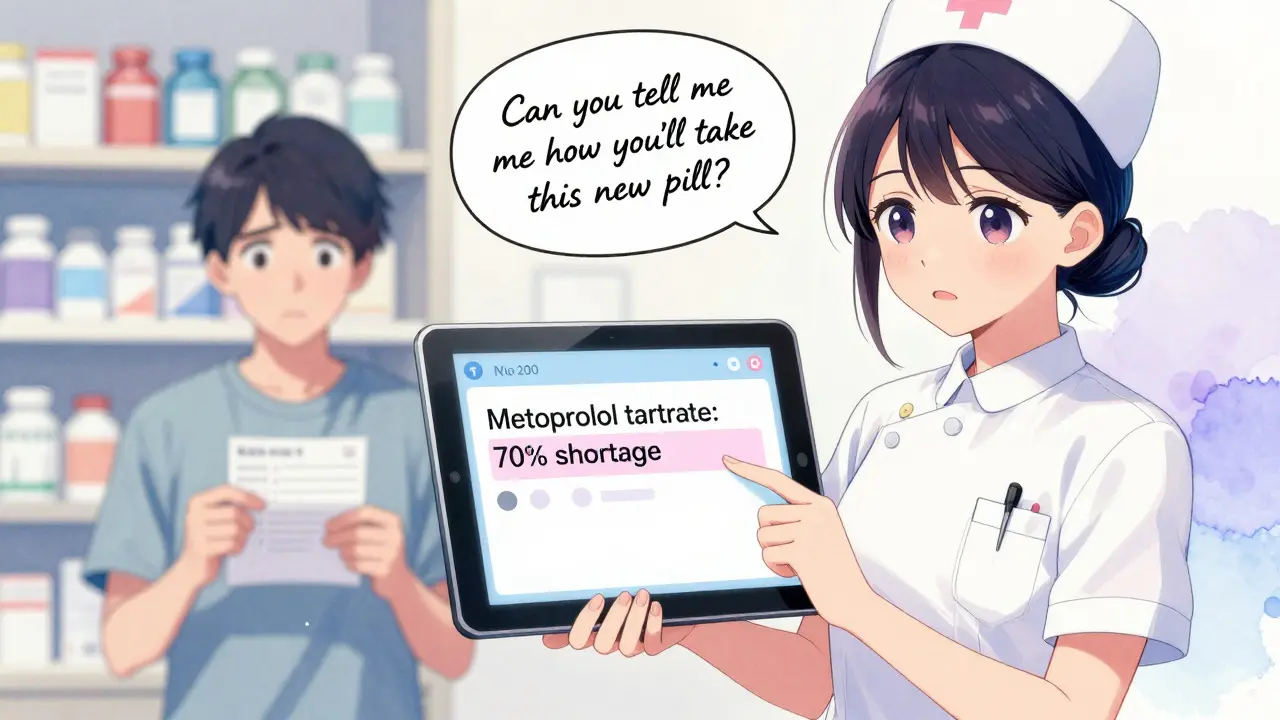
- Check: Ask the patient to explain it back. “Can you tell me how you’ll take this new pill?” If they can’t, you haven’t communicated yet.
- Change: Adjust your language if they’re confused. Use pictures, simple analogies, or written notes.
What Happens When Communication Fails
When providers skip the hard part-empathy, explanation, follow-up-the consequences show up in patient reviews, malpractice claims, and emergency visits. On Healthgrades, reviews mentioning “drug shortage” average just 2.1 stars. The top complaints? “No warning before my refill was denied” and “the pharmacist didn’t know more than I did.” Worse, 63% of patients don’t ask questions during these conversations-even when they’re confused. Why? Power imbalance. Many feel intimidated, scared to challenge their doctor. That’s why providers need to actively invite questions: “I know this is a lot to take in. What part feels unclear to you?” And documentation matters. CRICO Strategies found that in 92% of shortage-related malpractice cases, the provider didn’t document what was said, what was offered, or whether the patient understood. If you didn’t write it down, it didn’t happen-in the eyes of the law.Real Solutions That Work
Some clinics are doing this right. Mayo Clinic’s SHIP protocol (Shortage Handling and Information Protocol) trains every provider to use standardized templates. When a shortage hits, the system auto-generates a patient letter with the drug name, reason for change, alternative options, and a direct phone number to call. They saw a 28% drop in prescribing errors and an 83% continuation rate for treatment. Kaiser Permanente built shortage alerts into their electronic health record. When a provider opens a patient’s chart, a pop-up says: “Metoprolol tartrate: 70% shortage. Recommended alternative: metoprolol succinate 50mg daily.” It takes 15 seconds. No extra appointment needed. Memorial Sloan Kettering uses trained communication specialists for cancer drug shortages. These aren’t pharmacists or nurses-they’re experts in emotional support. They spend 37% more time on empathetic statements: “I know this is scary. You’ve been stable on this for years. We’re doing everything to get it back.”
What About Rural and Non-English Patients?
The gaps are widest where help is needed most. In rural areas, 68% of providers say they don’t get real-time shortage updates. A patient in Wyoming might not know their medication is gone until they show up at the pharmacy. That’s unacceptable. For non-English speakers, misunderstanding rates are 3.2 times higher. A Spanish-speaking patient might hear “you’ll get a different pill” and think it’s a completely different drug-not a generic version. Translated materials are not enough. You need live interpreters who understand medical terms, not just dictionary translations.What You Can Do Today
You don’t need a fancy system to start doing this right.- When you hear about a shortage, notify patients before they come in. A simple text or email: “We’re preparing for a possible shortage of your medication. We’ll contact you with options.”
- Keep a one-page cheat sheet of common shortages and approved alternatives in your exam room.
- Use the teach-back method every time. Don’t assume they understood.
- Document what you said, what they said, and how they responded.
- Ask: “What worries you most about this change?” Let them speak first.
The Bottom Line
Drug shortages aren’t going away. Supply chains are fragile. Manufacturing is concentrated. Global events keep disrupting production. But one thing you can control is how you talk to your patients. Clear, honest, empathetic communication doesn’t just prevent panic-it builds trust. And trust keeps people alive. Patients don’t need perfect solutions. They need to feel heard, informed, and safe. That’s not extra work. It’s the core of care.What should I do if my medication is suddenly unavailable?
Don’t stop taking it without talking to your provider. Call your clinic or pharmacy immediately. Ask: Is this a known shortage? What are my alternatives? Are they safe for me? Is there a timeline for when the original drug might return? Write down the answers. If you’re unsure, ask for a follow-up appointment. Never switch medications on your own.
Can I just use a different brand of the same drug?
Sometimes, yes. Many drugs have multiple brand names or generic versions. For example, metoprolol tartrate and metoprolol succinate are the same active ingredient but different release forms. Your provider needs to confirm the switch is safe based on your condition, other medications, and how your body responds. Never assume all versions are interchangeable. Always check with your provider or pharmacist.
Why don’t pharmacies tell me about shortages before I get there?
Many pharmacies don’t have real-time access to shortage data. Even if they do, they’re not always required to notify patients directly. That’s why your provider is the key link. If your doctor knows a shortage is coming, they should reach out before your refill. If they don’t, ask them to. You have the right to know.
How do I know if an alternative medication is really safe for me?
Ask your provider three things: 1) Why is this alternative chosen over others? 2) Is there research showing it works as well for my condition? 3) What side effects should I watch for? If they can’t answer clearly, ask for a referral to a pharmacist or specialist. Your safety isn’t guesswork-it’s based on your medical history and evidence.
What if I can’t afford the alternative medication?
Cost is a real barrier. Tell your provider upfront if affordability is a concern. Many alternatives have generic versions or patient assistance programs. Some drugmakers offer free samples during shortages. Your provider can help you find these options. Never skip doses because you can’t pay-there are always solutions if you speak up.
Are there any apps or tools I can use to track drug shortages?
The FDA maintains a public Drug Shortages page with updated lists. You can sign up for email alerts. Some pharmacy apps like GoodRx show availability status, but they’re not always accurate in real time. The most reliable source is still your provider or pharmacist. Use public tools as a backup, not a replacement for professional advice.
They act like patients are just data points. You get handed a new pill like it’s a coupon for a free coffee. No explanation. No ‘I know this sucks.’ Just ‘here, take this.’ I had a friend who went from metoprolol to a calcium channel blocker and ended up in the ER because she thought the new one was ‘stronger.’ No one told her the difference. That’s not care. That’s negligence dressed in a white coat.
And don’t get me started on the ‘teach-back’ method. If your provider asks you to repeat it back like you’re in third grade, they’re not being thorough-they’re being patronizing. But if they don’t ask at all? That’s worse.
Brother, this hits home. In Nigeria, we don’t even have the luxury of choice-sometimes the drug just doesn’t arrive at all. But when it does, and your doctor takes the time to sit with you, draw it out on a napkin, say ‘I know this scares you,’-that’s medicine. That’s healing. Not the pill. The humanity.
Providers who treat shortages like a logistics problem are missing the point. It’s not about supply chains-it’s about souls. You don’t fix fear with a form letter. You fix it with eye contact, silence, and a voice that says, ‘I’m here with you.’
so like… the whole system is rigged right? big pharma makes the shortage on purpose so they can push the new drug? and then the docs are just pawns? i mean… why else would they not tell you? why is it always ‘oh we just found out’? no. they knew. they always knew. and you? you’re just the sucker who took the pill every day like a good little zombie.
also… who even is the joint commission? sounds like a cult. they don’t even know what my name is but they want me to trust them with my life? lol.
There’s something deeply spiritual about how we handle medicine in this country. We treat drugs like sacred objects-when they disappear, we panic, we feel abandoned, we question our own worthiness. But what if the shortage isn’t a failure of supply, but a mirror? A reflection of how disconnected we’ve become from the rhythm of care?
When a provider says, ‘I don’t have your medication,’ they’re not just delivering bad news-they’re revealing a system that values efficiency over intimacy. And yet, the patients who survive these moments? They’re not the ones who got the right pill. They’re the ones who were held. Who were asked, ‘What scares you?’ Who were met not with a script, but with presence.
Maybe the real shortage isn’t of drugs-it’s of compassion. And that’s something no FDA regulation can fix. It has to be chosen. Every single time.
I’ve seen it. A nurse in a rural clinic, holding a patient’s hand while explaining why metoprolol succinate isn’t the same as tartrate. Not because she had to. But because she chose to. That’s the kind of care that outlives every drug on the shelf.
Why are we letting bureaucrats tell doctors how to talk to patients? This is America. We don’t need some Joint Commission telling us to say ‘pill’ instead of ‘pharmacologic agent.’ If a patient can’t understand basic medical terms, maybe they shouldn’t be in charge of their own health. This is socialism creeping into healthcare. Let providers do their job without being micromanaged by HR drones.
While the emotional and ethical imperatives outlined here are compelling, the structural realities must not be ignored. The FDA’s six-month advance notice requirement is inconsistently enforced. Only 43% of manufacturers comply in full. Meanwhile, EHR systems remain fragmented, with 68% of rural clinics still using paper-based tracking. Without interoperable, real-time shortage data feeds-no communication protocol, no matter how empathetic, can scale.
Technology is not the enemy of humanity. It’s the enabler. The Kaiser model proves that. Automation doesn’t replace empathy-it frees up time for it. The real question isn’t ‘should we communicate better?’ It’s ‘why haven’t we invested in the systems that make it possible?’
👏 This is the kind of piece that reminds me why I chose this field. The ‘Chunk, Check, Change’ method? Brilliant. Simple. Human.
I’ve used it in my clinic for a year now. Last week, a 72-year-old woman with heart failure was switched from lisinopril to valsartan. I chunked it: ‘Your old med is on backorder.’ Check: ‘Can you tell me what you’ll take and when?’ She said, ‘Morning, with breakfast, no more coughing.’ Perfect. Change: I gave her a printed card with the names, a drawing of a clock for timing, and my direct line.
She cried. Not because she was scared. Because someone finally listened.
Healthcare isn’t about pills. It’s about dignity. And dignity doesn’t come from a policy. It comes from a moment. Make that moment count. 🙏
the fda is just a front for big pharma and the fed and the military industrial complex and the shadow government and the reptilians really they are all connected and the shortages are planned to make you dependent on the new drugs that have tracking chips in them but dont tell anyone i said that
Let’s be real-this isn’t about communication. It’s about power. The system is designed to keep patients passive. ‘Trust your doctor’ is code for ‘shut up and take it.’
But here’s the thing: patients are waking up. We Google. We cross-reference. We show up with printed articles. We ask for the evidence. And when providers meet us with honesty, not defensiveness? Magic happens.
I’ve been on six different heart meds in three years due to shortages. Every time, the ones who said, ‘I don’t know, let me find out,’ or ‘Here’s the study, let’s read it together,’ earned my loyalty. The ones who brushed me off? I left. And I told everyone I know.
Transparency isn’t a nice-to-have. It’s the only thing keeping trust alive. And trust? That’s the only drug that never runs out.