
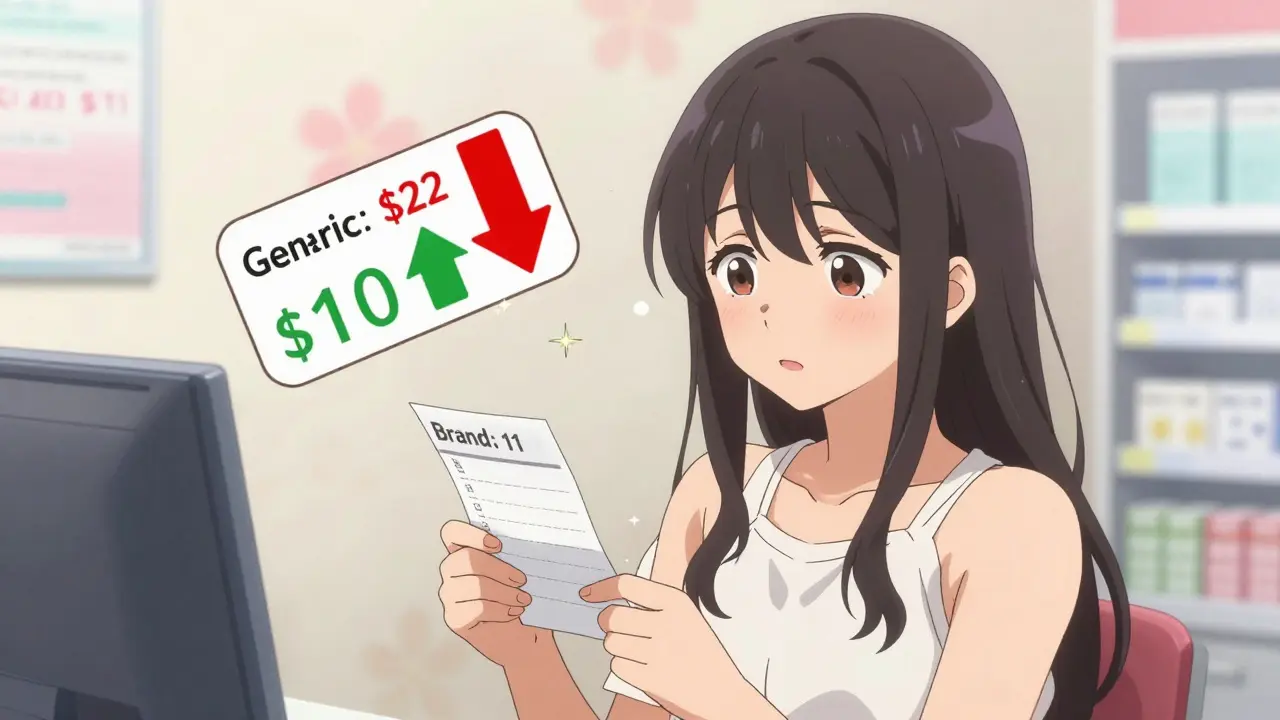
When you pick up a prescription, the price on the receipt can feel random. One month, your generic blood pressure pill costs $5. The next, it’s $22. Meanwhile, your neighbor pays $10 for the brand-name version of the same drug. What’s going on? The truth is, out-of-pocket costs for generics and brand-name drugs don’t follow simple logic. Even when a generic is cheaper, you might end up paying more - and it’s not because of the drug itself. It’s because of how insurance works.
Generics Are the Same, But Not Always Cheaper
Generic drugs contain the exact same active ingredients as brand-name drugs. They work the same way. They’re just as safe. The FDA requires them to meet the same standards. So why do some people pay more for a generic than a brand-name drug? The answer isn’t in the pill. It’s in the system.On average, generics cost 80 to 85% less than brand-name drugs. Nine out of every 10 prescriptions filled in the U.S. are for generics. But here’s the twist: brand-name drugs still make up nearly 75% of total drug spending. Why? Because their list prices have skyrocketed. In a 2021 study of 79 brand-name drugs, median list prices rose 16.7% over two years - faster than inflation. But most patients didn’t feel that increase. Why? Because many have fixed copays.
If your insurance plan charges a flat $10 copay for generics, it doesn’t matter if the drug’s list price jumps from $15 to $50. You still pay $10. But if your plan uses coinsurance - say, 25% of the drug’s price - then that $15 drug costs you $3.75. When it hits $50, you pay $12.50. That’s a 233% increase in your out-of-pocket cost. And that’s exactly what happens to people with high-deductible plans or Medicare Part D.
The Medicare Part D Trap
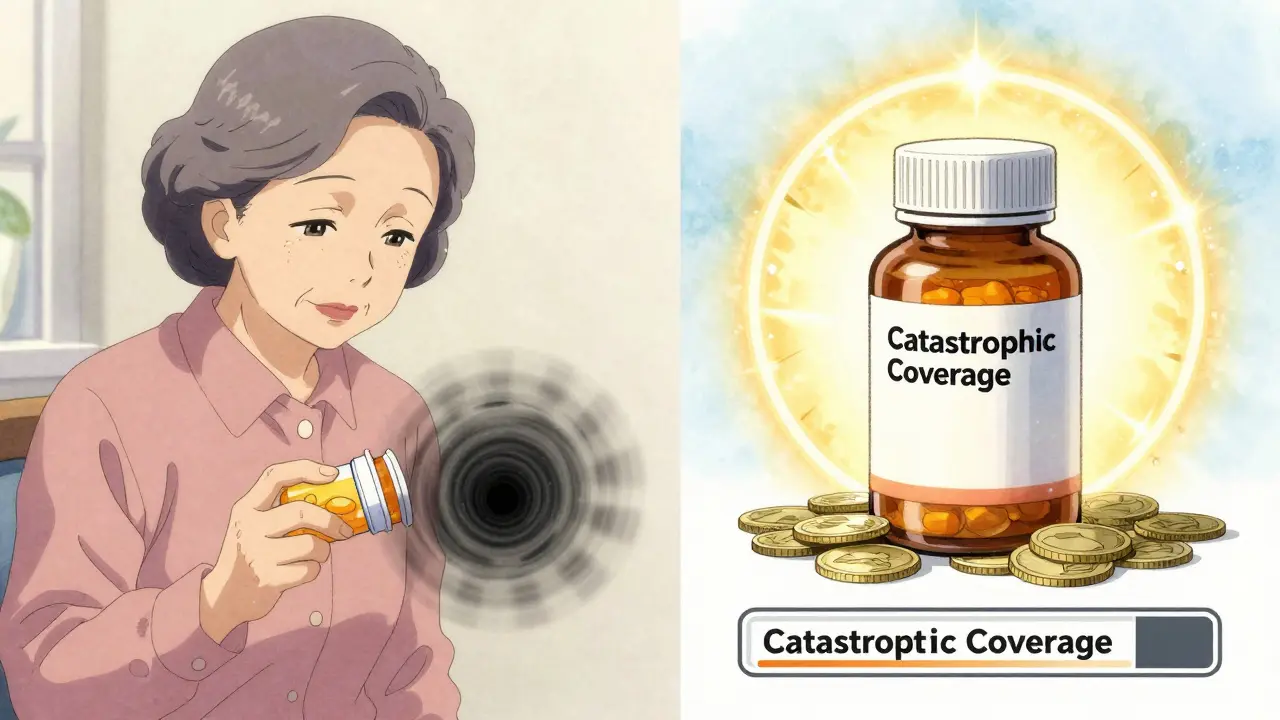
Medicare Part D is where things get truly confusing. In this program, patients pay more out-of-pocket for generic drugs than brand-name ones - even when the generic is cheaper per pill. How? It’s all about the coverage gap, also known as the “donut hole.”When you hit the coverage gap, you pay a higher percentage of the drug’s price. But here’s the catch: brand-name manufacturers give discounts during this gap that count toward your out-of-pocket spending. Generics don’t. That means if you’re taking a brand-name drug, every dollar you pay in the donut hole gets you closer to catastrophic coverage - where you only pay 5% of the cost. But if you’re on a generic, you’re paying the full price, and none of it counts toward escaping the gap.
In 2019, a patient needed to spend $982 out-of-pocket on brand-name drugs to reach catastrophic coverage. For generics? $3,730. That’s almost four times more. Even though the generic pill might cost $5 and the brand $20, the system makes you pay more to get the same benefit. This isn’t a glitch. It’s by design.
That’s why some Medicare patients are better off sticking with brand-name drugs - not because they’re better, but because the math works out. In 2020, the out-of-pocket threshold to reach catastrophic coverage jumped from $5,100 to $6,350. The gap got wider. The penalty for using generics got worse.
Who’s Really Paying?
You might think the drugmaker sets the price. But that’s not the whole story. Pharmacy benefit managers (PBMs) - middlemen between insurers, pharmacies, and drugmakers - negotiate rebates and discounts behind closed doors. These rebates don’t go to you. They go to the insurer or PBM. And because the price you pay is based on the list price (not the net price after rebates), you end up paying more.For example, a drug might have a list price of $100. The drugmaker gives a $70 rebate to the PBM. The net price is $30. But your insurance still charges you based on the $100 list price. If you’re on coinsurance, you pay $25. The PBM pockets $70. You pay $25. The drugmaker gets $30. No one’s winning except the middlemen.
This system creates a hidden tax on generics. A 2022 study from the USC Schaeffer Center found that patients overpay for generics by 13 to 20% because of these opaque pricing practices. The same study showed that in 2020, generic drugs saved the U.S. healthcare system $338 billion. But patients still paid billions more than they should have.
How to Pay Less - Even With Insurance
You don’t have to accept what your pharmacy says. Here’s what actually works:- Ask for cash prices. Many generic drugs are cheaper if you pay cash. Mark Cuban Cost Plus Drug Company, Blueberry Pharmacy, and GoodRx often offer prices lower than your insurance copay. In 2024, patients saved $4.96 on average per generic prescription using these services. For expensive drugs like insulin or antibiotics, savings can be $50 or more.
- Check your plan’s formulary. Not all generics are equal. Some plans have preferred generics that cost less. Others charge more for certain brands even if they’re generic. Ask your pharmacist: “Is there a lower-cost generic on my plan’s list?”
- Don’t automatically accept the brand. If your doctor writes a prescription without specifying “dispense as written,” the pharmacy can substitute a generic. If you want the brand, you have to ask for it - and pay more.
- Ask about prior authorization. If your doctor insists on a brand-name drug, they may need to file a prior authorization. Insurance will only cover it if they prove the generic won’t work. Don’t assume it’s denied. Push back.
Uninsured patients benefit the most from cash pricing. In 2020, 97% of cash payments for prescriptions were for generics. That’s because cash prices are almost always lower than insurance copays for these drugs. Even if you have insurance, paying cash can be smarter - especially if your deductible is high or you haven’t met it yet.
What You Can Do Right Now
Here’s a simple checklist to lower your out-of-pocket costs:- Before filling any prescription, ask your pharmacist: “What’s the cash price?”
- Compare that to your insurance copay. If cash is lower, pay cash.
- Use GoodRx or Mark Cuban Cost Plus Drug Company to find the lowest price before you go to the pharmacy.
- If you’re on Medicare Part D, track your out-of-pocket spending. Use the Medicare Plan Finder to see how much you’ve paid toward the catastrophic coverage threshold.
- Ask your doctor: “Is there a generic version? And if so, is it on my plan’s preferred list?”
You don’t need to be a healthcare expert to save money. You just need to know that the price on the screen isn’t the whole story. The system is designed to make you pay more - but you can outsmart it.
Why This Matters
People skip doses because they can’t afford their meds. One in four Americans says they’ve skipped a prescription because of cost. That’s not about being careless. It’s about a system that rewards complexity over fairness.Generics are the most effective tool we have to lower drug spending. They’re safe, effective, and affordable - if the system lets them be. But right now, the rules are rigged. The people who benefit most from generics are the ones who pay the most out of pocket.
It’s time to stop assuming that “generic = cheap.” Sometimes, it’s the opposite. And sometimes, the best way to save money isn’t to use your insurance - it’s to walk away from it.
Are generic drugs really as good as brand-name drugs?
Yes. The FDA requires generic drugs to have the same active ingredients, strength, dosage form, and route of administration as the brand-name version. They must also prove they’re bioequivalent - meaning they work the same way in your body. The only differences are in inactive ingredients like fillers or dyes, which don’t affect how the drug works. Generics are not cheaper because they’re lower quality. They’re cheaper because they don’t carry the marketing and R&D costs of the original brand.
Why is my generic drug more expensive than the brand-name version?
This usually happens with Medicare Part D. Brand-name manufacturers pay discounts during the coverage gap (donut hole) that count toward your out-of-pocket spending. Generic manufacturers don’t. So even if the generic pill costs less, you have to spend much more out-of-pocket to reach catastrophic coverage. It’s a structural flaw in the system, not a pricing error.
Should I always use my insurance to pay for prescriptions?
Not always. For many generic drugs, paying cash through services like GoodRx or Mark Cuban Cost Plus Drug Company is cheaper than using your insurance - especially if you haven’t met your deductible or your copay is high. Always ask your pharmacist for the cash price before you pay. If it’s lower, pay cash. Your insurance doesn’t get credit for cash payments, but you save money.
Can my doctor force me to take a brand-name drug?
Yes, but only if they write “dispense as written” or “do not substitute” on the prescription. Otherwise, pharmacists are legally allowed to substitute a generic. If your doctor believes a brand is medically necessary - say, because you had a bad reaction to a generic - they can file a prior authorization. But you still have the right to ask if a generic is an option.
How can I track my out-of-pocket spending on Medicare Part D?
Log in to your Medicare account at medicare.gov or use the Medicare Plan Finder tool. Your plan should also send you an annual statement showing how much you’ve spent out-of-pocket. Keep track of every payment - including cash payments for generics - because they all count toward reaching catastrophic coverage. If you’re spending a lot on generics and not getting closer to lower costs, it might be time to switch plans or pay cash instead.
Been there. Paid $28 for a generic statin last month. Cash price? $12. I don't even use insurance for generics anymore. Just walk in, ask for the cash price, and walk out with half the bill. The system is rigged, but you can beat it.
This hit home. My mom skipped her blood pressure meds last year because the copay jumped to $45. She didn't know cash could be cheaper. I showed her GoodRx last month - now she saves $30 every time. Thank you for writing this. People need to know.
So the system is designed to punish people who use generics? Wow. Just wow. This isn't healthcare. It's a pyramid scheme with pills.
Why don't people just stop using drugs altogether? It's all about personal responsibility. If you can't afford medicine, maybe you shouldn't be sick.
Thank you for this comprehensive breakdown. The structural inequities in Medicare Part D's coverage gap are not widely understood, and the fact that generic drugs do not benefit from manufacturer discounts during the donut hole is a critical oversight that disproportionately impacts low-income seniors. Policy reform is urgently needed.
Just paid $18 for my generic metformin at CVS. Went to Cost Plus Drug Co. - $4.99. I'm never using insurance for this again. Seriously, why are we still playing this game?
So PBMs are basically stealing from us while pretending to help? And the government lets them? Of course they do. The same people who profit off your asthma inhaler are the ones writing the laws. This isn't capitalism. It's a mafia with a pharmacy license.
It's wild how we've turned healing into a financial puzzle. We have the science to cure things, but the system rewards complexity over care. Maybe the real generic isn't the drug - it's the idea that health should be affordable for everyone.
You're all missing the real issue. The FDA doesn't require generics to prove long-term safety like brand names. That's why some people have bad reactions. You think it's about money? It's about risk. You're gambling with your health when you go generic.
Americans think they're smart because they use GoodRx. In the UK, we just get our meds covered. No games. No tricks. No 'cash price' nonsense. You people have turned healthcare into a horror show.
People who use cash for prescriptions are just lazy. If you can't afford your meds, you shouldn't be on them. Get a job. Get insurance. Stop gaming the system.
Try this: if your pharmacist says the copay is $25, ask them to call the manufacturer's patient assistance program. Many generics have free or $5 programs - you'd be shocked how many people don't know this. You don't need to be rich to save money. Just ask.
The entire pharmaceutical-industrial complex is a Ponzi scheme. PBMs, insurers, drugmakers - they're all feeding off the same carcass. The only solution is national price controls. Until then, we're all just rats in a maze trying to find the cheese that's been moved.
It's not hopeless. I used to pay $80 for my insulin. Now I pay $25 cash. I'm alive. My neighbor's still paying $400. He doesn't know better. You can change your story. Just start asking questions.