
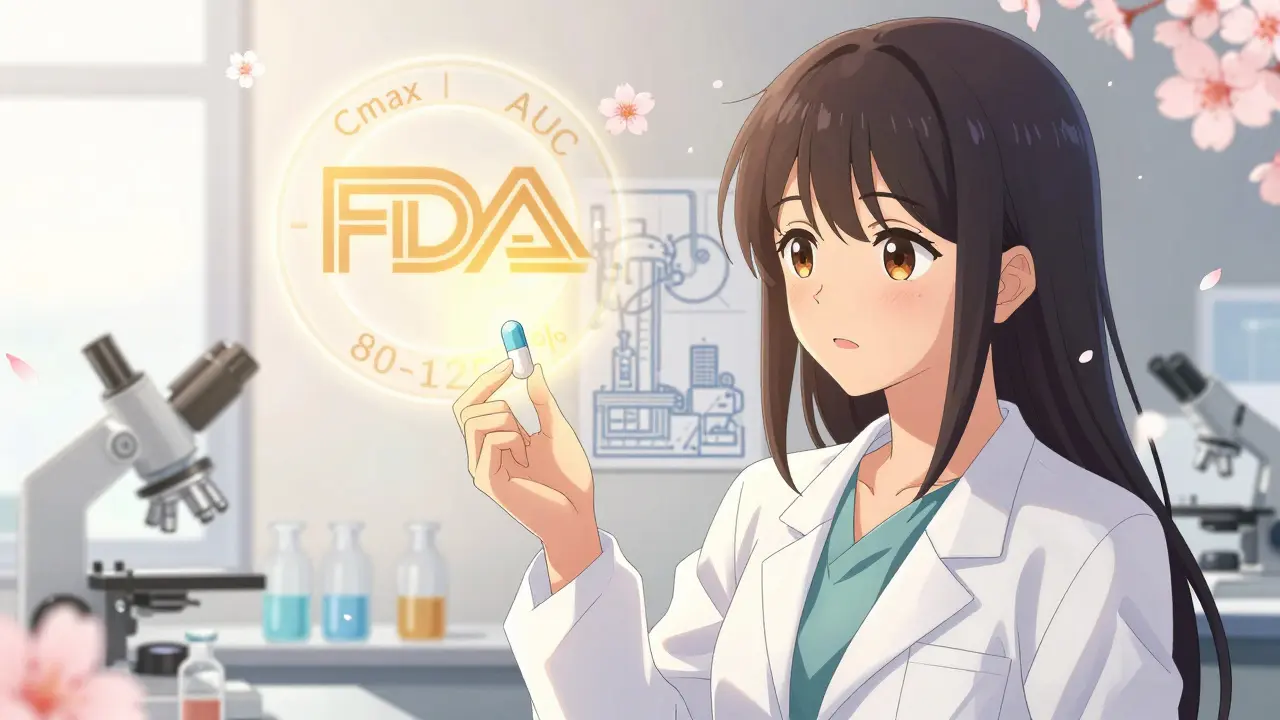
When you pick up a prescription at the pharmacy and see a generic version instead of the brand-name drug you expected, you might wonder: Is this really the same thing? The answer is yes - but only if it passed the FDA’s strict testing and quality controls. Every generic drug approved in the U.S. must meet the same high standards as its brand-name counterpart. It’s not just a cheaper copy. It’s a scientifically proven equivalent.
What Makes a Generic Drug ‘The Same’?
The FDA doesn’t just accept any drug that looks like the brand-name version. To be approved, a generic must be pharmaceutically equivalent and bioequivalent. Pharmaceutical equivalence means the generic has the same active ingredient, strength, dosage form (like tablet, capsule, or injection), and route of administration (oral, injectable, etc.) as the original. It also must have the same intended use and labeling.
But that’s only half the story. Two drugs can have identical ingredients and still behave differently in the body. That’s where bioequivalence comes in. The FDA requires that the generic drug delivers the same amount of active ingredient into your bloodstream at the same rate as the brand-name drug. This is measured using two key metrics: Cmax (the highest concentration in the blood) and AUC (the total amount absorbed over time).
For approval, the 90% confidence interval for both Cmax and AUC must fall between 80% and 125% of the brand-name drug’s values. That’s not a vague guideline - it’s a hard scientific threshold. If a generic drug’s absorption profile falls outside that range, it’s rejected. This ensures that your body gets the same dose, the same way, every time.
The ANDA Process: How Generics Get Approved
Generic drug companies don’t have to repeat the expensive clinical trials done by the original manufacturer. Instead, they submit an Abbreviated New Drug Application, or ANDA. The word “abbreviated” doesn’t mean “less thorough.” It means they can rely on existing safety data from the brand-name drug. What they must prove is that their version is identical in quality, performance, and effect.
The ANDA includes detailed information about the drug’s chemistry, manufacturing, and controls. The FDA reviews everything: the source of the active ingredient, how it’s mixed with inactive ingredients, how the tablets are pressed, how the capsules are sealed, and how the final product is tested before it leaves the factory. The agency also checks the manufacturing facility - whether it’s in the U.S., India, or elsewhere - to make sure it follows current Good Manufacturing Practices (cGMP).
These cGMP rules are not optional. They’re written into U.S. law (21 CFR Parts 210 and 211). Every batch of a generic drug must be tested for identity, strength, purity, and quality. The methods used to test each batch must be validated - meaning they’ve been proven to give accurate, repeatable results. No shortcuts. No guesswork.
The review process takes time. The FDA’s goal is to approve a complete ANDA within 10 months. But complex drugs - like inhalers, long-acting injectables, or topical creams - can take longer. In fiscal year 2022, the FDA approved 892 original ANDAs and issued 478 complete response letters, meaning those applications needed more data before approval.
Testing Complex Generics: Beyond Blood Levels
Not all drugs are created equal. For simple pills, measuring blood levels is enough. But for complex products, that’s not enough. Think of a cream for eczema or an inhaler for asthma. The way the drug is delivered - how it spreads on the skin, how it’s aerosolized in the lungs - matters just as much as how much gets into the blood.
The FDA has developed over 2,143 product-specific guidances for these tricky cases. Each guidance outlines exactly what tests are needed. For inhalers, that might mean checking particle size distribution. For topical creams, it could involve testing how the drug penetrates the skin layer by layer. For injectables, it may require analyzing the structure of nanoparticles.
These aren’t theoretical exercises. In 2023, the FDA released 27 new guidances, bringing the total to 2,143 across 1,528 unique drug products. This shows how seriously the agency takes quality control. One study found that 17% of complex generic products needed more than standard bioequivalence testing. That’s why the FDA spends $15.7 million annually on research into better testing methods for these drugs.
Manufacturing and Oversight: Who Makes Generics?
Many people assume generic drugs are made in low-quality factories overseas. That’s not true. In fact, about half of all generic drugs in the U.S. are made by the same companies that produce brand-name drugs. Many are made in the same facilities, on the same lines, using the same equipment. The difference? The label.
The FDA inspects around 3,500 manufacturing sites every year - half of them outside the U.S. These inspections are unannounced and thorough. They check everything: how raw materials are stored, whether equipment is cleaned properly, whether workers follow written procedures, and whether quality control records are accurate.
Every lot of a generic drug must be tested before release. That means if a company produces 100,000 bottles of a generic antibiotic, each batch must pass tests for potency, purity, and stability. The FDA doesn’t trust random sampling - it demands full documentation and testing for every single batch.
Stability and Shelf Life: How Long Do Generics Last?
A generic drug isn’t approved just because it works on day one. It has to stay stable over time. That’s why manufacturers must run stability studies. These involve storing the drug under extreme conditions - like 40°C and 75% humidity - for at least six months. They also test it under normal storage conditions for 12 to 24 months.
If the drug breaks down, changes color, or loses potency during these tests, it doesn’t get approved. The FDA requires that the expiration date on the bottle is based on real data, not guesswork. That’s why you’ll see expiration dates on generic drugs - and why they’re reliable.
Real-World Performance: Do Generics Work?
Over 90% of prescriptions filled in the U.S. are for generic drugs. That’s not because people are forced to take them - it’s because they trust them. A 2022 Consumer Reports survey found that 89% of users were satisfied with generic medications, and 62% actively chose them to save money.
But there are exceptions. Some drugs have a narrow therapeutic index - meaning even small changes in blood levels can cause problems. Levothyroxine, used for thyroid conditions, is one example. A 2021 study in JAMA Internal Medicine found that 12.3% of patients who switched between different generic versions had thyroid levels that shifted enough to need a dose adjustment.
Similarly, some patients report issues with seizure medications or blood thinners like warfarin. But these cases are rare. A 2023 Reddit thread with over 1,400 responses found that 83% of users noticed no difference between generic and brand-name versions. The FDA and the American Medical Association both affirm that approved generics are safe and effective. When problems occur, they’re usually tied to specific drugs - not the entire category.
Why This Matters: Cost and Access
Generic drugs saved the U.S. healthcare system $37 billion in 2022 alone. They make chronic conditions manageable for millions. Without them, many people would skip doses, delay treatment, or go without care entirely.
The generic drug market is growing. It was worth $135.7 billion in 2022 and is projected to hit $180.3 billion by 2027. But here’s the real stat: generics make up over 90% of prescriptions, yet account for only about 23% of total drug spending. That’s the power of competition - and the power of strict quality standards.
When you take a generic drug, you’re not getting a bargain bin product. You’re getting a medication that passed the same rigorous tests as the brand-name version - tested in labs, inspected in factories, and monitored by regulators. The FDA doesn’t cut corners. And neither should you.
Are generic drugs as effective as brand-name drugs?
Yes. The FDA requires that generic drugs be pharmaceutically and bioequivalent to their brand-name counterparts. This means they have the same active ingredient, strength, dosage form, and rate of absorption. Studies and real-world use confirm that approved generics work just as well.
Why are generic drugs cheaper?
Generic drugs cost less because manufacturers don’t have to repeat expensive clinical trials. They rely on the brand-name drug’s safety data and only need to prove their version is equivalent. This cuts development costs dramatically, allowing lower prices while maintaining quality.
Do all generic drugs come from overseas?
No. About half of all generic drugs in the U.S. are made by the same companies that produce brand-name drugs, often in the same facilities. The FDA inspects manufacturing sites worldwide - including in the U.S., India, China, and Europe - to ensure they meet strict quality standards.
Can I trust the expiration date on a generic drug?
Yes. Generic drugs undergo stability testing under extreme conditions to determine their shelf life. The expiration date is based on real data showing how long the drug remains safe and effective. If a generic fails these tests, it won’t be approved.
Are there any generic drugs I should avoid?
There’s no blanket reason to avoid any FDA-approved generic drug. However, for drugs with a narrow therapeutic index - like levothyroxine, warfarin, or certain seizure medications - small changes in absorption can matter. If you notice a change in how you feel after switching generics, talk to your doctor. But don’t assume the generic is faulty - the issue may be individual sensitivity, not quality.
lol so the fda says its all good but i still dont trust these generics. my cousin took some and his kidney went on vacation. just sayin.
Let me tell you, folks-this isn’t just ‘science,’ this is a triumph of regulatory rigor! The FDA doesn’t just ‘approve’ generics-they interrogate them. Every molecule. Every tablet press. Every damn manufacturing line. And if you think they’re ‘cheap’? You’re not just wrong-you’re dangerously uninformed. This is the difference between a pharmacy and a snake-oil tent.
Really appreciate this breakdown. I’ve been on generics for years and always wondered if I was risking my health. Knowing the FDA’s got this locked down makes me feel way better about saving cash on meds.
I switched to generic Adderall and felt like a zombie for two weeks. 😒 Maybe the FDA’s standards are just… *suggestions*?
Honestly? I used to be skeptical too. Then I read the ANDA guidelines. The level of detail? The batch testing? The stability studies under 75% humidity? It’s insane. If your pharmacy’s giving you a generic, you’re getting a product that went through more scrutiny than most luxury cars.
The FDA’s oversight is one of the most underappreciated public health achievements in modern history. The fact that 90% of prescriptions are generics-and that they’re this reliable-is a testament to institutional discipline. We should be proud.
The statistical rigor behind bioequivalence-80% to 125% confidence interval-is not arbitrary. It is derived from pharmacokinetic modeling, clinical outcomes, and population variability. To dismiss this as ‘government overreach’ is to misunderstand both pharmacology and statistics.
I work in pharma logistics in the UK and can confirm-same factories, same machines, same inspectors. The label changes, not the quality. The FDA’s got eyes everywhere, even in Chennai. 🙌
I’ve been on generic levothyroxine for five years. No issues. My TSH is stable. My energy’s back. I’ve switched brands three times. Zero problems. The system works. If you’re having trouble, talk to your doc-not Reddit.
You know what’s really wild? The FDA doesn’t even test the final product in every country. They rely on third-party labs. And sometimes those labs are… underfunded. So while the standards are high, the enforcement? Not always. I’ve seen the reports.
My grandma’s on 7 generics. She’s 82, sharp as a tack, and still gardening. If generics were a scam, she’d be dead by now. But she’s not. So… maybe they work? 🤷♂️
The assertion that generics are equivalent is not merely an assumption-it is a conclusion derived from decades of pharmacokinetic data, post-market surveillance, and real-world outcomes. The burden of proof lies with those who claim otherwise.
I used to hate generics till I found out my brand-name insulin was made in the same factory as the generic. Same batch. Same people. Same machine. Just a different sticker. Mind blown.