
Why Your Sleep Isn’t Improving (Even If You’re Trying)
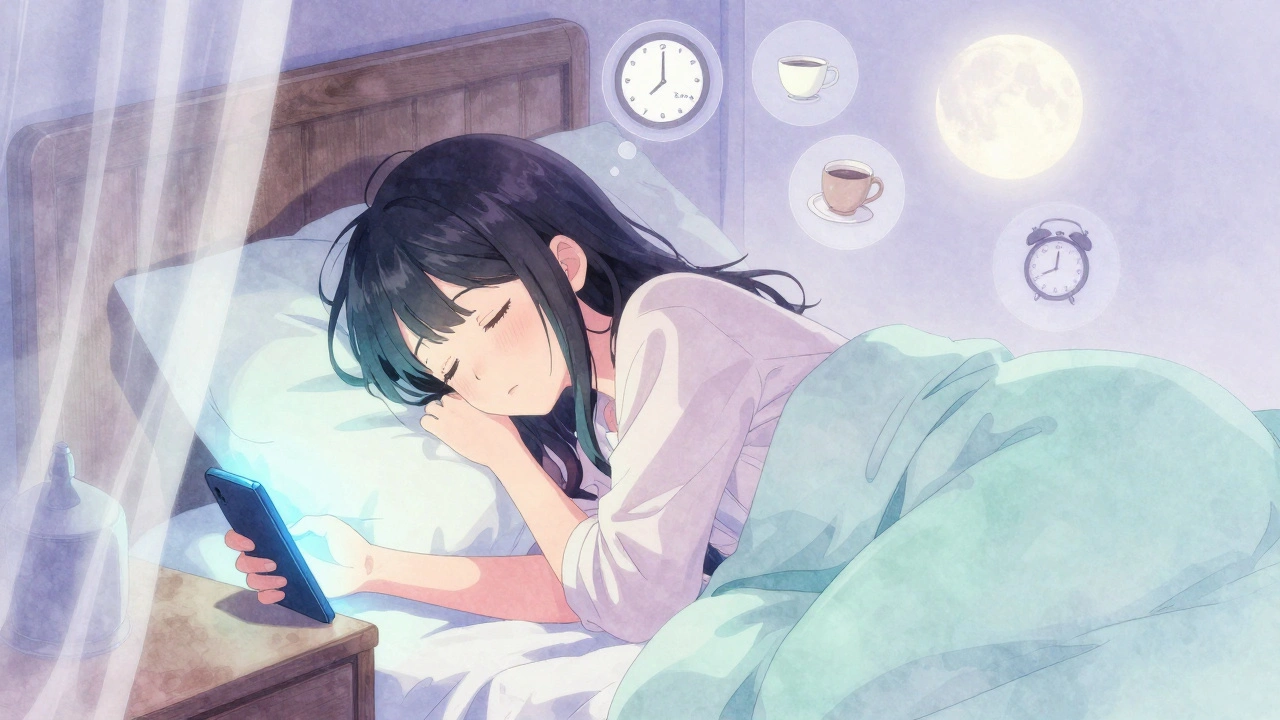
You’ve turned off the lights. You’ve read a book. You’ve even tried chamomile tea. But you’re still lying awake at 2 a.m., counting sheep that won’t stay still. If this sounds familiar, you’re not failing at sleep-you’re just missing the right sleep hygiene habits.
Sleep hygiene isn’t about fancy gadgets or expensive mattresses. It’s about the daily choices you make that either help your body wind down-or keep it wired. And the science is clear: fixing just a few of these behaviors can cut your time to fall asleep in half and boost your deep sleep by up to 30%.
The Core Problem: Your Body Doesn’t Know When to Shut Down
Your brain runs on a 24-hour clock. It’s not magic. It’s biology. When you go to bed at midnight on weekdays but 2 a.m. on weekends, your body gets confused. That’s why you feel groggy Monday morning, even after a full night’s sleep.
Research from the American Academy of Sleep Medicine shows that consistent wake times matter more than bedtimes. Why? Because your body learns when to release melatonin based on when you wake up-not when you fall asleep. If you wake up at 7 a.m. every day, your brain starts preparing for sleep around 10:30 p.m. If you sleep in till 10 a.m. on Saturday, that clock resets. And suddenly, Sunday night feels impossible.
What Actually Works: The 5 Evidence-Based Habits
Not all sleep advice is created equal. Some tips are myths. Others are backed by real data. Here are the five behaviors that have the strongest link to better sleep, based on studies of over 10,000 adults:
- Wake up at the same time every day-even on weekends. A 2023 study found that people who kept their wake time within 30 minutes of their weekday schedule reduced their sleep onset latency by 57%. That’s the time it takes to fall asleep. For many, that means cutting from 90 minutes down to 40.
- Avoid caffeine after 2 p.m. Caffeine has a half-life of 5-6 hours. That afternoon coffee? It’s still in your system at 10 p.m., blocking adenosine-the chemical that tells your brain it’s tired. One 2022 study showed that people who stopped caffeine after 2 p.m. fell asleep 17 minutes faster on average.
- Keep your bedroom cool-between 15.6°C and 19.4°C (60-67°F). Your core body temperature needs to drop by about 1°C to trigger sleep. A warm room fights that. If you’re sweating through your sheets, that’s why.
- Stop screens one hour before bed. Blue light isn’t the only problem. The real issue is mental stimulation. Scrolling through TikTok, checking emails, or arguing in group chats keeps your brain in ‘alert’ mode. A 2024 meta-analysis found that blue-light filters only improved sleep onset by 4-7 minutes. But putting the phone in another room? That cut it by 22 minutes.
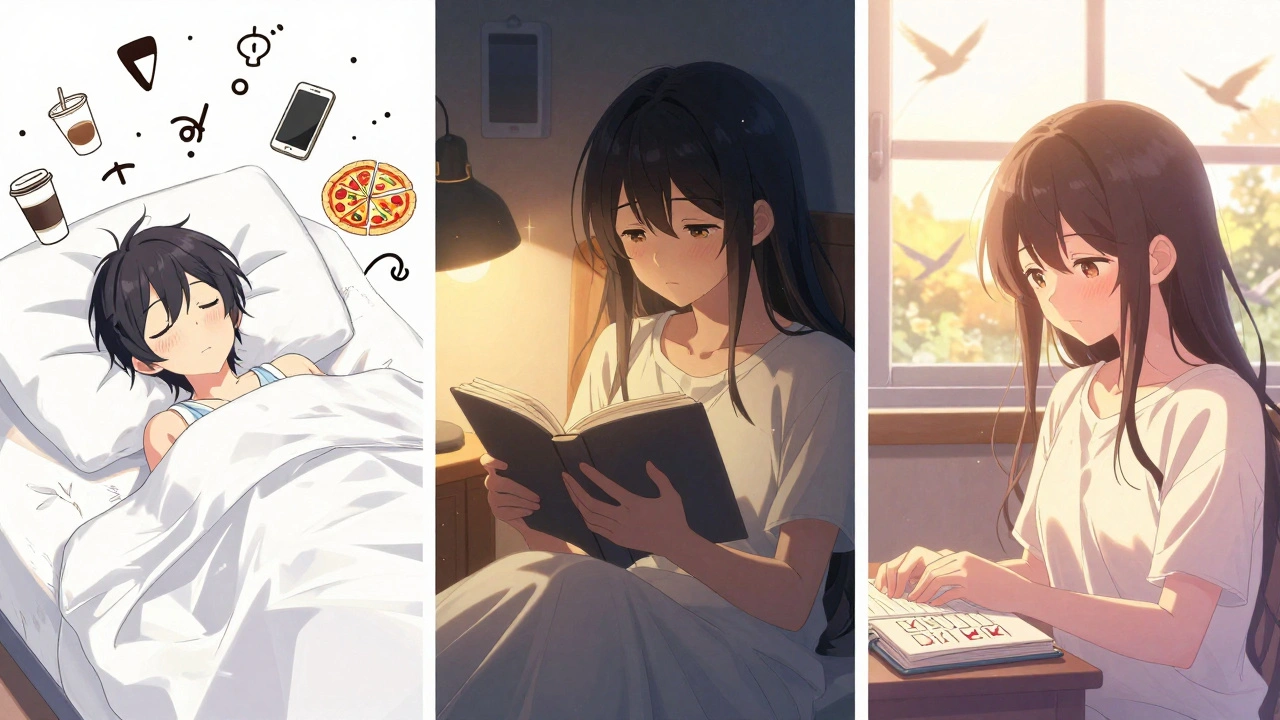
- Don’t eat heavy meals within 3 hours of bed. Digestion raises your body temperature and activates your nervous system. A late pizza or curry might feel comforting, but it delays melatonin release. Stick to a light snack if you’re hungry-like a banana or a small handful of almonds.
What Doesn’t Work (And Why You’re Wasting Time)
There’s a lot of noise out there. You’ve probably heard:
- “Exercise before bed ruins sleep.” False. A 2023 study from the University of Tsukuba found that 68% of participants slept better after evening workouts. The key? Don’t do intense cardio right before bed. A gentle walk or yoga is fine.
- “Use blue light glasses.” They help a little-but not enough to matter if your schedule is all over the place. Fix your wake time first. Then worry about glasses.
- “Drink warm milk.” It’s comforting, sure. But it doesn’t change your biology. Same with lavender sprays or weighted blankets. They might help you relax, but they won’t fix a broken circadian rhythm.

Why You’re Not Seeing Results (And How to Fix It)
Most people give up after a week. Why? Because sleep hygiene isn’t a quick fix. It’s a reset. Your body doesn’t change overnight.
Studies show you need at least 14-21 days of consistent practice before you notice real changes. That’s because your brain has to relearn how to associate your bed with sleep-not stress, not scrolling, not worrying.
Here’s what helps people stick with it:
- Habit stacking: Pair your new habit with something you already do. Example: “After I brush my teeth, I put my phone on charge in the kitchen.”
- Use a simple tracker: Just write down your wake time and how you felt the next day. No apps needed. A notebook works.
- Don’t obsess over sleep. The more you worry about falling asleep, the harder it gets. That’s called “sleep anxiety.” If you’re lying awake for more than 20 minutes, get up. Go read in dim light. Come back when you’re sleepy.
When Sleep Hygiene Isn’t Enough
Let’s be honest: if you’ve been doing all this for months and still feel exhausted, you might have more than just bad habits.
Sleep hygiene works great for mild sleep trouble. But if you’re lying awake for over an hour most nights, waking up multiple times, or feeling tired even after 8 hours-you might have insomnia or another sleep disorder. That’s not your fault. It’s not laziness.
The American Academy of Sleep Medicine says sleep hygiene alone is a weak treatment for chronic insomnia. But it’s the essential first step. After that, you need cognitive behavioral therapy for insomnia (CBT-I). It’s not pills. It’s talking to a trained therapist about your thoughts around sleep. And it’s more effective than medication.
Real People, Real Results
On Reddit’s sleep community, one user, u/NightOwlPhD, said: “I used to take 90 minutes to fall asleep. I started waking up at 6:30 a.m. every day-even on weekends. Three weeks later, I was asleep in 25 minutes. No pills. No apps. Just consistency.”
Another user in Sydney, a nurse working night shifts, said: “I couldn’t sleep during the day. I started using blackout curtains, earplugs, and a white noise machine. I stopped checking the clock. Within two weeks, I was getting 5 solid hours of sleep after my shift. It changed my life.”
What to Do Next
Don’t try to fix everything at once. Pick one habit. Start with wake time. Set your alarm. No snoozing. Even on Saturday. Do that for 10 days. Then add one more: no caffeine after 2 p.m.
Track your progress. Notice how you feel at 3 p.m. Are you less sluggish? Less irritable? That’s your body responding.
Sleep hygiene isn’t about perfection. It’s about progress. You don’t need to be a sleep guru. You just need to show up, day after day.
Common Questions About Sleep Hygiene
Can I nap during the day if I’m tired?
Short naps (20-30 minutes) before 3 p.m. are usually fine and can help restore alertness. But longer or later naps interfere with nighttime sleep. If you’re struggling to fall asleep at night, try skipping naps for a week. You might be surprised how much your sleep improves.
Does alcohol help me sleep better?
Alcohol might make you fall asleep faster, but it ruins your sleep quality. It blocks REM sleep-the stage where your brain processes emotions and memories. You’ll wake up more often, feel less rested, and may even have nightmares. Avoid alcohol within 3 hours of bedtime.
Should I use a sleep tracker?
They can help you spot patterns-like how caffeine or late meals affect your sleep. But don’t get obsessed with the numbers. Many trackers are inaccurate. Focus on how you feel. If you wake up refreshed and alert, that’s what matters most.
What if my partner snores or moves a lot at night?
You can’t control their behavior, but you can control your environment. Try earplugs, a white noise machine, or even separate beds if needed. Your sleep matters. It’s not selfish to protect it. If snoring is loud and frequent, your partner may have sleep apnea-see a doctor.
Is it okay to read in bed?
Only if it’s physical books or e-ink readers (like a Kindle) with no backlight. Avoid phones, tablets, or bright LEDs. Reading a novel in dim light can be a great wind-down ritual-but only if it’s calm and not stressful. If you start thinking about work or deadlines, put the book down.
Final Thought: Sleep Is a Skill, Not a Luck
You wouldn’t expect to run a marathon without training. Yet many people expect to sleep well without building the right habits. Sleep hygiene isn’t about willpower. It’s about creating the right conditions-like watering a plant so it can grow.
Start small. Stay consistent. Be patient. Your brain will catch up. And one day, you’ll wake up-not because the alarm went off-but because you’re finally, naturally, fully rested.
Sleep hygiene is one of those things that sounds simple until you actually try to do it. I used to think I was doing everything right-no screens, cool room, tea-but I kept waking up at 3 a.m. wondering why. Turns out, my wake time was all over the place. Once I committed to 7 a.m. every day, even weekends, it took about 12 days but suddenly I wasn’t dreading Monday anymore. No magic, just biology.
ugh this is such american bs. we dont have air conditioning in most of india and still sleep fine. wake up at same time? my uncle works 3 shifts a week and sleeps when he can. you people think sleep is a product you can optimize like a phone battery. its not. its nature. stop overthinking.
Let’s be real. The ‘wake up at the same time’ advice is a corporate sleep cult tactic. Who decided 7 a.m. is the universal reset button? The military? Big Pharma? The WHO? You’re ignoring chronotypes. My body naturally wakes at 10 a.m. forcing 7 a.m. just makes me depressed and cortisol-heavy. This whole post is a glorified sleep ad for Fitbit. They don’t mention that melatonin suppression from artificial light is a symptom of modern capitalism, not a personal failure.
Also, caffeine after 2 p.m.? My liver metabolizes it in 3 hours. I drink espresso at 4 p.m. and sleep like a baby. Your study probably sampled overworked white-collar drones who drink coffee like water. Not everyone’s biology is the same.
And why no mention of light exposure in the morning? That’s the real reset button. No one talks about that because it’s not sellable. You can’t monetize sunlight.
Also, the ‘don’t obsess’ advice? That’s the most privileged thing I’ve read all week. Try having a newborn, a 9-to-5, and a landlord who turns the heat up to 80°F. Sleep hygiene is a luxury for people who don’t live in housing crises.
And don’t even get me started on CBT-I being the ‘real’ solution. It’s expensive, hard to access, and most therapists are trained to treat anxiety, not circadian biology. This post is 90% marketing.
People still believe in this sleep hygiene nonsense? You think avoiding caffeine after 2 p.m. is the answer? My grandmother in Kerala slept through monsoon storms, ate spicy curry at midnight, and woke up at 5 a.m. every day without an alarm. She never owned a smartwatch. She didn’t even have a fan. You’re overcomplicating something that was never broken. Modern life is the problem, not your bedtime routine.
And reading in bed? Of course you can. My mother read novels until 2 a.m. and slept like a log. Your ‘e-ink only’ rule is absurd. It’s not the screen-it’s the content. If you’re reading thrillers or work emails, of course you won’t sleep. Put down the drama, not the device.
Also, ‘sleep is a skill’? That’s the most condescending thing I’ve heard since ‘just meditate’. Some people have insomnia because of trauma, not because they didn’t stack their habits right. You’re blaming the victim.
Wake up at the same time every day. That’s it. Everything else is noise.
Okay but have you considered the epistemological framework of circadian entrainment? Like, the very notion of ‘sleep hygiene’ is a neoliberal construct that pathologizes natural variability in human chronobiology. We’re being sold a myth of control-like if we just optimize our environment enough, we can transcend biological entropy. But what if sleep isn’t a problem to be solved? What if it’s a surrender? A sacred collapse into the dark? I’m not saying ignore the science-I’m saying the science is incomplete. Your body isn’t a machine. It’s a mythopoetic ecosystem. And sometimes… you just need to let go.
Also, I use a weighted blanket infused with organic lavender and it’s basically a spiritual experience. I cry every night. It’s beautiful.
I just want to say how much this post helped me. I’ve been struggling with sleep for years and I thought I was broken. Reading this made me realize I wasn’t failing-I was just missing the right pieces. I started with just one thing: waking up at 7 a.m. every day. No snoozing. Even on Sunday. It felt impossible at first. I was so tired. But after 10 days, I noticed I wasn’t reaching for coffee at 10 a.m. anymore. I felt… calmer. Not because of a gadget or a supplement. Just because I showed up for myself. I’m not cured. But I’m not drowning anymore. Thank you for writing this. It felt like someone finally saw me.
Interesting how this post ignores the African reality. In Lagos, most people sleep in rooms with no AC, no blackout curtains, and noise from generators, horns, and preachers at 4 a.m. Yet they still function. Why? Because sleep is not a luxury-it’s an adaptation. You don’t need to ‘optimize’ sleep. You need to survive. This advice is for people who have the privilege of choosing when to rest. For the rest of us? We sleep when we can. And we’re fine. You’re not broken. You’re just privileged.
i think the real issue is we’ve turned sleep into a performance. like we’re auditioning for the role of ‘healthy adult’ and if we don’t hit 7 hours of deep sleep with 92% efficiency according to our apple watch, we’re failures. but sleep isn’t a metric. it’s a rhythm. a quiet collapse. a letting go. and maybe the more we try to control it, the more it slips away. i used to track everything. then i stopped. i just read in bed, turned off the light, and didn’t care if i slept. weirdly? i started sleeping better. maybe the answer isn’t more rules. maybe it’s fewer.
Wake up at the same time? LOL. My cousin in Texas sleeps till noon every day and runs a six-figure business. He doesn’t care about your sleep cult. Your ‘science’ is just woke corporate propaganda. China sleeps less, works more, and owns the future. You’re not optimizing sleep-you’re optimizing compliance. Wake up at 7 a.m.? Wake up at 5 a.m. and start a business. That’s real sleep hygiene.
One must approach the matter of somnolent regulation with the utmost rigor and intellectual fortitude. The proposition that one may achieve restorative slumber through the mere calibration of diurnal wakefulness is, in truth, a reductionist fallacy. One must consider the intricate interplay of neuroendocrine signaling, environmental chronobiological entrainment, and the psychoaffective residue of diurnal stressors. Furthermore, the assertion that caffeine consumption post-14:00 constitutes a primary impediment to melatonin secretion is empirically incomplete, as individual cytochrome P450 polymorphisms significantly modulate pharmacokinetic profiles. One might even posit that the entire paradigm of sleep hygiene is a neoliberal construct designed to externalize systemic societal exhaustion onto the individual. One’s bed, after all, is not merely a locus of rest-it is a sacred vessel of existential retreat. One must, therefore, not merely ‘follow advice’-one must cultivate a ritual of surrender. And yet, one must also acknowledge the structural barriers that prevent many from even possessing a bed of sufficient quality. This is not a personal failing. It is a societal collapse.
you know what works better than all this? not caring. i used to stress about sleep so much i’d lie there for hours thinking about how i wasn’t sleeping. then i just stopped trying. i read dumb stuff on my phone. i watched bad tv. i didn’t care if i slept. and guess what? i started sleeping. like, naturally. maybe the whole point is to stop trying to fix it. maybe sleep is like love. the more you chase it, the more it runs.
I actually tried the ‘don’t obsess’ thing after reading your comment. I got up and read a novel in dim light last night. Didn’t check the time. Came back to bed an hour later. Fell asleep in 8 minutes. I didn’t even realize I was tired until I wasn’t fighting it anymore.