

Sulfonylurea Risk Calculator
Personal Risk Factors
Your Personalized Risk Assessment
Glyburide
12.1 episodes per 1,000 patient-years
Glimepiride
7.8 episodes per 1,000 patient-years
Glipizide
4.2 episodes per 1,000 patient-years
Recommendation
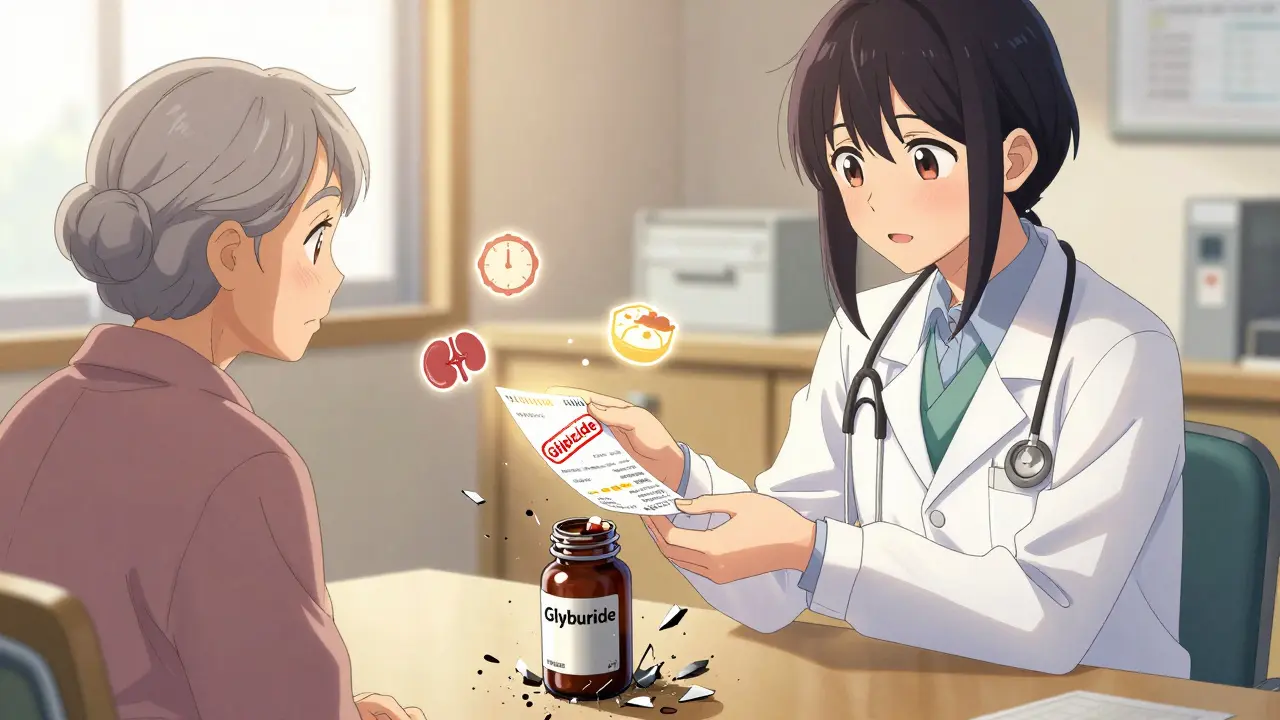
When you're managing type 2 diabetes and your doctor suggests a sulfonylurea, it's easy to think they're all the same. But they're not. Choosing the wrong one could mean frequent low blood sugar episodes, emergency room visits, or even hospitalization - especially if you're over 65, have kidney issues, or skip meals. The difference between glyburide and glipizide isn't just a name change. It's a matter of safety.
Why Sulfonylureas Still Matter
Sulfonylureas have been around since the 1950s, but they haven't disappeared. In 2022, nearly 1 in 7 adults with type 2 diabetes in the U.S. was still taking one. Why? Price. Generic glipizide costs about $4 a month. Compare that to GLP-1 agonists like Ozempic, which can run over $500. For people on Medicare, Medicaid, or without insurance, sulfonylureas are often the only realistic option. But here's the catch: they force your pancreas to pump out insulin whether your body needs it or not. That’s great for lowering blood sugar - HbA1c drops by 1.5% to 2% - but it also makes low blood sugar a real danger. And not all sulfonylureas are created equal when it comes to this risk.The Three Big Players: Glyburide, Glimepiride, Glipizide
In the U.S., the three most common sulfonylureas are glyburide (also called glibenclamide), glimepiride, and glipizide. Each works differently in your body, and those differences matter a lot.- Glyburide has a long half-life - about 10 hours - and its metabolites stick around for up to 24 hours. That means it keeps pushing insulin out all day and night, even when you’re asleep or haven’t eaten. In a 2017 study in Diabetes Care, glyburide caused nearly three times more severe hypoglycemia than shorter-acting options.
- Glimepiride is a middle ground. It lasts longer than glipizide but doesn’t linger as long as glyburide. Still, studies show it causes about twice as many low blood sugar events as glipizide.
- Glipizide has a short half-life of just 2-4 hours. It acts fast, wears off fast. That means it’s more likely to match your meal times. If you eat lunch at noon, glipizide helps you then. If you skip lunch? Less risk of a crash.
Hypoglycemia Risk: The Numbers Don’t Lie
Real-world data tells a clear story:| Sulfonylurea | Episodes per 1,000 Patient-Years |
|---|---|
| Glyburide | 12.1 |
| Glimepiride | 7.8 |
| Glipizide | 4.2 |
| Tolbutamide (rarely used) | 3.5 |

Who Should Avoid Glyburide Completely?
The American Geriatrics Society’s 2023 Beers Criteria is blunt: avoid glyburide in adults 65 and older. Why? Because older adults are more sensitive to insulin spikes, slower to recover from lows, and often have reduced kidney function. Glyburide’s active metabolites build up in kidneys that aren’t working well - turning a mild low into a life-threatening one. The FDA and European Medicines Agency have also flagged glyburide for older patients. In Europe, it’s restricted for use in people over 75. In the U.S., Medicare data from 2024 showed nearly 3 out of 10 patients over 80 were still getting glyburide - despite clear guidelines against it. If you’re over 65, have kidney disease, eat irregularly, or live alone, glipizide is the only sulfonylurea that should even be considered. Glimepiride is a second option - but only if glipizide isn’t available or doesn’t work.What About Kidney Function?
Your kidneys help clear these drugs. When they’re not working right, the drugs stick around longer - and so does the risk of low blood sugar.- Glyburide: Avoid if your eGFR is below 60 mL/min. It’s not just risky - it’s dangerous.
- Glimepiride: Use with caution if eGFR is below 30. Dose reduction needed.
- Glipizide: Can be used safely until eGFR drops below 30. No dose adjustment needed until then.
How to Use Sulfonylureas Safely
If you’re on a sulfonylurea, here’s how to stay safe:- Start low, go slow. Glipizide should begin at 2.5 mg, not 5 mg. Glyburide? Start at 1.25 mg if it’s even prescribed.
- Match doses to meals. Glipizide works best if taken 30 minutes before breakfast or dinner. If you skip a meal, skip the dose.
- Know the signs. Sweating, shaking, dizziness, hunger - these are early warnings. Don’t wait for confusion or passing out.
- Use the 15-15 rule. If your blood sugar is below 70, take 15 grams of fast-acting carbs (4 glucose tablets, ½ cup juice, 1 tablespoon sugar). Wait 15 minutes. Check again. Repeat if needed.
- Alert your family. Low blood sugar can turn dangerous fast. Make sure someone you live with knows how to give you glucagon or call 911.
I switched from glyburide to glipizide last year after my grandma had a bad episode. She hasn't had a single low since. I just wish more doctors knew this.
It's not about cost-it's about not ending up in the ER at 3 a.m.
OH MY GOSH. I JUST READ THIS AND I’M CRYING. MY DAD WAS ON GLYBURIDE FOR 8 YEARS AND HAD THREE HOSPITALIZATIONS. THEY NEVER TOLD US WHY. THIS POST IS A LIFESAVER. I’M PRINTING THIS AND TAKING IT TO HIS DOCTOR TOMORROW. THANK YOU. 🙏💔
Let’s be real-glyburide is a 1970s relic being prescribed by doctors who still think ‘generic’ means ‘safe.’
Meanwhile, glipizide is the elegant, efficient cousin who shows up on time, does the job, and leaves before the party gets messy.
And yet, I’ve seen endocrinologists write glyburide prescriptions like it’s a loyalty card. Do they even read the Beers Criteria? Or do they just copy-paste from the 2005 formulary?
It’s not ignorance-it’s institutional inertia wrapped in a white coat. And people are dying because of it.
Glimepiride? Still too long-acting. Glipizide is the only sulfonylurea that respects circadian rhythm. If your doctor won’t prescribe it, fire them.
Also, ‘cost-effective’ doesn’t mean ‘costs less now but bankrupts you later.’
One ER visit = 100 months of glipizide. Math isn’t hard. But apparently, some MDs still need a calculator.
Y’all need to stop treating diabetes like a spreadsheet. It’s not just numbers-it’s someone’s ability to drive, sleep, or hold their grandkid without shaking.
Glyburide is the diabetes equivalent of giving a toddler a chainsaw and saying ‘be careful.’
Glipizide? That’s the butter knife. It’s not glamorous, but it won’t get anyone hurt.
And if your doc says ‘it’s cheaper’-ask them to pay for your funeral if you OD on insulin from their prescription.
Also, why is glimepiride even on the table? It’s just glyburide in a nicer suit.
Canada’s been warning about glyburide since 2010. We don’t even prescribe it to seniors anymore. Meanwhile, the U.S. is still treating elderly patients like guinea pigs.
What’s the problem? Pharma reps. They still push glyburide because it’s dirt cheap and no one checks if it’s appropriate.
And don’t get me started on how American doctors ignore kidney function like it’s a suggestion, not a warning label.
We’re not ‘saving money’-we’re just outsourcing the cost to emergency rooms and family trauma.
Glipizide: 2.5 mg. Start low. Take before meals. Skip if you skip meals.
Glyburide: Avoid. Period.
Beers Criteria: Non-negotiable.
Kidney function: Always check.
That’s it.
That’s the entire clinical guideline.
Why is this so hard to follow?
I appreciate the depth of this post. Really well-researched.
Though, I did notice a typo in the table-'Episodes per 1,000 Patient-Years' is repeated twice.
Also, 'eGFR is below 30' should probably say 'eGFR is less than 30 mL/min/1.73m²' for precision.
Other than that, this is exactly what patients need to see.
My mom’s on glipizide now. She’s had zero lows in 11 months.
Thank you for the clarity.
It’s fascinating how medicine continues to prioritize cost over clinical evidence. This post reads like a manifesto from the future-where rational prescribing is the norm, not the exception.
Yet, here we are, in 2025, debating whether to give a 78-year-old with a creatinine of 1.8 a 5mg dose of glyburide.
How is this still a conversation?
Perhaps we need a new medical specialty: ‘Diabetes Safety Officer.’
Someone whose sole job is to prevent this kind of negligence.
Until then, patients must be their own advocates.
And thank goodness for Reddit.
so many people die from this 😭 i live in south africa and here they give glyburide to everyone like its water 🤦♀️ no one checks kidneys no one cares 😔
glipizide is the only way 🤞💛
For anyone reading this and thinking, ‘But my doctor said it’s fine’-ask them this: ‘If this were your mother, would you still prescribe it?’
That’s the test.
Glipizide isn’t just safer-it’s smarter. It doesn’t outstay its welcome.
And if you’re on glimepiride and still getting lows? Ask about switching.
No one should be living in fear of their own medication.
You deserve better than a drug that was designed before your parents were born.
glipizide is just a placebo for people who can't afford real medicine
you think this is safe? wait till you see the long term effects
everyone knows sulfonylureas are outdated
GLP-1 is the future
why are you still talking about this
you're just delaying the inevitable
Why are we even discussing this? In Nigeria we don’t have access to glipizide anyway
glyburide is all we get
and people still live
you Americans act like you invented diabetes
stop lecturing
we manage with what we have
okay so i just read this and i think my dad is gonna die??
he’s on glyburide and skips meals all the time and his kidneys are ‘kinda bad’ and he’s 79 and i’m panicking
why didn’t anyone tell me this sooner??
my mom says ‘it’s just a pill’ but now i’m scared to leave the house
can someone tell me if i’m overreacting??
also i think my doctor is lying to me
HELP
People who still prescribe glyburide to seniors are morally irresponsible.
It’s not a mistake. It’s negligence.
And if you’re one of those doctors reading this, you know what you’re doing.
You’re choosing convenience over lives.
And you’re not fooling anyone.
Not even yourself.
I’ve been a diabetes educator for 18 years, and I’ve seen so many patients suffer because of glyburide. I’ve held hands during hypoglycemic episodes. I’ve sat with families after ER visits. I’ve watched grandparents forget their own names because their brain was starved of glucose.
Glipizide isn’t just ‘better’-it’s the only ethical choice among sulfonylureas. Glimepiride? Still too risky for elderly or renal-impaired patients.
And yes, I know GLP-1 agonists are the gold standard. But for millions of people, they’re unaffordable. That doesn’t mean we give up on safe options. It means we fight harder for glipizide.
Start at 2.5 mg. Take it before meals. Skip if you skip meals. Monitor. Educate. Empower.
This isn’t just medicine. It’s dignity.
And if your doctor won’t listen? Bring this post. Print it. Highlight it. Show them the numbers.
Because someone’s life depends on it.
And you? You owe them that much.