
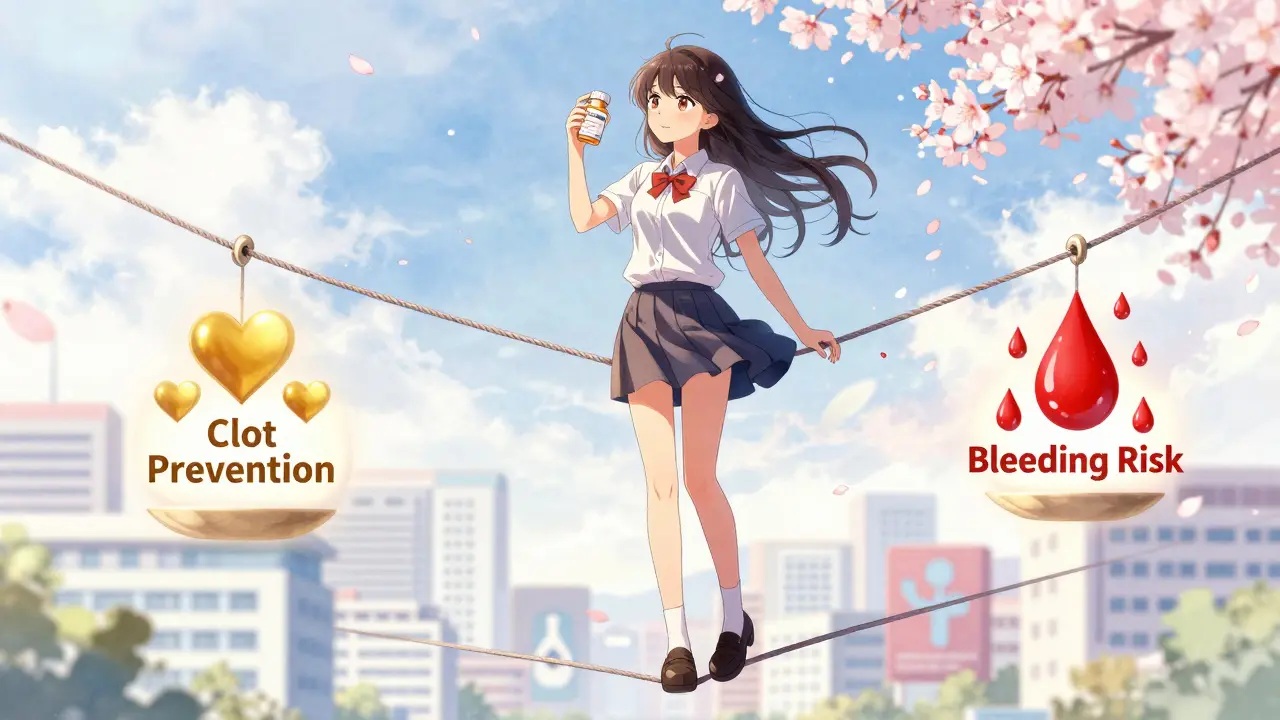
When you're on anticoagulants, the goal isn't just to stop clots-it's to stop clots without causing a bleed. It's a tightrope walk. One wrong dose, one missed kidney test, one interaction with ibuprofen, and you could end up in the ER with internal bleeding. This isn't theoretical. Every year, 1 in 50 people on blood thinners ends up hospitalized because of a bleed. And it’s not just the elderly. Even younger patients with atrial fibrillation or a history of deep vein thrombosis are at risk if the balance isn’t managed right.
Why Blood Thinners Are Necessary-and Dangerous
Anticoagulants, or blood thinners, don’t actually thin your blood. They slow down the clotting process. That’s critical if you have atrial fibrillation, a mechanical heart valve, or a history of pulmonary embolism. Without them, clots can form in your heart or veins and travel to your brain, lungs, or heart, causing strokes, heart attacks, or sudden death. But here’s the catch: the same mechanism that stops dangerous clots can also cause dangerous bleeds. A cut that stops quickly in a healthy person might keep oozing in someone on warfarin. A fall that results in a bruise for most people could lead to a brain bleed for someone on a DOAC. The risk isn’t random. It’s predictable. People over 75 have two to three times the bleeding risk. Those with kidney problems? Double the risk. And if you’re taking aspirin or naproxen at the same time? Your bleeding risk jumps by 50 to 70%.Warfarin vs. DOACs: Which Is Safer?
There are two main families of anticoagulants: warfarin and the newer direct oral anticoagulants (DOACs)-apixaban, rivaroxaban, dabigatran, and edoxaban. Warfarin has been around since the 1950s. It’s cheap-about $4 a month. But it’s finicky. You need regular blood tests (INR) to make sure your level is in the sweet spot: 2.0 to 3.0 for most people, or 2.5 to 3.5 if you have a mechanical mitral valve. If your INR is too low, you’re at risk for clots. Too high? You’re at risk for bleeding. Studies show that if your time in therapeutic range (TTR) drops below 70%, your bleeding risk goes up 15% for every 10% drop. DOACs changed the game. They don’t need routine blood tests. Dosing is fixed. No food restrictions. For most people, they’re safer. Clinical trials show DOACs reduce major bleeding by 19-20% compared to warfarin. Apixaban, in particular, cuts bleeding risk by 31%. But DOACs aren’t perfect. They rely on your kidneys. If your creatinine clearance (CrCl) drops below 25 mL/min, apixaban needs a lower dose. Rivaroxaban needs adjustment if CrCl is below 50 mL/min. If you skip kidney checks, you’re overdosing. And unlike warfarin, there’s no simple reversal agent for all DOACs-though we do have specific antidotes now.Reversal Agents: When Things Go Wrong
If a patient on warfarin starts bleeding heavily, doctors reach for four-factor prothrombin complex concentrate (4f-PCC). It fixes the INR in 15 minutes. Fresh frozen plasma? It takes hours to thaw and doesn’t work as fast. Vitamin K helps, but it takes days to fully reverse the effect-too slow for emergencies. For dabigatran, there’s idarucizumab. It’s a specific antidote. Give 5 grams IV, and the drug’s effect is neutralized within minutes. For apixaban, rivaroxaban, and edoxaban, andexanet alfa is the answer. But here’s the problem: it costs about $13,000 per dose. Not every hospital stocks it. And it’s not always available after hours. Heparin? Protamine can reverse it-but only unfractionated heparin. Low molecular weight heparins like enoxaparin? Protamine only reverses about 60% of the effect. That’s why we avoid heparin in patients with a history of heparin-induced thrombocytopenia (HIT), which happens in up to 5% of users.
Who Shouldn’t Be on Anticoagulants?
Not everyone needs them. And some people shouldn’t get them at all. If you’ve had a major bleed in the past six months, restarting anticoagulation is risky. But if you’re at high risk for another clot-say, you have atrial fibrillation with a CHA₂DS₂-VASc score of 5-you’ll likely need to restart within days, once the bleeding is controlled. The American College of Cardiology says: don’t stop unless the bleeding risk clearly outweighs the clotting risk. Patients with uncontrolled high blood pressure? Avoid anticoagulants until their BP is stable. A systolic pressure over 160 mmHg triples the risk of brain bleeds. Those with severe liver disease? Their clotting factors are already messed up. Adding anticoagulants can push them over the edge. And don’t forget drug interactions. Fluconazole, amiodarone, and even some antibiotics can boost warfarin levels. NSAIDs like ibuprofen and naproxen are dangerous with any anticoagulant. Acetaminophen is safer-but even that can raise INR if taken in high doses over time.Practical Steps to Prevent Bleeding
You don’t need a PhD to stay safe on anticoagulants. Just follow these steps:- Know your kidney function. Get your CrCl checked at least once a year. More often if you’re over 75 or have diabetes.
- Never skip INR checks if you’re on warfarin. Set phone reminders. If you miss one, call your clinic immediately.
- Avoid NSAIDs. Use acetaminophen for pain. If you need something stronger, talk to your doctor about alternatives.
- Use a soft-bristled toothbrush. Bleeding gums are common. Floss gently.
- Wear medical alert jewelry. If you collapse, paramedics need to know you’re on a blood thinner.
- Don’t stop cold turkey. Stopping anticoagulants suddenly increases clot risk. Always consult your doctor.
- Watch for signs of bleeding. Unexplained bruising, blood in urine or stool, severe headaches, dizziness, or vomiting blood? Go to the ER. Don’t wait.

The Future: Better Tools, Fewer Bleeds
The next big thing? Universal reversal agents. Ciraparantag is in late-stage trials. If it works, it could reverse all major anticoagulants with one injection. That’s huge. Point-of-care tests for DOACs are also coming. Right now, we can’t quickly check if someone has too much apixaban in their system. New devices may soon give us a reading in minutes-like an INR machine for DOACs. Early modeling suggests this could reduce bleeding events by 15-20%. And then there’s personalized dosing. Genetic testing for warfarin sensitivity (CYP2C9 and VKORC1 genes) is available but not widely used. In the future, we may tailor doses based on genetics, weight, age, and kidney function-all at once.Bottom Line: Safety Is a Team Effort
Anticoagulants save lives. But they kill too, if not handled right. The key isn’t choosing the best drug-it’s choosing the right drug for the right person, at the right dose, with the right monitoring. If you’re on a blood thinner, you’re not alone. But you’re also not powerless. Know your numbers. Ask questions. Speak up if you’re bruising easily or feeling off. Your doctor can’t help if you don’t tell them what’s happening. The goal isn’t to avoid anticoagulants. It’s to use them safely. And that starts with awareness, not fear.Can I take ibuprofen while on warfarin or a DOAC?
No. Ibuprofen and other NSAIDs significantly increase your risk of stomach and brain bleeds when taken with any anticoagulant. Use acetaminophen (Tylenol) instead for pain or fever. If you need stronger pain relief, ask your doctor about alternatives like gabapentin or low-dose opioids-never self-prescribe NSAIDs.
How often should I get my blood tested if I’m on a DOAC?
Routine blood tests aren’t needed for DOACs like apixaban or rivaroxaban. But your kidney function must be checked at least once a year-and every 3 to 6 months if you’re over 75, have diabetes, or have known kidney disease. A simple blood test for creatinine and estimated glomerular filtration rate (eGFR) is all it takes.
What should I do if I miss a dose of my anticoagulant?
If you miss a dose of a DOAC, take it as soon as you remember-if it’s within 6 hours of your usual time. If it’s been longer, skip the missed dose and take your next one at the regular time. Never double up. For warfarin, skip the missed dose and resume your regular schedule the next day. Always call your doctor if you miss more than one dose or are unsure.
Are there natural alternatives to anticoagulants?
No. Supplements like garlic, ginger, ginkgo, or fish oil may have mild blood-thinning effects, but they are not reliable or safe substitutes for prescribed anticoagulants. Relying on them can lead to deadly clots. Never stop your medication to try a natural remedy without talking to your doctor first.
Can I still have surgery or a dental procedure while on anticoagulants?
Yes, but only with careful planning. Most minor procedures-including dental cleanings and extractions-can be done safely without stopping your anticoagulant. For major surgery, your doctor will weigh your clotting risk against bleeding risk. Sometimes, they’ll temporarily switch you to heparin injections or pause your medication for a short time. Never stop your anticoagulant on your own.
Man, I’ve been on apixaban for AFib for three years now. The scariest part wasn’t the meds-it was realizing how many people just wing it. I set phone alerts for my kidney labs, use Tylenol instead of Advil, and wear my medical alert bracelet even to bed. It’s not glamorous, but I’m still here. Small stuff adds up.
Let’s be honest: this entire narrative is industry-sponsored propaganda. DOACs are expensive, untested long-term, and designed to replace warfarin-not because they’re safer, but because Big Pharma can charge $400/month for them. The ‘19% reduction in bleeding’? Sponsored trials. The real data? It’s buried in the fine print. And don’t get me started on reversal agents-$13,000 for a shot? That’s not medicine, that’s extortion.
okay so i just missed my dose of rivaroxaban like 3 days ago and now i have this weird bruise on my thigh and i think im bleeding internally?? like i dont know if its normal or not?? my dr is on vacay and i cant reach anyone and im scared to go to the er because what if they just think im crazy??
There’s something deeply human about how we treat anticoagulants-as if they’re either a miracle cure or a ticking time bomb. But they’re neither. They’re tools. And like any tool, their danger lies not in the tool itself, but in how we misunderstand its purpose. The real tragedy isn’t the bleed-it’s the patient who stops taking their med because they were never taught *why* it matters. Education isn’t an add-on. It’s the foundation.
According to the CDC, anticoagulant-related ER visits have increased 200% since 2010. Coincidence? Or is this the result of aggressive marketing pushing high-risk patients onto DOACs without proper screening? The FDA has received over 12,000 adverse event reports for DOACs since 2015. Yet, we’re told they’re ‘safer.’ Safer for whom? The shareholders? Not the patient.
I’ve been a nurse for 18 years, and I’ve seen both sides. Warfarin patients who tracked their INRs religiously? Lived decades. DOAC patients who skipped kidney checks? Ended up in ICU with intracranial hemorrhage. The drug isn’t the problem. The system is. We don’t follow up. We don’t educate. We just write the script. And then we’re shocked when things go wrong.
It is imperative to underscore that the pharmacokinetic profiles of direct oral anticoagulants are heavily influenced by renal clearance, particularly in elderly populations. A creatinine clearance threshold of less than 30 mL/min necessitates dose modification for apixaban, as per the 2023 ACC/AHA guidelines. Furthermore, the absence of routine coagulation monitoring introduces a significant diagnostic blind spot in acute hemorrhagic scenarios. Consequently, point-of-care assays for DOAC concentration are not merely advantageous-they are clinically indispensable.
My dad’s on warfarin. He’s 82. We got him a smart pill dispenser with alarms, switched him to Tylenol, and started doing monthly INR checks at the pharmacy. He’s been fine for two years. It’s not magic. It’s just showing up. You don’t need to be a genius. You just need to be consistent.
For those asking about natural alternatives: I understand the desire to avoid pharmaceuticals. But let me be clear-ginger, garlic, and fish oil do not provide anticoagulant efficacy comparable to even the lowest dose of warfarin. In fact, studies show they lack therapeutic predictability and carry no validated reversal protocols. Choosing them over prescribed therapy is not holistic-it’s hazardous. Your doctor isn’t pushing pills for profit. They’re trying to prevent a stroke that could leave you paralyzed. Please, don’t gamble with your brain.
so i just found out my cousin died from a brain bleed on rivaroxaban and no one told her she needed kidney tests?? like wtf?? this is insane. my mom is on it too and i just made her book a blood test. please someone tell me she’s gonna be ok??
It’s easy to focus on the risks, but let’s not forget the lives saved. My brother had a pulmonary embolism at 34. Without anticoagulants, he wouldn’t be here to see his daughter graduate. The fear is real-but so is the hope. Stay informed. Stay careful. But don’t let fear silence your life.
They’re lying about the reversal agents. The real reason they don’t stock andexanet is because they want you to die so they can sell more drugs next time. And the kidney tests? They’re just a way to make you come back for more bills. You think they care if you live? They care about your insurance. Wake up.