
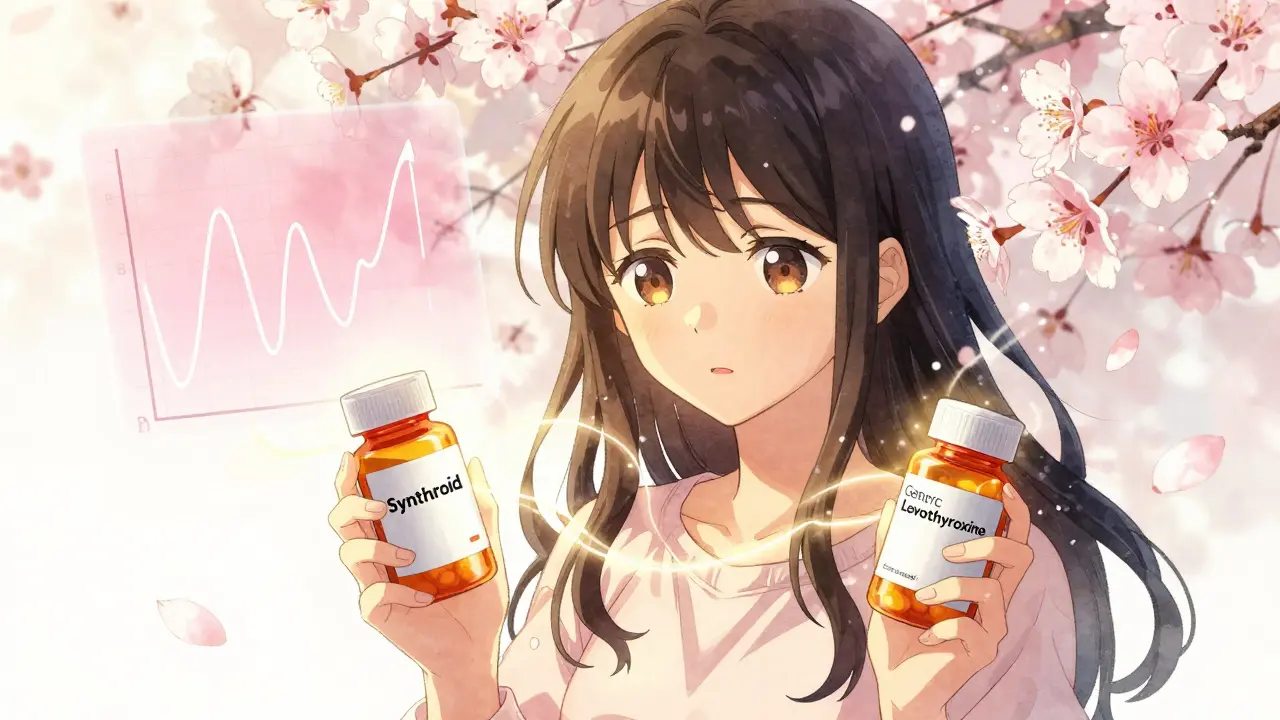
When you pick up a prescription, you might not think twice about whether it’s the brand-name drug or the cheaper generic version. After all, the FDA says they’re the same. But for some people, switching to a generic isn’t just a cost-saving move-it’s a health risk. You might feel more tired, get headaches, or notice your condition suddenly worsening, even though the pill looks almost identical. Why does this happen? And why do some people react badly while others don’t notice a difference at all?
What Makes a Generic Drug ‘The Same’?
Generic drugs are required by law to contain the same active ingredient as the brand-name version, in the same strength and form. That means if you take a generic version of levothyroxine, it has the same thyroid hormone as Synthroid. The FDA calls this bioequivalence. To get approved, a generic must deliver between 80% and 125% of the active drug into your bloodstream compared to the brand. That’s a wide range-nearly a 50% swing. Two different generics of the same drug can differ by up to 45% in how quickly they’re absorbed, and both can still be considered ‘equivalent’ under FDA rules.
This doesn’t matter much for most medications. For drugs like metformin, used for diabetes, the body can handle these small variations without issue. But for others, even a tiny shift can cause real problems.
When Small Changes Have Big Consequences
Some medications have what’s called a narrow therapeutic index (NTI). That means the difference between a dose that works and one that’s too high-or too low-is very small. A few percentage points can mean the difference between control and crisis.
Drugs like levothyroxine (for thyroid), warfarin (a blood thinner), phenytoin (for seizures), carbamazepine (another seizure med), and digoxin (for heart rhythm) fall into this category. For these, the FDA’s 80-125% bioequivalence range is too loose. A 10% drop in absorption might mean your thyroid levels go off track. A 15% spike in warfarin could put you at risk for bleeding. A 5% dip might trigger a seizure.
Studies back this up. One 2019 study in JAMA Internal Medicine looked at over 2,000 people who switched from brand-name levothyroxine to generics. Nearly 24% had thyroid hormone levels move outside the safe range within six months. Only 14% of those who stayed on the brand did. Another study found that 17% of epilepsy patients had breakthrough seizures after switching to generic lamotrigine.
It’s Not Just the Active Ingredient
Here’s the part most people don’t realize: the active ingredient is only a small part of the pill. Up to 99% of a tablet’s weight comes from inactive ingredients-fillers, dyes, binders, coatings, preservatives. These don’t treat your condition, but they affect how the drug is absorbed, how fast it dissolves, and whether your body reacts to it.
One patient might have a reaction to sodium metabisulfite, a preservative used in some generics. That chemical triggers asthma attacks in 5-10% of asthmatics. Another might get headaches because the coating on their new generic version dissolves too slowly, changing how quickly the drug enters the bloodstream. A third might notice mood changes after switching to a generic bupropion because of a different filler affecting absorption rates.
Patients on Reddit and Drugs.com report consistent patterns: 38% of those who switched to generic levothyroxine say their symptoms got worse. Over 60% of users who switched generic bupropion report increased anxiety or headaches. These aren’t anecdotes-they’re patterns seen across thousands of reports.

Why Do Some People React and Others Don’t?
Not everyone reacts the same way. Why? Genetics, metabolism, age, other medications, and even gut health play a role. Some people have slower liver enzymes that process drugs differently. Others have sensitive digestive tracts that react to certain fillers. People with complex medication regimens-taking five or more pills a day-are especially vulnerable. One study found that 28% of these patients had adverse effects after switching between different generic manufacturers, compared to just 12% who stayed on one formulation.
It’s not about being ‘sensitive’ or ‘difficult.’ It’s about biology. Your body’s response to a drug isn’t just about the active ingredient. It’s about how your system interacts with every single component of the pill. Two people can take the same generic, but if one has a slower metabolism and the other has a more acidic stomach, their bodies will handle it differently.
What Doctors and Pharmacists Are Doing About It
Many healthcare providers now know this isn’t just theoretical. The American Thyroid Association recommends checking thyroid levels 6-8 weeks after any switch in levothyroxine. For warfarin, INR levels must be checked within 3-5 days of switching. Pharmacists at CVS and Walgreens now have protocols to block automatic substitution for NTI drugs unless the doctor specifically approves it.
Some pharmacies keep a log of which generic manufacturer a patient uses and stick with it. If you’ve been stable on a particular brand of generic, ask your pharmacist to keep prescribing that version. You’re not being picky-you’re being smart.
The FDA also now tracks which generics cause problems. In 2024, they released new draft guidance for 23 high-risk drug classes, pushing for tighter manufacturing standards. They’ve even approved an ‘authorized generic’ version of Synthroid-made by the same company as the brand, but sold under a generic label. It’s the same pill, just cheaper.

What You Can Do
If you’ve noticed changes after switching to a generic, don’t ignore them. Track your symptoms. Keep a simple log: date of switch, how you felt before and after, any new side effects. Bring this to your doctor. If you’re on levothyroxine, warfarin, or another NTI drug, ask for a blood test after any switch.
Ask your pharmacist for the inactive ingredients list. The FDA has a public database of all inactive ingredients in approved drugs. If you know you’re allergic to certain dyes or preservatives, you can check before accepting a substitution.
If your doctor agrees, ask for a prescription that says ‘Dispense as Written’ or ‘Do Not Substitute.’ This legally prevents the pharmacy from swapping your medication without approval.
And if you’re on a stable generic version-don’t switch unless you have to. Consistency matters. Your body adapts to the exact formulation, not just the active ingredient.
The Bigger Picture
Generics save the U.S. healthcare system over $370 billion a year. That’s huge. But that doesn’t mean every patient should be treated the same. For 96% of drugs, generics work just fine. But for the 4% with narrow therapeutic indexes, the stakes are higher. A small variation in absorption can mean hospitalization, seizures, or worse.
The system isn’t broken-it just needs better rules for the high-risk cases. New research shows pharmacogenomic testing can predict how someone will respond to a generic with over 80% accuracy. That could mean personalized substitution recommendations in the future: ‘This patient should stay on Formulation A because of their CYP2D6 gene variant.’
For now, the best defense is awareness. If you feel different after a switch, it’s not in your head. It’s biology. And you have the right to ask for stability, testing, and transparency.
Are generic medications always safe?
For most medications, yes. Generics are safe and effective for the vast majority of people. But for drugs with a narrow therapeutic index-like levothyroxine, warfarin, and phenytoin-even small differences in how the body absorbs the drug can lead to serious side effects. These cases are rare, but they’re real and well-documented.
Why do some people feel worse on generic drugs?
It’s often not the active ingredient that’s the issue-it’s the inactive ingredients. Fillers, dyes, coatings, and preservatives can affect how quickly the drug is absorbed or trigger allergic reactions. Some people’s bodies process these components differently, leading to symptoms like fatigue, headaches, or mood changes. Genetic differences in metabolism also play a role.
Can I ask my pharmacist to keep giving me the same generic brand?
Yes. You can ask your doctor to write ‘Dispense as Written’ or ‘Do Not Substitute’ on your prescription. This prevents the pharmacy from switching to a different generic manufacturer without your doctor’s approval. Many pharmacists will honor this request, especially for high-risk medications.
What should I do if I think my generic medication isn’t working?
Track your symptoms and when they started. Note any changes in energy, mood, sleep, or physical symptoms. Then schedule a check-up with your doctor. For medications like levothyroxine or warfarin, blood tests can show if your levels have shifted. Don’t assume it’s ‘all in your head’-documented cases show real biological differences in response.
Are there any generics that are safer than others?
Yes. Some manufacturers produce generics with more consistent manufacturing processes. The FDA’s ‘authorized generic’ versions-made by the original brand company but sold as generics-are often the most stable option. For example, the authorized generic of Synthroid is chemically identical to the brand. Ask your pharmacist if an authorized generic is available for your medication.
I switched to a generic levothyroxine last year and didn’t think twice until I started feeling like I’d been drugged with sleep syrup. No energy, brain fog, crying over commercials. Went back to my original brand and boom-back to normal. It’s not in my head. My body remembers the exact pill it was used to.
So let me get this straight-you’re saying the FDA’s entire generic approval system is a scam because some people feel weird? That’s it? No one’s ever had a placebo effect on thyroid meds? You’re blaming chemistry for human inconsistency.
Let’s be clear: the FDA’s 80-125% bioequivalence range is a regulatory loophole designed to protect pharmaceutical conglomerates, not patients. The same companies that make brand-name drugs also manufacture the generics under different labels. The inactive ingredients? Often sourced from the same overseas suppliers with zero oversight. This isn’t about biology-it’s about corporate capture of the drug supply chain. They profit whether you get Synthroid or the ‘generic’ made in the same factory under a different sticker.
And don’t get me started on authorized generics. They’re not ‘safer’-they’re just the same pill with a cheaper label. The system is rigged to keep you dependent on the illusion of choice while the margins stay fat. The real solution? Nationalize drug manufacturing. Or at least require full disclosure of all excipients on every pill bottle. But that would cost too much for the lobbyists.
Thank you for writing this. I’ve been on warfarin for 12 years and switched generics once-my INR spiked so high I almost bled out. I’ve never switched again. I keep the bottle from the original manufacturer and ask for it every time. It’s not picky, it’s survival. If you’ve ever felt off after a switch, you’re not crazy. You’re just paying attention.
Ah, the sacred tablet-the modern-day oracle. We have reduced the divine alchemy of healing to a chemical ballet choreographed by corporate chemists who care more about dissolution rates than soul resonance. The inactive ingredients? They are the silent choir singing in frequencies only your gut microbiome can hear. Your CYP2D6 variant? A cosmic signature written in DNA. To say ‘it’s just a pill’ is to deny the metaphysical architecture of your being. You are not a data point. You are a symphony of bioelectrical whispers, and the filler in your capsule? It’s the dissonant note that breaks the harmony.
I’ve been a pharmacist for 18 years and I’ve seen this over and over. People get switched to a new generic and think they’re going crazy. Nine times out of ten it’s just a different binder making the pill dissolve slower. But the real win? When you find the one that works and stick with it. Talk to your pharmacist. Keep a log. Don’t let the system make you feel like you’re overreacting. You’re not. You’re just doing what smart people do-paying attention.
If you’re on a narrow therapeutic index drug and you feel different after a switch-don’t wait. Go to your doctor. Get tested. Demand consistency. Your health is not a cost-saving experiment. You have every right to ask for the same formulation. Write ‘Do Not Substitute’ on your prescription. Most pharmacies will honor it. Don’t let anyone make you feel guilty for wanting to feel normal.
They’re putting microchips in the fillers. You think the FDA cares about your thyroid? They’re tracking your hormone levels to feed AI models for predictive healthcare. That’s why they allow the 45% swing-it’s not an accident. It’s a surveillance tool. Next thing you know, your pharmacy will auto-substitute based on your social credit score.
My mom’s on carbamazepine and switched generics last year. Seizures came back. We found out the new one had a different dye. She’s allergic to FD&C Red No. 40. Nobody told us. Now we check every label. It’s wild how no one talks about this stuff until it hits your family.
Interesting. In India, generics are the only option-and we don’t have this problem. Maybe it’s because we don’t over-medicate? Or maybe the Western obsession with ‘brand loyalty’ is just marketing? Your body adapts. You’re not fragile. Maybe stop treating pills like sacred relics?
How quaint. You assume the FDA is even remotely competent. The agency is staffed by ex-pharma executives who rotate in and out like a revolving door. The ‘authorized generic’ of Synthroid? A PR stunt. The same company owns both. The entire system is a performance art piece designed to make you believe you have agency while you’re being quietly herded into cost-efficient compliance. Your ‘awareness’ is the illusion they want you to have.
It is not a coincidence that the most vulnerable populations-elderly, low income, those on multiple meds-are the ones most likely to be switched to generics without warning. This is systemic neglect disguised as fiscal responsibility. The solution is not individual vigilance. It is policy change. Mandatory pre-switch testing for NTI drugs. Mandatory labeling of excipients. And yes, reimbursement parity so patients can choose brand when clinically indicated. This is not a fringe issue. It is a public health failure.
I used to think I was just depressed. Then I switched generics. My anxiety went nuclear. I couldn’t sleep. I started seeing shadows. I thought I was losing my mind. I went back to the original. Within three days, the shadows vanished. I cried. Not because I’m weak. Because I was gaslit for a year by doctors who said ‘it’s all in your head.’ It wasn’t. It was the coating.
Here’s the thing from my side of the world-generics save lives. In rural India, people can’t afford brand names. But I’ve seen patients on warfarin or epilepsy meds get stable on one generic and stay on it for years. The problem isn’t generics. It’s switching without monitoring. If your doctor doesn’t check levels after a switch, that’s the real issue. Don’t blame the pill. Blame the lack of follow-up.
It is incumbent upon the medical and pharmaceutical communities to acknowledge the documented biological variance in patient response to pharmaceutical formulations, irrespective of active ingredient equivalence. The current regulatory framework, while scientifically adequate for broad-spectrum therapeutics, demonstrates insufficient granularity for medications possessing a narrow therapeutic index. The imperative for individualized pharmaceutical management-particularly through the use of pharmacogenomic profiling and the preservation of consistent generic formulations-is not merely prudent, but ethically obligatory. Patient autonomy in therapeutic continuity must be institutionalized, not treated as an exception.