
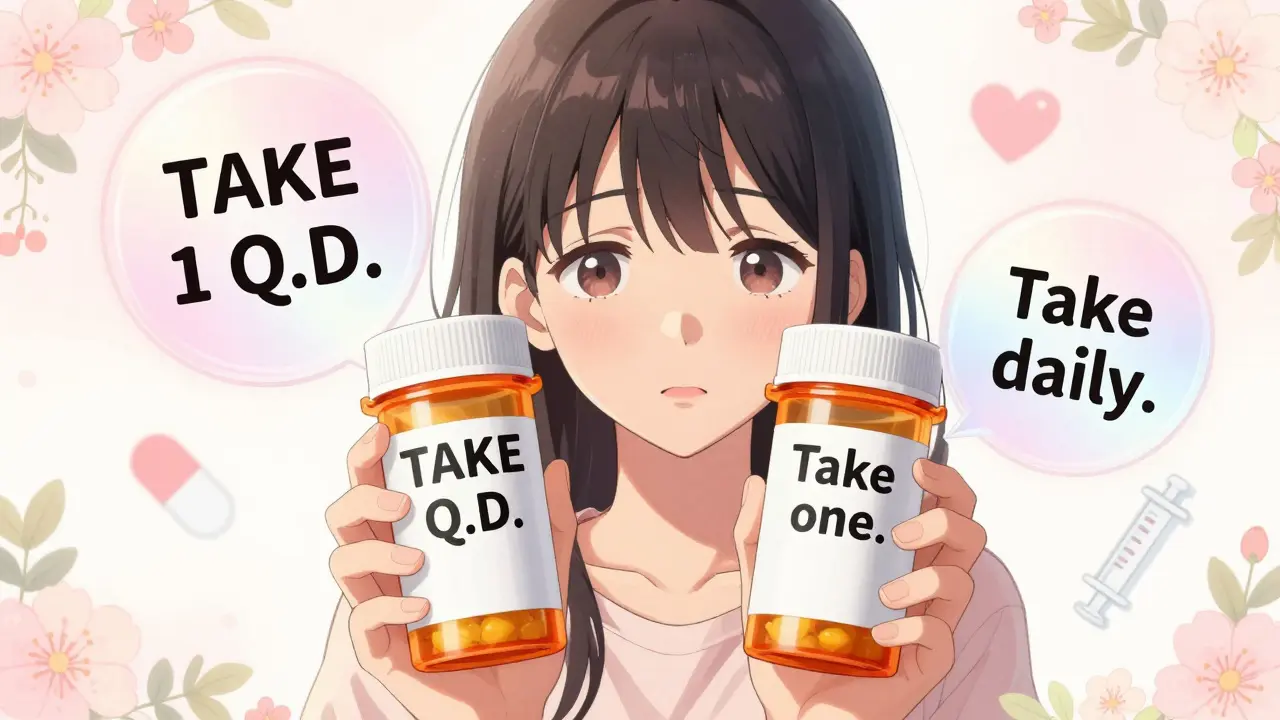
Have you ever noticed that your prescription label looks completely different from your spouse’s, even if you both take the same medicine? Or maybe you picked up a refill and couldn’t find the dosage instructions because the layout changed overnight? You’re not imagining it. Prescription labels across the U.S. vary wildly - and that’s not just a quirk of design. It’s a serious safety issue hiding in plain sight.
Why Do Prescription Labels Look So Different?
There’s no single federal rule that tells pharmacies exactly how to format a prescription label. The FDA sets rules for the professional drug information that doctors and pharmacists use - things like side effects, drug interactions, and clinical trial data. But when it comes to the little paper sticker you hold in your hand? That’s a patchwork of state laws, pharmacy systems, and voluntary guidelines. The U.S. Pharmacopeial Convention (USP) tried to fix this in 2012 with General Chapter <17>, a set of evidence-based standards designed to make labels easier to read. They recommended things like:- Using sentence case: "Take one tablet by mouth twice daily" instead of "TAKE ONE TABLET BY MOUTH TWICE DAILY"
- Using clean, non-condensed fonts like Arial or Helvetica
- Putting instructions in plain language: "For high blood pressure" instead of "For hypertension"
- Leaving enough space between lines - 1.5 spacing - so text doesn’t run together
- Black text on white background for maximum contrast
State Laws Create Chaos
Here’s where it gets messy. Even though USP <17> is the gold standard, states get to decide whether to enforce it. As of 2023, only 28 states have adopted any version of these standards - and only 15 have fully implemented them. Take Texas. Their rules require:- Pharmacy name, address, and phone number
- A unique prescription ID number in at least 10-point font
- Patient name and animal name (for pet meds)
- Dispensing date and pharmacist ID
Pharmacy Software Makes It Worse
There are about 12 major pharmacy management systems in use across the U.S. Each one formats labels differently. Even within the same chain - like CVS or Walgreens - a store using System A might print labels that look nothing like a store using System B. Pharmacy technicians report that switching systems during mergers or upgrades causes confusion. One 2022 survey found that 73% of techs had customers return because the label format changed between refills. A patient might have taken their blood thinner correctly for months - then suddenly, the label switched from "1 tablet twice a day" to "Take 1, 2x daily." They thought "2x" meant two tablets at once. That’s how errors happen.
The Real Cost: Medication Errors
This isn’t just annoying. It’s dangerous. A 2021 survey by the National Community Pharmacists Association found that 68% of patients struggled to understand their labels at least sometimes. Over 22% admitted to making a medication error because of confusing labeling. The Institute for Safe Medication Practices estimates that if every label followed USP <17> standards, medication errors could drop by 30-40%. Dr. Michael Cohen, a leading patient safety expert, says name confusion and unreadable labels are the #1 reason people take the wrong dose. One Reddit user shared how they took double their prescribed dose of a blood thinner because the refill label changed format. Another person didn’t realize their antibiotic was for a skin infection - not a sinus infection - because the purpose wasn’t listed. They took it for the wrong illness. Between 2019 and 2022, the Texas Pharmacists Association recorded 417 medication errors directly tied to label confusion - nearly 1 in 5 of all reported errors.Who’s Trying to Fix It?
Progress is slow, but it’s happening. CVS Health announced in April 2023 that it would roll out USP <17> standards to all 10,000+ of its pharmacies by December 2024. A pilot in 500 stores cut patient clarification calls by 33%. That’s a clear sign that standardization works. The Biden administration’s 2022 Patient Safety Action Plan set a goal of 90% state adoption of standardized labeling by 2026. The FDA also issued draft guidance in June 2023, hinting that federal rules might be coming. Meanwhile, the market is adapting. Medication adherence apps now scan your physical label and reformat it into a clean, consistent digital display. Smart pill dispensers use USP-style text to remind you when to take your pills. These tools aren’t replacing paper labels - they’re compensating for them.
What You Can Do Right Now
Until every label looks the same, here’s how to protect yourself:- Read every label - even if it’s a refill. Don’t assume it’s the same as last time.
- Ask for plain language. If it says "Take 1 q.d." - ask what that means. "q.d." isn’t common knowledge. "Once daily" is.
- Request a large-print or audio label. Many pharmacies offer these, but only 38% consistently provide large print. Ask anyway.
- Check the purpose. If it doesn’t say why you’re taking the medicine, ask. "For high blood pressure" is safer than just "Hydrochlorothiazide."
- Take a photo. Save a picture of your label. Compare it to future refills.
What’s Next?
The U.S. spends $29 billion a year on preventable medication errors. Inconsistent prescription labels contribute to 8-12% of those. That’s more than $2 billion in avoidable costs - not just in money, but in hospital visits, ER trips, and lives lost. The technology to fix this exists. The research proves it works. The patient demand is there. What’s missing is consistent enforcement. For now, the system is broken. But change is coming. And until it does, your best defense is knowing what to look for - and never trusting a label just because it looks familiar.Why don’t all pharmacies use the same label format?
There’s no federal law requiring a single format. The FDA regulates professional drug information, but not the patient-facing label. Instead, each state’s board of pharmacy sets its own rules. Some states follow the USP <17> standards; others don’t. Plus, pharmacies use different software systems that format labels differently, even within the same chain.
What’s the USP <17> standard?
USP General Chapter <17> is a set of evidence-based guidelines created to make prescription labels easier to read and understand. It recommends using sentence case, sans-serif fonts like Arial, 1.5 line spacing, black text on white background, and plain language (e.g., "for high blood pressure" instead of "for hypertension"). It also advises including the reason for the medication and making labels accessible to people with visual impairments or limited English.
Can I ask for a different label format?
Yes. Under accessibility guidelines from the Access Board, pharmacies are required to offer alternative formats if you have trouble reading the standard label. This includes large print, braille, audio labels, or digital versions. You don’t need a doctor’s note - just ask. Many pharmacies don’t proactively offer these, so you’ll need to request them.
Do prescription labels have to include why I’m taking the medicine?
No, not in most states. The USP <17> standard strongly recommends including the purpose (e.g., "for diabetes" or "for anxiety"), but only a few states require it. If your label doesn’t say why you’re taking the drug, ask your pharmacist. Knowing the reason helps you spot errors - like if you’re given the wrong medicine but the label still says "for high blood pressure."
Are digital apps better than paper labels?
For many people, yes. Apps that scan your prescription label can convert confusing text into a clean, consistent display with reminders, dosage history, and plain-language explanations. They’re not a replacement - paper labels still matter - but they’re a powerful safety net, especially if your physical label changes format between refills.
I never thought about this until my mom moved from Texas to Florida and her blood pressure med label looked totally different. She took the wrong dose for a week because 'take one'变成了'1 tab qd'. Scary stuff. I just hope they fix this soon. 🤞
Honestly? It’s 2024 and we still don’t have federal standards for something this critical? 🤦♀️ Only in America. We regulate the color of cereal boxes but let people die because a pharmacy’s software decided to use Comic Sans for dosage instructions. USP standards have been around for over a decade. Why is this still a debate? #FirstWorldProblems
Oh wow. So the solution to medication errors is... more paperwork? 🤭 Let me guess - next they’ll mandate that pharmacists sing the instructions in a Broadway musical so we don’t miss the 'take with food' part. This is like trying to fix a leaking roof by adding more shingles. The real fix? One standard. One format. One system. Stop the chaos. I’m tired of being my own pharmacist.
Interesting. In India, most labels are handwritten and we still manage. But I see your point - clarity matters more than tradition. Maybe the real issue isn’t the format but the lack of training for staff to explain it. A good pharmacist can make any label work.
This is why people die. No more excuses.
While I appreciate the intent behind standardizing label formats, I must emphasize the importance of preserving autonomy for local pharmacy practices. Each state’s regulatory framework reflects its unique demographic and linguistic needs. A one-size-fits-all federal mandate may inadvertently compromise accessibility for non-English speakers or rural populations who rely on localized contextual cues. We must balance uniformity with cultural competence.
The USP standards are a paradigm shift in pharmacovigilance. The absence of standardized nomenclature and typographic hierarchy constitutes a systemic failure in health literacy infrastructure. I’m particularly concerned about the cognitive load imposed on geriatric populations with low visual acuity - the current state of label design is a violation of accessibility jurisprudence. 🚨
I’ve worked in pharmacy for 18 years. The software differences between systems are insane. One system uses 8pt font for the patient name. Another puts the refill date in bold. I’ve seen patients cry because they couldn’t read their own label. The fact that CVS is moving to USP standards? That’s huge. Hope the rest follow. 🙏
I used to work at a pharmacy that switched systems mid-year. We had a guy come in every week for his blood thinner because the label changed from '1 tablet twice daily' to '1 tab 2x a day' - he thought 2x meant two pills. He ended up in the ER. This isn’t a 'quirk.' It’s a ticking time bomb. Please, if you’re reading this - always double-check. Even if it’s the same med.
I’m so glad you mentioned taking a photo. I started doing that after my grandma mixed up her insulin and metformin because the labels looked identical. One had 'for diabetes' and the other didn’t. She’s fine now, but I wish we’d known sooner. Small things save lives.
I never realized how much I rely on the position of the instructions until I got a new label and couldn’t find the dose. Now I always read the whole thing. Even if it’s a refill.