
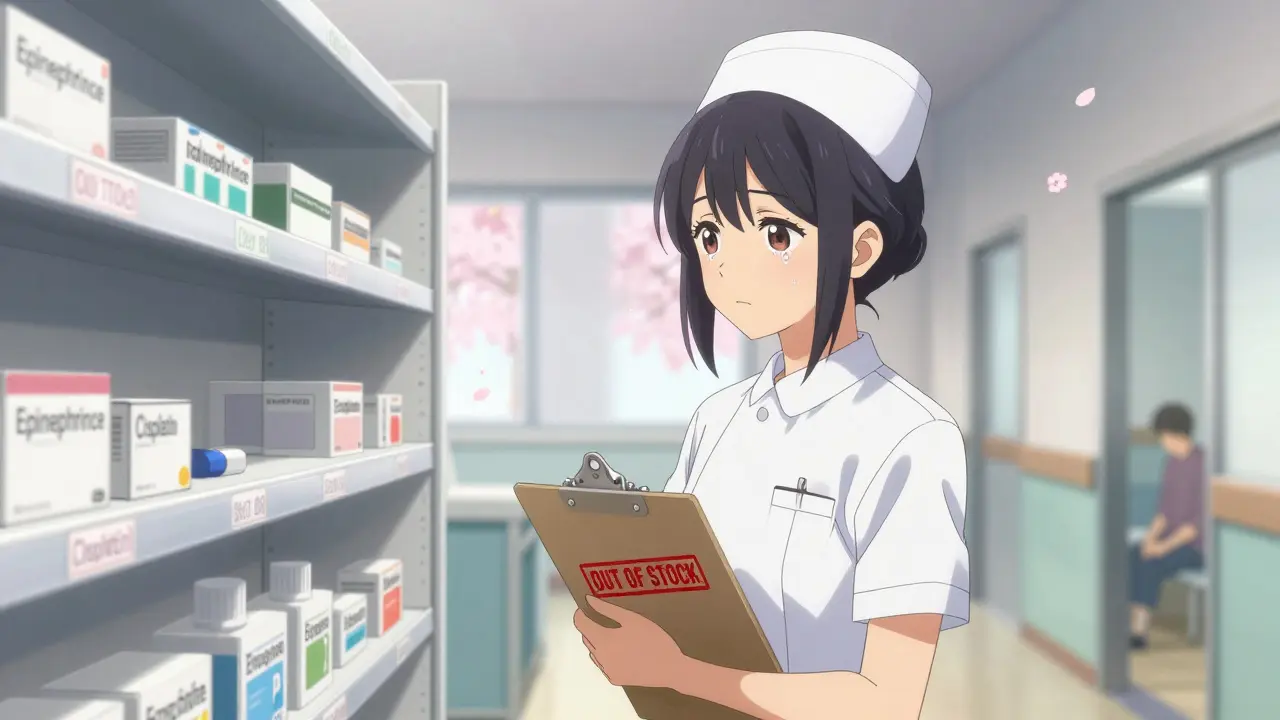
When you fill a prescription for a generic drug, you probably assume it’ll be there when you need it. But for millions of Americans, that’s not a guarantee. As of April 2025, there were 270 active drug shortages in the U.S., according to the American Society of Health-System Pharmacists. And nearly all of them involve generic medications - the cheap, life-saving pills and injections that make up 90% of prescriptions but just 13% of drug spending. This isn’t a temporary glitch. It’s a systemic failure rooted in how these drugs are made, where they’re made, and how little money manufacturers make from them.
Why Generic Drugs Are the First to Go Missing
Generic drugs don’t have the same financial cushion as brand-name drugs. A single dose of a generic antibiotic might cost less than $1. A chemotherapy injection? Maybe $3. When profit margins are this thin, manufacturers don’t have room to absorb disruptions. If a factory in India gets shut down by an FDA inspection, or a typhoon hits a plant in China, there’s no money left over to reroute production or stockpile extra inventory. Brand-name drugmakers, by contrast, often have multiple factories, global supply chains, and enough profit to keep backup stock on hand. Generic manufacturers? They’re operating on razor-thin margins - and it’s showing.One of the most dangerous shortages involves sterile injectables: IV fluids, antibiotics, chemotherapy drugs, and emergency medications like epinephrine. These aren’t pills you swallow. They’re injected directly into veins, often in hospitals or cancer clinics. Making them requires clean rooms, specialized equipment, and weeks of testing. One tornado in 2023 took out a Pfizer facility and halted production of 15 critical medications. Another time, quality issues at an Indian plant shut down cisplatin - a key chemotherapy drug - nationwide. No backups. No alternatives. Just patients waiting.
The Global Bottleneck: China and India
Almost 40% of the world’s active pharmaceutical ingredients (APIs) come from China. India handles much of the final manufacturing. Together, they supply the raw materials and finished products for the majority of U.S. generics. But this isn’t a diversified network - it’s a single, fragile pipeline. If one factory in Shanghai stops producing, or if political tensions disrupt shipping from Mumbai, the ripple effect hits hospitals in Ohio, Texas, and Maine.The FDA has known about this risk for years. Reports show Chinese manufacturers have been hesitant to submit proper documentation for their facilities - not because they’re dishonest, but because they fear inspections might expose poor practices. Meanwhile, domestic inspections in the U.S. have been cut back. The result? A dangerous gap in oversight. A drug can be approved, shipped across the globe, and end up in a hospital without ever being properly checked.
Consolidation Creates Single Points of Failure
For many older generic drugs - like the ones used in ICUs or for kidney disease - there are only one or two manufacturers left. Why? Because when the price drops below $2 per dose, smaller companies can’t compete. They exit the market. The few remaining players then dominate. It sounds efficient. It’s not. It’s a recipe for disaster.Take the case of doxycycline, a common antibiotic. In 2024, a single manufacturer’s production halt caused a nationwide shortage. Hospitals rationed doses. Patients with Lyme disease or pneumonia faced delays. The FDA later confirmed: only two companies were making it. When one failed, the other couldn’t scale up fast enough. No backup. No redundancy. Just a broken system.
The Hidden Cost: Healthcare Workers on the Frontlines
Behind every shortage is a nurse, pharmacist, or doctor scrambling to find a solution. One hospital pharmacist in Ohio told Pharmacy Times they spend 20-30% of their workweek just managing shortages. That’s not time spent on patient care. That’s time spent calling distributors, compounding drugs from scratch, or switching patients to less effective alternatives.Doctors report having to choose between two risky options: use a substitute that might not work as well, or delay treatment. A cancer patient might wait weeks for a chemotherapy drug. A newborn in the NICU might get a weaker IV fluid. These aren’t theoretical risks. They’re daily realities in hospitals across the country.
The American College of Physicians found that shortages hit internal medicine and specialty care the hardest. Patients with chronic conditions, autoimmune diseases, or infections are the most vulnerable. And there’s no easy fix. You can’t just “order more” when the entire global supply chain is strained.
Why Tariffs Won’t Solve This
Some lawmakers have pushed for tariffs on imported drugs - 50%, even 200% - to force production back to the U.S. But experts warn this could make things worse. Higher tariffs mean higher costs. Higher costs mean manufacturers will raise prices or quit entirely. And if those imported APIs become too expensive, hospitals will face even bigger shortages.The CSIS analysis points out that the U.S. produces less than 30% of its own APIs. Rebuilding that capacity would take 5-7 years and $20-30 billion. Even then, it wouldn’t cover all drugs. The infrastructure doesn’t exist. The skilled workers aren’t trained. The regulatory process is slow. Tariffs might sound like a patriotic solution, but they ignore the economic reality: generics are cheap because they’re made cheaply. Make them expensive, and you make them unavailable.
What’s Being Done - and Why It’s Not Enough
There are proposals. The Strategic National Stockpile could be expanded to hold six months’ worth of critical generics. Bills like S.2062 suggest mandatory reserves. Others call for public-private partnerships to fund domestic production. Transparency rules are being discussed - like labeling where APIs come from.But implementation is stuck. Federal agencies like HHS have lost staff and funding. Regulatory bodies are overwhelmed. And manufacturers? They’re stuck in a cycle: low prices → low profits → no investment → more shortages → even lower prices. It’s a trap.
The University of Wisconsin School of Pharmacy says the only real solution is to increase the number of manufacturers. More players mean more competition, more redundancy, more resilience. But how do you get companies to enter a market where the profit per pill is less than a coffee?
The Path Forward: A New Economic Model
The system isn’t broken because of bad actors. It’s broken because the economics don’t add up. We need a new approach. One idea: government-backed price guarantees for essential generics. If a drug like epinephrine or heparin is critical, the government could guarantee a minimum price - just enough to cover production, quality control, and a small profit. That would let manufacturers plan ahead, invest in equipment, and hire workers.Another idea: create a national inventory network. Instead of each hospital hoarding its own stock, a centralized system could track and redistribute shortages in real time. If a batch of IV fluids is available in Atlanta but needed in Detroit, move it. No more scrambling. No more rationing.
And yes - we need better oversight. More FDA inspectors. Better data sharing between countries. Mandatory reporting from manufacturers when production halts. Right now, we learn about shortages after patients are already affected.
What Patients and Providers Can Do Now
While systemic change takes time, there are small steps that help:- Hospitals should track which generics are most at risk - especially sterile injectables and older drugs with few manufacturers.
- Pharmacists can build relationships with multiple suppliers, not just one.
- Doctors should document when a shortage forces a substitution - and report it to the FDA’s shortage database.
- Patient advocacy groups can push for transparency: ask hospitals to disclose which drugs are in short supply.
The goal isn’t to eliminate all shortages. That’s impossible. But we can stop the ones that kill.
What’s Next?
The number of active shortages in 2025 is still near record levels. Without a major shift in how we value and fund generic drug production, the problem will only get worse. Geopolitical tensions, climate disruptions, or a new pandemic could trigger a cascade of failures. The next shortage might not be a forgotten antibiotic. It might be the drug that keeps a cancer patient alive.For now, the system is still holding - barely. But it’s not sustainable. And if we don’t fix the economics behind it, we’ll keep paying the price in delayed treatments, compromised care, and lost lives.
Why are generic drug shortages getting worse?
Generic drug shortages are worsening because of thin profit margins, geographic concentration of manufacturing in China and India, consolidation of production to just one or two manufacturers per drug, and a lack of investment in quality control or backup capacity. The economic model for generics doesn’t allow for resilience - when one factory fails, there’s no backup.
Are brand-name drugs also affected by shortages?
Brand-name drugs experience shortages too, but far less frequently. They typically have higher profit margins, diversified supply chains, and stockpiled inventory. They can absorb disruptions better than generic manufacturers, who operate on razor-thin margins and rely on single-source suppliers.
Can the U.S. just make all its own generic drugs?
Rebuilding full domestic production for generics isn’t feasible in the near term. It would require $20-30 billion in investment, 5-7 years to build facilities, and a workforce trained in sterile manufacturing. Even then, it wouldn’t cover all drugs. The cost would make generics unaffordable. A mix of strategic domestic production and diversified global sourcing is more realistic.
How do drug shortages affect patients?
Drug shortages delay treatments, force risky substitutions, and sometimes lead to canceled surgeries or worsened outcomes. For example, shortages of chemotherapy drugs have delayed cancer care. IV fluid shortages have forced hospitals to ration fluids for critically ill patients. Antibiotic shortages have led to longer hospital stays and increased resistance.
What role does the FDA play in preventing shortages?
The FDA monitors and publishes drug shortage data, inspects manufacturing facilities, and can expedite approval of new suppliers. But its capacity is stretched thin. Domestic inspections have decreased while oversight of foreign facilities has increased, creating gaps. The FDA can’t fix the economic problems behind shortages - only policy changes can do that.
Okay but have you heard about the Chinese lab in Shanghai that got bought by a shell corporation owned by a guy who used to run a vape company?
They’re not just making drugs-they’re *weaponizing* supply chains. I’ve got a cousin who works at the FDA (yes, really) and she says they’ve been flagging these ‘anomalous batch signatures’ since 2022. No one listens.
And don’t even get me started on the Indian plants. One of them? Their entire QA team was fired last year because they kept refusing to sign off on contaminated vials. So now? They just… don’t report it.
It’s not a shortage. It’s a cover-up. And the government’s letting it happen because they’re scared of the price tag. You think epinephrine is $3? Wait till it’s $300.
They’re coming for your insulin next.
I’ve been a pharmacist for 18 years. I’ve seen this coming since the 2010s.
It’s not about tariffs or patriotism. It’s about economics. When a drug sells for $1.20 a pill and your overhead is $1.18, you don’t invest in backup generators or redundant systems. You just hope the factory doesn’t flood.
And when it does? You pray the FDA doesn’t shut you down for a paperwork error. Because if they do? You’re out. And no one else can pick up the slack.
We’re not broken. We’re just… out of money.
The real bottleneck isn’t China or India-it’s the lack of API diversification. We’ve got a mono-oligopoly in sterile manufacturing.
When you have two players controlling 87% of the IV fluid market, and one of them has a single production line with zero redundancy, you’re not managing risk-you’re gambling with ICU patients.
The FDA’s inspection backlog? That’s not bureaucracy. That’s systemic negligence. They’re auditing 12 facilities a year while 400+ foreign sites operate without real oversight.
Fixing this isn’t about spending more. It’s about restructuring the incentive model. Profit margins need to be >15% for critical generics. Otherwise, you’re just asking for collapse.
I’m from Nigeria, and we’ve been dealing with this for decades. No one here has reliable access to antibiotics or insulin. We’ve learned to adapt-substituting, rationing, sourcing from neighbors.
But here’s the thing: you guys have the infrastructure. You have the money. You have the tech.
And yet? You’re letting your hospitals scramble because ‘it’s cheaper to import.’
It’s not a supply chain problem. It’s a values problem. When you treat life-saving meds like commodity snacks, people die. Simple as that.
I had to give my mom a different chemo drug last year because the one she needed was gone. She got sick for weeks. It was terrifying.
Why can’t we just make more? It’s pills. It’s not rocket science.
bro honestly the FDA is just overwhelmed. they got 300 inspectors for 10,000 global facilities. that’s like having one cop for a city of 30 million.
and don’t even get me started on the ‘quality control’ reports. half of em are written in broken english and signed by people who’ve never seen a lab.
we need a blockchain ledger for every batch. real-time tracking. no more ‘we’ll check it later.’
also-why are we still using fax machines to report shortages? 🤦♂️
This isn’t rocket science. We need a national strategic reserve for critical generics-like the military does with ammo and fuel.
6 months of stock. No excuses.
And we need to pay manufacturers a fair price. Not ‘market rate.’ Not ‘lowest bid.’ A fair price. Enough to cover quality, redundancy, and a little profit.
It’s not expensive. It’s cheaper than ICU stays from delayed chemo. Cheaper than sepsis from no antibiotics.
Let’s stop pretending this is about cost. It’s about survival.
Oh wow, so we’re just supposed to be grateful that the system is *barely* not killing us?
Let me get this straight: we let a single factory in India hold the fate of 200,000 cancer patients… because ‘it’s cheaper’?
Meanwhile, the same people who run this system are sipping lattes at their $800k homes in Palo Alto, talking about ‘market efficiency.’
Here’s a radical idea: what if we stopped treating life-saving medicine like a TikTok trend?
Just a thought.