

Imagine your parent or grandparent, usually sharp and alert, suddenly becomes confused, quiet, or agitated after starting a new pill. You think it’s just aging - or maybe a bad night’s sleep. But what if it’s something far more serious - and completely preventable? That’s medication-induced delirium, a sudden, dangerous shift in thinking and awareness that’s far more common than most people realize - especially in older adults.
It’s not dementia. It’s not just being tired. It’s an acute, often reversible brain disturbance triggered by medications. And in people over 65, it’s the most common cause of sudden confusion in hospitals and nursing homes. Studies show it affects up to 20% of older adults admitted to the hospital. For those over 85, the risk jumps to more than double. And here’s the kicker: most of these cases are caused by drugs that are still routinely prescribed - even though we’ve known for decades how to avoid them.
What Does Medication-Induced Delirium Look Like?
Delirium doesn’t always mean shouting or thrashing around. In fact, that’s the least common version. The most frequent type - happening in about 72% of cases - is called hypoactive delirium. These patients sit quietly, stare blankly, don’t respond to questions, and seem withdrawn. They’re often mistaken for being depressed, tired, or just ‘getting old.’ That’s why it’s missed in 70% of cases.
Hyperactive delirium is the one people picture: restlessness, hallucinations, yelling, or trying to pull out IV lines. Mixed delirium swings between the two. The key signs? Sudden change. If your loved one was alert yesterday and today they don’t know where they are, can’t follow a simple conversation, or seem like a different person - that’s not normal aging. That’s delirium.
And it’s not just confusion. People with delirium often have trouble sleeping, their attention flickers in and out, and their speech becomes incoherent. Symptoms change hour to hour - they might seem fine in the morning and lost by afternoon. That’s why family members are often the first to notice. A 2020 study found that 89% of caregivers reported a ‘complete transformation’ in their loved one within 48 hours of starting a new medication.
Which Medications Are the Biggest Culprits?
Not all drugs are created equal when it comes to brain risk. The biggest offenders fall into three categories: anticholinergics, benzodiazepines, and certain opioids.
Anticholinergic drugs block acetylcholine - a brain chemical critical for memory, attention, and alertness. These are everywhere: over-the-counter sleep aids like diphenhydramine (Benadryl), bladder medications like oxybutynin, antidepressants like amitriptyline, and even some allergy pills. The American Geriatrics Society’s 2023 Beers Criteria® lists 56 medications to avoid in seniors because of this risk. The more of these drugs someone takes, the worse it gets. People on three or more anticholinergic meds have nearly five times the risk of delirium compared to those on none.
Benzodiazepines - like lorazepam (Ativan) or diazepam (Valium) - are prescribed for anxiety, insomnia, or seizures. But in older adults, they’re a major trigger. Studies show they triple the odds of delirium. Even worse, they make episodes last longer - by an average of 2.3 days in ICU patients. And they’re often given before surgery or during hospital stays, even when not needed.
Opioids for pain are tricky. They’re necessary, but some - like morphine and especially meperidine - carry high delirium risk. Meperidine’s metabolite can overstimulate the brain, causing confusion and seizures. Hydromorphone is a safer alternative, with 27% lower delirium rates at the same pain-relieving dose.
Even some antibiotics like ciprofloxacin and antipsychotics like quetiapine - once thought to be low-risk - are now flagged in the 2023 Beers Criteria® for increasing delirium risk. And don’t forget withdrawal. Stopping a benzodiazepine too fast can cause delirium tremens - a life-threatening form of delirium.

Why Is This So Hard to Spot?
Delirium hides in plain sight. Because it looks like dementia, many doctors assume it’s just ‘progression of Alzheimer’s.’ But delirium comes on fast - over hours or days. Dementia creeps in over months or years. The difference matters.
Also, symptoms fluctuate. A patient might be lucid during a doctor’s visit, then slip into confusion at night. Staff who aren’t trained to look for it often miss the signs. One study found only 35% of hospital staff could correctly identify hypoactive delirium. That’s why screening tools like the Confusion Assessment Method (CAM) are critical - and why so few hospitals use them consistently.
Another problem? Polypharmacy. Older adults often take 5, 10, or even 15 medications. It’s hard to know which one caused the problem. But when you step back and look at the whole list - especially anticholinergics and sedatives - the pattern becomes clear.
How to Prevent It - Before It Happens
Here’s the good news: medication-induced delirium is one of the most preventable conditions in geriatric care. You don’t need fancy tech or expensive drugs. You need awareness and action.
1. Review every medication - especially before hospital admission. Ask your doctor or pharmacist: ‘Is this drug on the Beers Criteria® list?’ Use the Anticholinergic Cognitive Burden (ACB) scale. A score of 3 or higher means high risk. If your loved one is on multiple anticholinergics, ask if any can be stopped, switched, or reduced.
2. Avoid benzodiazepines unless absolutely necessary. For anxiety or sleep, try non-drug options first: light exposure, routine, calming music, or cognitive behavioral therapy. If a sedative is needed, use the shortest-acting option - like lorazepam - and only for a few days.
3. Manage pain without opioids when possible. Use acetaminophen, ice packs, physical therapy, or heat. Studies show multimodal pain control cuts opioid use by 37%, which directly lowers delirium risk.
4. Use the STOPP/START criteria. This is a simple checklist doctors use to spot inappropriate medications (STOPP) and missing ones (START). Hospitals that use it reduce delirium by 26%.
5. Don’t stop meds cold turkey. If a benzodiazepine or sleep aid has been used for weeks, taper it slowly over 7-14 days. Abrupt withdrawal can cause delirium.
6. Advocate for screening. Ask: ‘Are you using the CAM tool to check for delirium?’ If they say no, push for it. The American Hospital Association reports hospitals using CAM have 32% fewer cases.
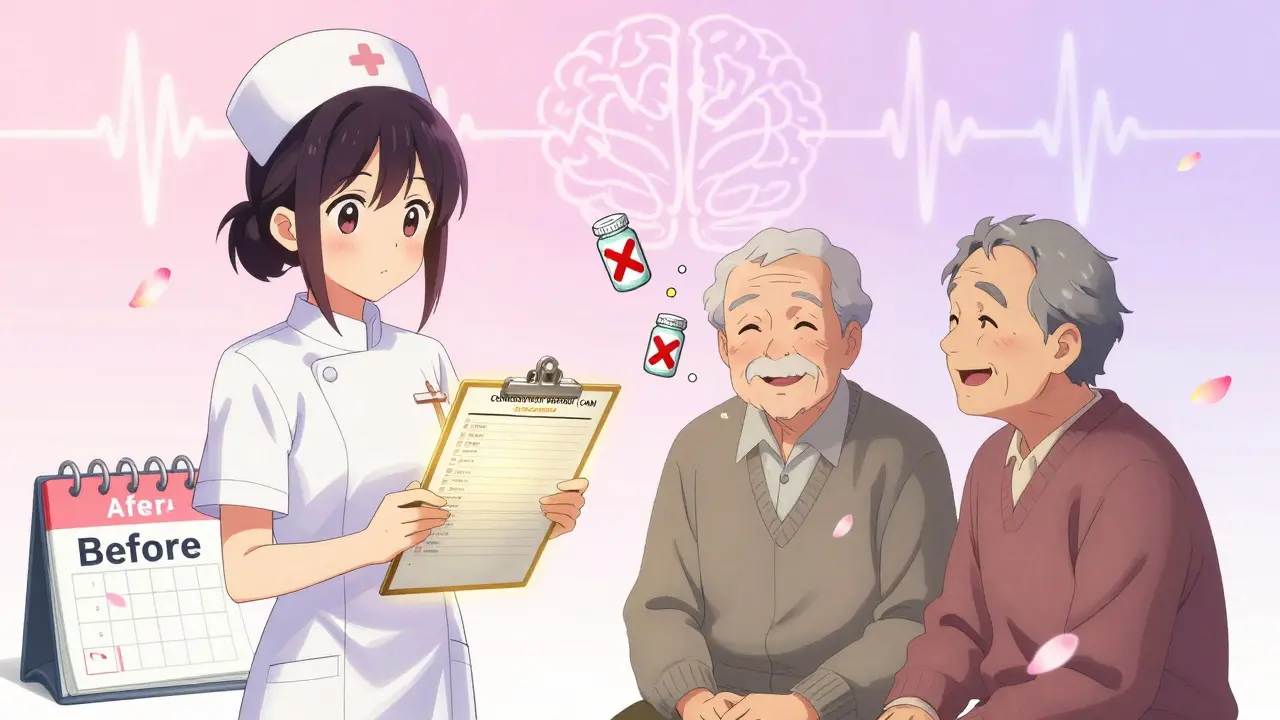
What Happens If It’s Not Caught?
Delirium isn’t just a scary episode - it has lasting damage. People who experience it have twice the risk of dying within a year. Their hospital stays are eight days longer on average. Recovery is slower - many never regain their previous level of thinking or mobility. For someone with dementia, delirium can accelerate decline. One study found delirium episodes lasted over 8 days in dementia patients, compared to under 5 days in those without.
And the cost? In the U.S. alone, medication-induced delirium adds $164 billion a year to healthcare spending. Medicare and Medicaid now classify hospital-acquired delirium as a ‘never event’ - meaning they won’t pay for extra care caused by it. That’s why hospitals are being pushed to act.
What’s Changing Now?
Things are starting to shift. The FDA now requires stronger warning labels on anticholinergic drugs. The National Institute on Aging is funding $12.5 million to build real-time alerts in electronic health records that flag high-risk medication combinations. Some hospitals are using AI tools that predict delirium risk with 84% accuracy by analyzing a patient’s drug list.
But progress is slow. A 2023 study found 43% of hospitals still routinely prescribe high-risk drugs to older adults. Only 18% screen for anticholinergic burden. That means most families are left to fight this battle alone.
Here’s what you can do today: write down every pill your loved one takes - including vitamins, supplements, and OTC drugs. Take that list to their doctor. Ask: ‘Which of these could be affecting their brain?’ Don’t accept ‘it’s just aging.’ Ask for alternatives. Ask for a review using the Beers Criteria®. You’re not overstepping - you’re saving their mind.
Medication-induced delirium isn’t inevitable. It’s a medical error waiting to happen - and one we have the power to stop.
so like... you're telling me my grandma's 'senior moment' after her new allergy pill is actually a brain glitch caused by benadryl? and we've known this for decades? wow. just wow. i'm gonna need a minute to process how many of my relatives are basically walking side effects.
The 2023 Beers Criteria® update significantly expands the anticholinergic burden classification, particularly with the inclusion of newer OTC formulations. Clinically, the ACB scale ≥3 correlates with a 4.7x increase in delirium incidence (95% CI: 3.1–7.2), per the AGS 2023 meta-analysis. Pharmacists should initiate med reconciliation prior to admission.
I’ve seen this happen. My dad was on 11 meds. They gave him Ativan for ‘anxiety’ after a minor surgery. He spent 3 days screaming at the ceiling, thinking the walls were talking. The nurse said he was ‘just confused.’ CONFUSED? HE WASN’T CONFUSED - THEY WERE JUST TOO LAZY TO READ THE LABELS. THIS IS MURDER BY MEDICATION. AND NO ONE GETS IN TROUBLE.
You know what’s wild? The fact that we treat elderly patients like they’re just broken machines that need more parts. We stack meds like Jenga blocks and then act surprised when the tower falls. But here’s the real kicker - if this happened to a 30-year-old, we’d call it iatrogenic poisoning. Why is it ‘just aging’ when it’s an old person? We’ve normalized neglect.
This is so important! 💯 My aunt had this happen after starting oxybutynin - she stopped recognizing us for 4 days. We thought it was dementia worsening. Turned out, one med change and she was back to her old self. Everyone needs to ask: 'Is this on the Beers list?' 🙏
I think people just dont get it like its not like you can just stop giving people meds like its a game of musical chairs and you just take away one and everything is fine like some of these people have been on these drugs for 15 years and theyre dependent on them and if you just yank them out the withdrawal is worse than the delirium like you have to be careful and not just go on some crusade against all anticholinergics like its a villain in a movie
I’m so glad someone finally said this. My mom went from cooking dinner to staring at the fridge for 3 hours after a new sleep aid. We thought she was just tired. Turns out? Benadryl. One week off, and she was back. I wish I’d known this sooner. 😢
So what? People get confused. It’s old age. Stop making it a big deal.
I’ve been a nurse for 18 years and this is the #1 preventable tragedy I’ve seen. Families don’t know to ask. Doctors don’t have time. But if you bring a full med list - including supplements - and say, 'Can we run this through the Beers Criteria?' - you’ll be treated like a hero. Do it. It saves minds. 💙
Let’s be real - this isn’t about medicine. It’s about society’s abandonment of the elderly. We medicate them into silence because we don’t want to sit with them. We don’t want to hear their fears. We don’t want to deal with the fact that they’re scared, lonely, and forgotten. So we give them a pill that turns their mind to fog and call it ‘management.’ We’re not fixing anything. We’re just making it easier to ignore them.
Ah yes, the classic American medical tragedy - where profit meets pharmacology and the elderly become collateral damage. How quaint. One might even say it’s a form of institutionalized ageism dressed up as ‘standard of care.’ How terribly British of them to have warned us decades ago. We’re just so... *innovative* here.
Beers Criteria is outdated. Polypharmacy is inevitable. Delirium is multifactorial. Stop oversimplifying.
This post is just fearmongering. You’re scaring people into stopping necessary meds. Most of these drugs are life-saving. If your grandma gets confused, maybe she needs a different doctor, not a conspiracy theory.