
ICH Development Cost & Time Estimator
Estimate Your Development Savings
Calculate how much time and money you could save by following ICH guidelines instead of running separate trials in multiple regions.
Your Estimated Savings
By using ICH harmonized guidelines, you can save approximately 12-18 months in development time and avoid redundant testing across regions.
The cost of not following ICH can be substantial - as the article notes, "You spend $50 million. Then you try to sell it in Europe. The EMA says your data doesn't meet ICH E3 standards. You have to redo the entire study. Now you're out $100 million."
Every pill you take, every vaccine you receive, every cancer drug that gives you hope - it didn’t just appear on shelves because one country said so. It passed through a global system designed to make sure it’s safe, effective, and made the same way everywhere. That system is the ICH guidelines.
What Are the ICH Guidelines and Why Do They Matter?
The International Council for Harmonisation of Technical Requirements for Pharmaceuticals for Human Use (ICH) isn’t a government. It’s not a company. It’s a quiet but powerful alliance between regulators and drug makers from over 40 countries. Started in 1990 by the U.S., EU, and Japan, it now includes regulators from Canada, Australia, Switzerland, the UK, and more. Their goal? To stop the same drug from being tested five different ways in five different countries. Before ICH, a drug company might run separate clinical trials in the U.S., Europe, and Japan - each with different rules on how to measure side effects, how to report data, even how to store samples. That meant longer waits, higher costs, and sometimes, unnecessary animal testing. ICH changed that. Today, if a drug follows ICH guidelines, regulators across member countries accept the same data. No redoing trials. No extra paperwork. Just faster, safer access to medicines. The real win? Patients. Less duplication means fewer people exposed to experimental drugs than necessary. Fewer animals used in labs. And drugs reach people faster - sometimes years faster.The Four Pillars of ICH: Quality, Safety, Efficacy, and Multidisciplinary
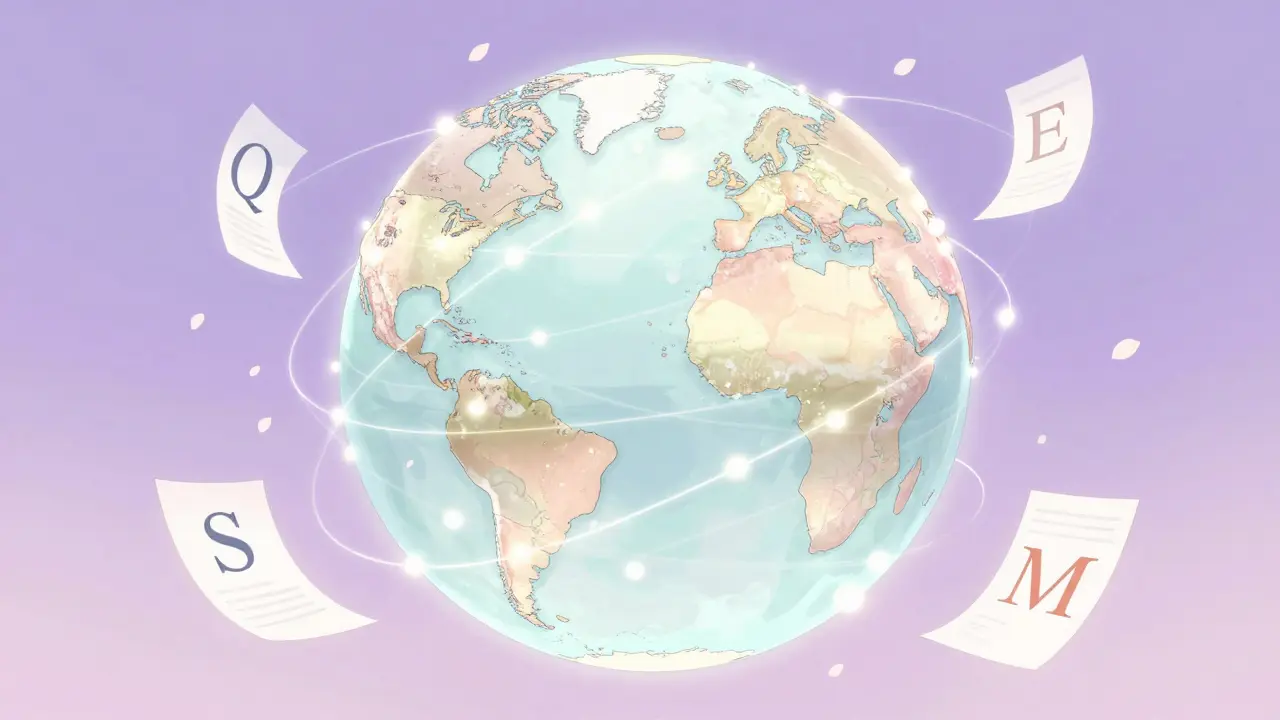
ICH organizes its work into four main areas. Think of them as the four legs of a table holding up global drug safety.- Quality (Q): How the drug is made. This includes everything from the purity of ingredients to how the tablet is pressed. ICH Q7, for example, sets the standard for Good Manufacturing Practice (GMP) - the rules every factory must follow to avoid contamination or mix-ups.
- Safety (S): What the drug might do to your body. ICH S1 tells companies how to test if a drug causes cancer. ICH S2 covers DNA damage. ICH S9 deals with cancer drugs - which are often too toxic for standard safety tests, so special rules apply.
- Efficacy (E): Does it actually work? ICH E6 is the big one here. It’s the global standard for Good Clinical Practice (GCP). If you’ve ever been in a clinical trial, the rules protecting you - how consent forms are written, how data is tracked, how side effects are reported - all come from ICH E6.
- Multidisciplinary (M): The glue that holds it all together. This includes things like electronic submission formats (ICH M4) and now, real-world evidence (ICH M13A). The latest update, ICH M13A, released in June 2024, sets one global way to prove that a generic pill works the same as the brand name - no more country-by-country bioequivalence studies.
There are over 60 finalized guidelines. Each one has been tested in labs, debated by scientists, and reviewed by regulators. They don’t just sit on a shelf. They’re law in practice.
How ICH Works: A 5-Step Process That Builds Trust
You can’t just write a guideline and expect the world to follow it. That’s why ICH has a five-step process that takes years - and that’s the point.- Concept Stage: A problem is identified. Maybe regulators notice different countries use different methods to test liver toxicity.
- Consensus Building: Experts from industry, academia, and regulators form working groups. They review every study, argue over methods, and draft a proposal.
- Step 2: Adoption: The draft is shared with all member regulators. Feedback is collected. Changes are made.
- Step 4: Implementation: This is the big one. Each country’s regulator - like the FDA in the U.S. or the EMA in Europe - formally adopts the guideline as their own rule. Once adopted, it’s no longer optional. Drug companies must follow it.
- Step 5: Enforcement: Regulators audit companies. If a drug doesn’t meet ICH standards, it gets rejected. No exceptions.
This process isn’t fast. ICH S1 on carcinogenicity took 10 years to finalize. But that’s why it works. Every step is transparent. Every voice is heard. And when it’s done, everyone - from a small biotech in Sydney to a giant pharma in Zurich - plays by the same rules.

Real-World Impact: From Clinical Trials to Generic Pills
Take ICH E6 (Good Clinical Practice). Before 1996, clinical trial data in Japan looked nothing like data from the U.S. Different forms, different definitions, different ways of recording a patient’s nausea. That made it impossible to combine results across regions. Now? A trial in Brazil, South Korea, or Germany can be submitted to the FDA with zero changes. That’s ICH E6. Or look at ICH M13A. Before June 2024, a company making a generic version of a blood pressure pill had to run separate bioequivalence studies for each market. In the U.S., they used one method. In the EU, another. In Japan, a third. Now, with ICH M13A, one study satisfies all three. That cuts development time by 12 to 18 months. For patients waiting for affordable meds, that’s life-changing. Even the UK - after Brexit - didn’t walk away from ICH. In May 2022, the UK’s MHRA became a full member. Why? Because the cost of ignoring ICH was too high. Drug companies wouldn’t bother testing in the UK if they had to re-run everything for Europe or the U.S. ICH keeps the UK in the global game.What’s Next? Real-World Evidence and Emerging Therapies
ICH isn’t stuck in the past. In June 2024, it released a reflection paper on real-world evidence (RWE). This isn’t about lab tests or controlled trials. It’s about using data from everyday life - electronic health records, pharmacy databases, patient apps - to track how drugs perform after they’re on the market. Why does this matter? Because traditional trials don’t always show what happens to a 75-year-old with five other diseases taking six other pills. Real-world data can catch rare side effects, show if a drug works in diverse populations, or even prove a drug is safe for long-term use. ICH is now creating one global way to collect, analyze, and report this data. That’s huge. The next frontier? Gene therapies, cell therapies, AI-driven drug discovery. These aren’t pills. They’re living treatments. ICH is already working on new guidelines for these. But it’s not easy. How do you standardize a therapy made from a patient’s own cells? How do you validate an AI model that finds new drug targets? These questions are being debated now. The answers will shape the next decade of medicine.Why ICH Beats Other Systems
There are other global health groups - like the WHO or the International Pharmaceutical Regulators Programme (IPRP). But none have ICH’s power. Why? Because ICH isn’t just advice. It’s binding when adopted. The FDA doesn’t just “recommend” ICH E6. It enforces it. The EMA doesn’t just “suggest” ICH Q7. It inspects factories for compliance. And because the biggest markets - the U.S., EU, Japan, UK, Canada - all follow the same rules, companies have no choice but to comply. Other systems offer guidance. ICH sets the floor. And because it’s built by the people who make drugs and the people who regulate them, it’s practical. It doesn’t exist in theory. It lives in labs, clinics, and manufacturing plants.
The Hidden Cost of Not Following ICH
Imagine you’re a small company trying to bring a new asthma inhaler to market. You design your trial for the U.S. You spend $50 million. Then you try to sell it in Europe. The EMA says your data doesn’t meet ICH E3 standards. You have to redo the entire study. Now you’re out $100 million. And your patients wait another two years. That’s the risk of ignoring ICH. It’s not about bureaucracy. It’s about survival. For patients, it’s about access. For companies, it’s about staying in business.Where to Find the Latest ICH Guidelines
The official source is ich.org. It’s not flashy, but it’s complete. Every guideline, every Q&A, every update - all free. The FDA and EMA also publish their own versions with local notes, but the core is always ICH. If you’re in the industry - whether you’re a scientist, a regulator, or a pharmacist - bookmark it. Check it quarterly. Guidelines change. The latest update, ICH M13A, was implemented in June 2024. The next one could be out next year.Final Thought: Safety Isn’t National. It’s Global.
Medications don’t stop at borders. A side effect in Germany can show up in Australia. A contamination in India can reach Canada. The old way - each country doing its own thing - was slow, expensive, and risky. ICH proves that when regulators and industry work together, we get better drugs faster. With fewer tests. Fewer animals. Fewer delays. And most importantly - fewer patients harmed. It’s not perfect. It’s not fast enough. But it’s the best system we have. And right now, it’s keeping millions of people safe - one guideline at a time.What are the ICH guidelines and who creates them?
The ICH guidelines are a set of globally accepted scientific and technical standards for developing and registering medicines. They are created by the International Council for Harmonisation of Technical Requirements for Pharmaceuticals for Human Use (ICH), a unique partnership between regulatory agencies like the FDA and EMA, and pharmaceutical industry representatives from over 40 countries.
Why are ICH guidelines important for medication safety?
ICH guidelines ensure that medicines are tested and manufactured using the same high standards worldwide. This reduces duplication of clinical trials, prevents unnecessary animal testing, and helps regulators catch safety risks like cancer-causing effects or toxic reactions early. By aligning requirements, ICH makes it easier to detect problems across borders and respond faster.
What’s the difference between ICH E6 and ICH S1?
ICH E6 is about Good Clinical Practice - it sets rules for how clinical trials with humans are conducted, including how consent is obtained and side effects are recorded. ICH S1 is about safety testing in animals - specifically how to test if a drug can cause cancer. E6 protects patients in trials; S1 protects future patients by identifying long-term risks before a drug is approved.
Are ICH guidelines mandatory?
Not by global law, but in practice, yes. When a country’s regulator - like the FDA, EMA, or MHRA - adopts a guideline at Step 4, it becomes mandatory for any drug seeking approval in that market. Most major countries have adopted all core ICH guidelines, making them de facto global requirements.
How often are ICH guidelines updated?
Guidelines are updated as science evolves. The ICH uses a formal Revision Procedure for updates, which can take 1-3 years. Major updates like ICH M13A on bioequivalence were added in 2024. The organization also releases Q&A documents to clarify existing rules. The process is ongoing - with new guidelines in development for gene therapies and AI-driven drug discovery.
Can a country ignore ICH guidelines?
Technically yes, but it’s rarely practical. Countries that don’t adopt ICH standards risk being isolated. Drug companies won’t spend millions testing a product just for one market if they can’t sell it elsewhere. The UK stayed in ICH after Brexit because leaving would have made its pharmaceutical industry uncompetitive. For emerging markets, adopting ICH is often the fastest path to attracting global investment and ensuring medicine quality.
Honestly I never thought about how much work goes into making sure a pill I swallow doesn’t kill me. I just grab it off the shelf like it’s cereal. But reading this made me realize ICH is the silent hero behind every prescription. No drama, no hype, just science that works. Thanks for the clarity.
The harmonization of regulatory standards is a critical advancement in global pharmaceutical governance. Consistency in clinical trial design, manufacturing protocols, and safety assessment reduces redundancy and enhances public health outcomes.
You know, I keep thinking about how strange it is that we trust a system like this - not because it’s perfect, but because it’s the least bad option we’ve got. We’re talking about life and death here, and the people who design these rules are scientists and corporate lawyers sitting in rooms for years debating whether a tumor in a rat means anything for a 72-year-old diabetic in Ohio. It’s messy. It’s slow. It’s bureaucratic. But somehow, it works. And that’s the real miracle. Not the drug. Not the trial. The fact that we agreed to a common language for suffering. That’s humanity, quietly doing its job.
ICH is the reason my dad got his cancer drug two years sooner than he would’ve otherwise. No red tape. No country jumping through hoops. Just science that moves. We need more of this. Less politics. More alignment. The world’s too connected to keep doing things the old way
Why are we letting other countries tell us how to do medicine? We invented modern pharma. Why do we care what Europe or Japan thinks? Just make our own rules and let the rest catch up. ICH is just globalism in a lab coat
Love how this breaks it down without jargon. Seriously, if you work in healthcare and haven’t read ICH guidelines, you’re doing yourself a disservice. It’s not boring - it’s the backbone of everything we do. Keep sharing stuff like this
They say ICH saves time and money but let’s be real - it’s just another way for Big Pharma to control the narrative. The same companies that write the guidelines are the ones who benefit. Transparency? Sure. But who’s really at the table? Not patients. Not small labs. Just the big players with the lobbyists
Agreed with Paul - this isn’t just about efficiency. It’s about equity. A kid in Nairobi deserves the same safe meds as a kid in Boston. ICH makes that possible. Don’t let cynicism blind you to the good this system does