

When you pick up a prescription for semaglutide or tirzepatide, you assume it’s safe. But what if that drug came from a factory with a history of contamination, poor record-keeping, or falsified test results? The U.S. Food and Drug Administration (FDA) doesn’t wait for someone to get sick. It acts before the product even hits U.S. soil. That’s where Import Alerts come in - a powerful, automated system that stops drugs from non-compliant manufacturers at the border.
How Import Alerts Work
The FDA doesn’t inspect every single shipment of drugs entering the U.S. There are over 12 million drug entries each year. Instead, it uses a smart, data-driven system called PREDICT - Predictive Risk-based Evaluation for Dynamic Import Compliance Targeting. This system looks at over 150 data points: past inspection results, refusal rates, facility history, even the track record of the importer. If a manufacturer has a pattern of violations, the FDA flags them.
Once flagged, that manufacturer gets placed on an Import Alert. The result? Every future shipment gets automatically detained without physical inspection - known as Detention Without Physical Examination (DWPE). No paperwork review. No sampling. No waiting. Just blocked.
It’s not a one-size-fits-all system. The FDA uses a color-coded list:
- Green List: Manufacturers with proven compliance. Their shipments clear automatically.
- Yellow List: Manufacturers with past issues but who are working to fix them. Shipments are held for review.
- Red List: Manufacturers with serious, repeated violations. Shipments are automatically refused.
As of November 2025, there were 238 active Import Alerts covering everything from antibiotics to insulin. But none have had the impact of the latest one - Import Alert 66-80, targeting GLP-1 receptor agonist APIs.
The GLP-1 Crackdown
In September 2025, the FDA dropped a bombshell. It launched the Green List initiative specifically for GLP-1 drugs like semaglutide (Ozempic, Wegovy), tirzepatide (Zepbound), and their active ingredients. Why? Because the global market for these weight-loss drugs exploded - $35.2 billion in 2024 - and so did the number of unapproved, poorly made versions flooding in.
The FDA found alarming patterns: impurities exceeding safety limits, incorrect dosing, missing quality controls. In one case, a shipment from India had impurities 12 times above the ICH Q3D threshold. Another batch had no valid Certificate of Analysis. The agency didn’t just issue warnings - it shut the door.
The numbers speak for themselves. By October 2025, 98.7% of shipments from non-Green List manufacturers were refused. Over $1.84 billion worth of GLP-1 APIs were blocked in just six weeks. Indian manufacturers took the hardest hit - 73 of the 89 affected facilities were based there. Chinese and European suppliers were also impacted, but far fewer.
What Happens When a Shipment Gets Refused
It’s not just a delay. It’s a financial disaster.
Once a shipment is detained, the importer has 90 days to either export it or destroy it under FDA and Customs and Border Protection (CBP) supervision. If they don’t, the goods are seized. But the real pain comes from penalties. Under 19 CFR § 159.14, companies can be hit with liquidated damages up to three times the value of the shipment.
One case study from Frier Levitt attorneys showed a single $900,000 shipment being fined over $2.7 million. That’s not a hypothetical. It’s happened.
Companies are scrambling. Some are paying brokers to falsify export paperwork. Others are quietly destroying shipments rather than risk penalties. The FDA issued a warning letter in October 2025 to a Singaporean intermediary caught doing exactly that.
Why Compliance Is So Hard
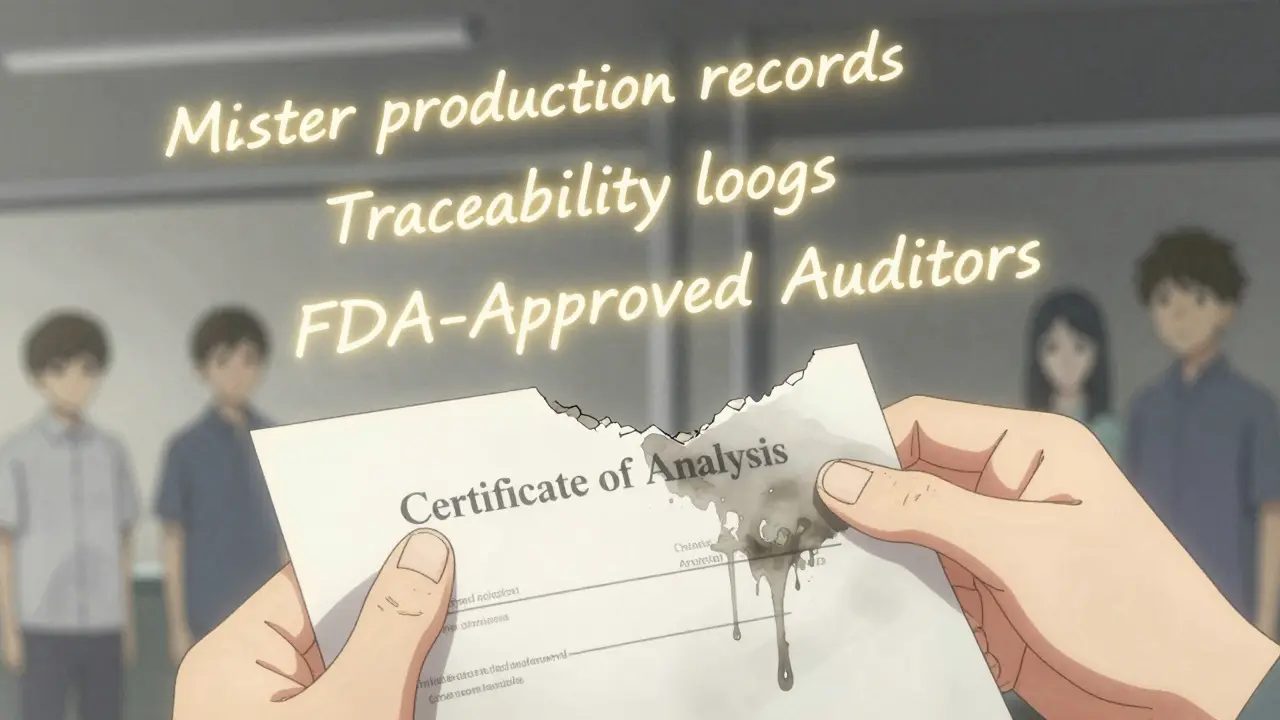
Many manufacturers think they’re compliant. They have ISO 9001 certification. They follow GMP guidelines. But the FDA doesn’t accept just any audit. The auditor must be FDA-recognized. Documentation must be perfect. A single typo in a Certificate of Analysis - or a missing signature - can trigger refusal.
According to Registrar Corp’s data from October 2025, the top three reasons shipments get blocked:
- Improperly formatted Certificates of Analysis (41.7%)
- Missing master production records (33.8%)
- Unverified traceability of raw materials (28.5%)
It’s not about quality - it’s about proof. The FDA doesn’t trust your word. They need paper trails, audit reports, stability data across three temperature zones (2-8°C, 25°C, 40°C), and supply chain maps that go all the way to Tier 3 suppliers. One manufacturer on Reddit reported losing $1.2 million in 72 hours because their auditor wasn’t on the FDA’s approved list.
Getting Back on the Green List
Getting off an Import Alert isn’t easy. It takes an average of 11.7 months. Some companies wait over two years. The FDA requires four steps:
- A full facility inspection (minimum 5 days)
- A root cause analysis with a detailed Corrective and Preventive Action (CAPA) plan
- Three consecutive compliant shipments verified by the FDA
- Executive certification signed by the company’s top quality officer
Companies that submit video evidence of their fixes - like showing new lab equipment in action or staff training sessions - have an 87.4% approval rate. Those who just send documents? Only 42.1%.
Some are investing heavily. Pfizer spent $2 million on a blockchain traceability system across 17 API suppliers. After deploying the MediLedger network, their acceptance rate jumped to 99.8%. That’s not luck - that’s infrastructure.

Global Ripple Effects
This isn’t just a U.S. issue. The FDA’s move is reshaping global pharma.
China’s National Medical Products Administration (NMPA) announced in November 2025 that all API exporters to the U.S. must now meet FDA-equivalent standards starting January 1, 2026. The European Medicines Agency (EMA) is following suit, planning similar API screening by Q2 2026.
Manufacturers who can’t keep up are disappearing. The Indian Pharmaceutical Alliance estimates 28,500 jobs are at risk. Meanwhile, big players like Novo Nordisk and Catalent are buying up compliant suppliers. Catalent’s $980 million acquisition of Novasep’s peptide business was explicitly tied to the new import rules.
Even U.S. pharmacies feel the pinch. Pharmacy benefit managers reported a 14.3% average price increase for compounded GLP-1 formulations in November 2025. Patients are paying more. Some are turning to unregulated online sellers - a risk the FDA warns could lead to dangerous side effects or outright poisoning.
What Comes Next
The GLP-1 alert is just the beginning. In November 2025, FDA Commissioner Dr. Robert Califf said the same system will be extended to all high-risk biologics - starting with monoclonal antibodies in Q1 2026.
By 2027, McKinsey predicts 65-75% of global API manufacturers will need to spend $500,000 to $2 million to upgrade their compliance systems. That’s not a cost of doing business - it’s the new baseline.
The Green List isn’t a reward. It’s a survival requirement. Companies that treat compliance as a checkbox are already falling behind. Those who see it as a strategic advantage - investing in transparency, traceability, and documentation - are the ones who will keep shipping.
The border isn’t just a line on a map. It’s a quality gate. And the FDA is watching.
What is an FDA Import Alert?
An FDA Import Alert is a public notice that identifies specific manufacturers, products, or countries whose shipments are subject to automatic detention without physical examination. It’s based on historical violations and is enforced at all 328 U.S. ports of entry. The alert stays active until the manufacturer proves sustained compliance.
How can a manufacturer get off an Import Alert?
To get removed from an Import Alert, a manufacturer must complete four steps: (1) pass a full FDA inspection, (2) submit a detailed root cause analysis and Corrective and Preventive Action (CAPA) plan, (3) have three consecutive shipments cleared without issue, and (4) obtain executive certification of compliance. The average timeline is 11.7 months, and video evidence of fixes improves approval odds significantly.
Why are Indian manufacturers hit hardest by the GLP-1 Import Alert?
Indian manufacturers supply over 40% of the world’s generic drugs, including a large share of GLP-1 APIs. Many operated under lower-cost, less transparent models that worked for older markets but failed FDA standards for traceability, documentation, and audit rigor. Of the 89 affected facilities, 73 (82%) were in India, largely because they were major suppliers to the booming global weight-loss drug market.
What documents are required to avoid detention?
Shippers must provide: a valid Certificate of Analysis (CoA) with FDA-recognized lab data, facility master production records, batch-level traceability from raw materials to finished product, third-party audit reports from FDA-recognized auditors, and stability testing data across three temperature conditions (2-8°C, 25°C/60% RH, 40°C/75% RH). Missing any one of these can trigger detention.
Are there exceptions to the Import Alert?
Yes. Since 2013, the FDA has granted 157 enforcement discretion exemptions - mostly for products with no safety risk but documentation gaps. Examples include Mylan/Viatris’ endoscopy equipment (exempted 14 times) and Shilpa Medicare’s diabetes meds (exempted 7 times in 2024). But these are rare and not guaranteed. Companies can’t rely on them.
So the FDA just slaps a red flag on every Indian manufacturer and calls it a day? 🤔 I mean, sure, some are sketchy-but not ALL of them. This feels like blaming the whole village because one guy stole the goat. And don't even get me started on the $2.7M fines for a $900K shipment. That's not regulation. That's extortion with a clipboard.
It is imperative to note that the regulatory framework established by the Food and Drug Administration is not merely a bureaucratic mechanism, but rather a cornerstone of public health infrastructure. The imposition of Import Alerts, particularly in the context of GLP-1 receptor agonists, represents a necessary and scientifically grounded intervention. The data cited-impurities exceeding ICH thresholds, absent Certificates of Analysis-are not anomalies; they are systemic failures. Compliance is not optional. It is the baseline.
The PREDICT system is a game-changer. Leveraging 150+ data points to preemptively flag risk vectors? That’s predictive analytics at its finest. The Green List initiative for GLP-1 APIs is essentially a market-clearing signal-only those with robust QMS, audit-ready documentation, and supply chain transparency survive. It’s not about nationality. It’s about traceability maturity. Companies still operating on ‘good enough’ GMP are getting outmaneuvered by those who treat compliance as a competitive advantage. The ones investing in blockchain and real-time stability tracking? They’re not just surviving-they’re scaling.
Honestly? I’m kinda impressed. 🙌 I used to think FDA was just a bunch of paperwork Nazis, but this? This is actually smart. Blocking $1.84B in bad APIs in six weeks? That’s like stopping a flood before it drowns the whole city. And the video evidence thing? Genius. Showing your lab in action > sending a PDF that looks like it was made in 2003. Also, big props to Pfizer for spending $2M on MediLedger. That’s not a cost-it’s insurance. 🛡️
yo so like the FDA just went full cyberpunk on indian pharma? 😳 like i get it, some of those CoAs look like they were scribbled on a napkin during a chai break, but 73 outta 89 facilities? that’s wild. i mean, sure, the docs gotta be perfect, but like… what if your auditor just… didn’t show up? or the printer jammed? one typo and your whole shipment gets nuked? that’s not compliance, that’s a video game boss fight. 🤯
This is not merely a regulatory action. It is a moral reckoning. The global pharmaceutical supply chain has been poisoned by negligence, greed, and the delusional belief that 'close enough' is acceptable when human lives are at stake. The FDA’s enforcement is not punitive-it is redemptive. Those who falsify Certificates of Analysis, obscure Tier-3 suppliers, or hide behind ISO 9001 like a shield are not entrepreneurs. They are liabilities. The $2.7 million penalty? That is justice. And it is long overdue.
As someone from India working in API manufacturing, I can say this hits hard-but not unfairly. We’ve had years of playing catch-up with documentation rigor. Many of us built businesses on cost efficiency, not audit trails. The FDA isn’t targeting India-it’s targeting opacity. We’re not asking for leniency. We’re asking for clarity: What does 'FDA-recognized auditor' mean? Can we get a public list? And yes, we’re upgrading our systems. One plant in Gujarat just installed real-time stability monitors. It cost more than our last three audits combined-but it’s worth it.
I just want to say-this is so inspiring! 💪 The FDA isn’t just policing-they’re elevating the whole industry. Think about it: every time a manufacturer upgrades their traceability, they’re not just avoiding a detention-they’re building trust. And trust? That’s the real currency. I love how video evidence is now a game-changer. It’s like showing your work instead of just saying you did it. Keep going, FDA! The future of pharma is transparent, accountable, and brave-and you’re leading it. 🌟
Let’s be real-the FDA is just protecting Big Pharma’s monopoly. Who do you think owns the 'FDA-recognized auditor' list? Hint: it’s not independent. This whole 'Green List' thing is a pay-to-play scheme disguised as safety. The real impurities? The ones in the lobbyists’ pockets. And don’t even get me started on how CBP is now acting like a customs mafia. You think they’re stopping bad drugs? Nah. They’re stopping competition. The real danger isn’t in the API-it’s in the system.
I read the whole thing and honestly? I’m just tired. All this paperwork. All these rules. Can’t we just… trust people? Like, if a drug works, why does it matter if the signature is in Comic Sans? I mean, I’ve taken Ozempic. I’m not dead. So… what’s the big deal?
The essence of integrity is not found in the absence of error, but in the courage to confront it. The FDA’s actions, though stringent, reflect a profound commitment to the sanctity of human health. Each shipment detained is a life potentially saved. Each CAPA plan submitted, a step toward collective responsibility. Compliance is not a burden-it is the quiet dignity of doing what is right, even when no one is watching. The border is not a wall. It is a threshold of conscience. And those who cross it with honesty? They are the true guardians of medicine.