
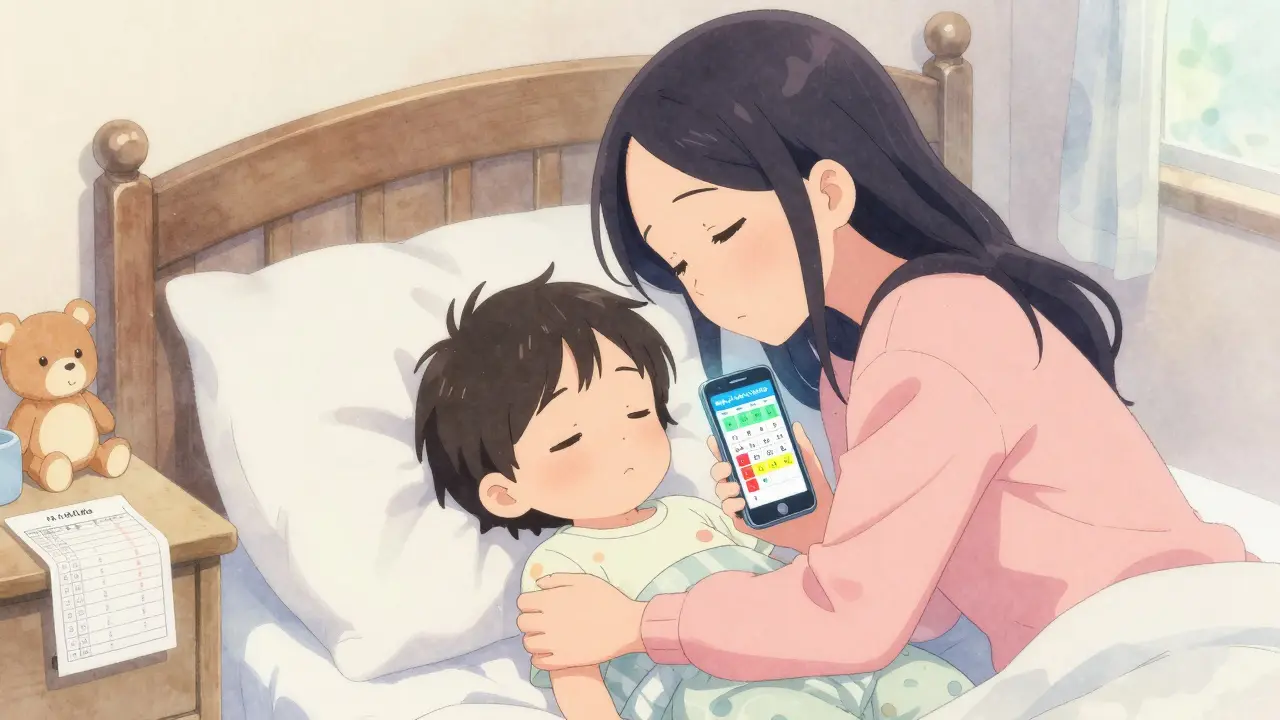
Getting the right dose of medicine for a child isn’t just tricky-it’s life-or-death. A child’s body doesn’t process drugs the same way an adult’s does. Too little, and the treatment won’t work. Too much, and it can cause serious harm-or worse. That’s why tracking pediatric doses with apps and dosing charts isn’t optional. It’s essential.
Why Pediatric Dosing Is So Different
Adult medications often use fixed doses: one pill, twice a day. Kids? It’s never that simple. Their dose depends on weight, age, kidney and liver function, and sometimes even body surface area. A 10-pound infant needs a fraction of what a 60-pound toddler needs. Even small mistakes can lead to overdose.Studies show pediatric medication errors happen up to three times more often than in adults. Many of these errors come from manual calculations. Picture this: a parent, tired and stressed, tries to figure out how much acetaminophen to give their feverish 18-month-old. They grab a printed chart, but the weight is listed in kilograms. They don’t know how to convert pounds. They guess. That’s how errors start.
Apps Designed for Clinicians: Speed and Accuracy in Emergencies
In hospitals and ERs, time is everything. That’s where tools like Pedi STAT is a mobile application designed for emergency medical providers to rapidly calculate pediatric drug doses based on patient weight and clinical condition come in. Developed by emergency doctors at Connecticut Children’s Medical Center, it launched in 2009 to fix a simple but deadly problem: clinicians were wasting precious seconds doing math during crises.Today, Pedi STAT version 4.2.1 works on iOS and Android. It holds over 200 pediatric medications. Just type in the child’s weight in kilograms (or pounds-it auto-converts), tap the drug, and the correct dose appears in seconds. It even suggests the right size IV catheter or syringe. In a 2022 study, manual calculations took an average of 18.7 seconds with a 12.3% error rate. Pedi STAT? Under 3 seconds. Error rate? Less than 1%.
Another tool, Epocrates is a clinical decision support app with a database of over 4,500 medications, including pediatric dosing, drug interactions, and allergy alerts, is popular among doctors for its massive drug database and interaction checker. It flags dangerous combinations-like giving a child an NSAID with a blood thinner. But it’s not built for speed in emergencies. It’s better for routine prescribing.
For hospital staff, these apps aren’t just helpful-they’re becoming standard. Over 89% of U.S. children’s hospitals now use them. Many integrate with electronic health records like Epic and Cerner. But that’s only half the story.
Apps for Parents: Keeping Track at Home
Most pediatric meds aren’t given in hospitals. They’re given at home-by tired parents, grandparents, or babysitters. That’s where apps like My Child’s Meds is a parent-focused mobile app that tracks scheduled doses, sends reminders, prevents double dosing, and stores child health records with visual dosage charts come in. Developed with input from the Royal College of Paediatrics and Child Health and WellChild, it’s built for real-life chaos.Imagine your child takes four different medications: one every 6 hours, another every 8, and a third only when fever hits. You write it down on paper. You forget. You give the dose twice by accident. That’s where My Child’s Meds shines. It shows a color-coded calendar. Green for given. Red for missed. Yellow for warning. It alerts you if you’re about to give a second dose too soon. One parent in Sydney told me: “It saved us when my toddler’s fever schedule got mixed up during night feedings. I almost gave him another dose-I checked the app first.”
Another app, NP Peds MD is a parent-friendly app providing pediatrician-approved dosage tables for common over-the-counter medications by weight in kilograms and pounds, gives clear, visual charts for Tylenol, Advil, and antihistamines. No math needed. Just find your child’s weight, and the right dose pops up. A 2023 study found parents using NP Peds MD got the dose right 78% of the time. With paper charts? Only 52%.
And here’s the kicker: My Child’s Meds is free. No subscription. No ads. Just simple, safe tracking. It’s available only on iOS, but that’s okay-most parents who need this level of precision use iPhones.

The Big Problem: Apps Don’t Talk to Each Other
Here’s where things break down. The app your pediatrician uses? Pedi STAT. The app you use at home? My Child’s Meds. They don’t connect. No data sharing. No sync.When your child leaves the hospital, you get a paper discharge sheet with doses written in milligrams and milliliters. You try to enter it into your app. But the app only accepts kilograms. You convert wrong. You give too much. A 2024 study in the Journal of Pediatric Pharmacology and Therapeutics documented a 22-month-old who got 300% too much ibuprofen because a parent entered weight in pounds instead of kilograms in a free, unvalidated app.
According to the American Academy of Pediatrics, 87% of medication errors in kids happen during care transitions-when they move from hospital to home. That’s not a tech problem. It’s a system problem. Apps are great, but they’re islands.
What You Should Use: A Simple Guide
If you’re a healthcare provider:- Use Pedi STAT for emergencies. Fast, accurate, built for speed.
- Use Epocrates for routine prescribing. Great for checking interactions.
- Use Harriet Lane Handbook as your reference. It’s the gold standard-but it’s pricey ($69.99/year) and too complex for home use.
- Download My Child’s Meds. It’s free, trusted by pediatricians, and prevents double dosing.
- Use NP Peds MD for quick OTC dose checks (Tylenol, Advil, allergy meds).
- Never use random apps from the app store that don’t say “pediatrician-approved.” Many are just note-takers with no calculation power.
How to Use These Tools Safely
Apps aren’t magic. They’re tools. And tools can be misused.Here’s how to stay safe:
- Always check the weight unit. Kilograms or pounds? Make sure your app knows. Most apps auto-convert, but you should still double-check.
- Verify the dose. Even if the app says 5 mL, cross-check with the prescription label or the drug’s official dosing chart.
- Keep a paper backup. Phones die. Apps crash. Have a printed copy of your child’s medication schedule. Tape it to the fridge.
- Reconcile weekly. Every Sunday, compare your app’s log with your pharmacy’s refill record. If something doesn’t match, call your pediatrician.
- Teach caregivers. Grandparents, babysitters, daycare staff-they need to know how to use the app too. Show them. Don’t assume they’ll figure it out.

The Future: Smarter, Safer, Connected
The next big leap? Integration. The Healthcare Information and Management Systems Society (HIMSS) is working on a standard to let hospital apps talk to home apps. Expected by late 2025, this could mean your child’s hospital discharge instructions automatically sync to your phone.Some apps are testing AI that predicts when a parent might make a mistake-like if they’re giving a dose too early or too late. Others are linking to smart pill dispensers that only release the right amount at the right time.
But tech alone won’t fix this. Training will. The NIH and AAP both warn: doctors and parents must understand why the dose is what it is. Relying on an app without knowing how to calculate manually is dangerous. In a 2023 simulation, 22% of medical residents couldn’t calculate an epinephrine dose when their device failed.
Final Word: Don’t Guess. Track.
Pediatric dosing isn’t about being perfect. It’s about being consistent. About reducing the chance of error. About giving your child the right medicine, at the right time, in the right amount.Apps like My Child’s Meds and Pedi STAT aren’t fancy gadgets. They’re safety nets. And if you’re caring for a child on medication-whether it’s daily antibiotics, asthma inhalers, or seizure meds-your safety net should be digital, reliable, and always there.
Download the right app. Set it up. Teach others. Keep a paper copy. And never, ever guess.
Can I use any medication app for my child?
No. Only use apps developed with pediatric clinical input, like My Child’s Meds or NP Peds MD. Many apps on the app store are just digital notebooks-they don’t calculate doses or prevent errors. Always check if the app is endorsed by a pediatric hospital or pharmacy group.
What if my child’s weight changes quickly?
Update the weight in your app immediately. Many pediatric medications, especially antibiotics and pain relievers, are weight-based. A 2-pound change can mean a different dose. Recheck dosing every time your child gains or loses weight, especially during illness or growth spurts.
Is it safe to rely only on an app?
No. Apps can crash, have bugs, or be misused. Always verify the calculated dose against the prescription label or a trusted printed dosing chart. Keep a paper backup. Never assume the app is 100% foolproof.
Do I need to pay for these apps?
For parents: My Child’s Meds is free. NP Peds MD is free. For clinicians: Epocrates has a free version, but full features require a $175/year subscription. Harriet Lane Handbook costs $69.99/year. Avoid paid apps that don’t clearly state their clinical backing.
How do I share my child’s medication list with the doctor?
My Child’s Meds has a “Share with Provider” feature that exports a PDF of the medication list. Print it or email it before appointments. Don’t rely on memory. Even small details like dosage timing matter.
Next Steps
- If you’re a parent: Download My Child’s Meds today. Set up your child’s medications. Turn on reminders.
- If you’re a caregiver: Ask the parent or doctor for a printed copy of the dosing schedule. Don’t guess.
- If you’re a healthcare worker: Use Pedi STAT in emergencies. Train new staff. Always double-check the weight unit.
- If you’re using multiple apps: Make sure they’re all updated. Delete untrusted apps.
Medication safety isn’t about technology. It’s about habits. The right app, used the right way, can turn a risky guess into a confident action.
Apps are not a substitute for clinical judgment. Relying on them without understanding pharmacokinetics in pediatrics is dangerous. Weight-based dosing isn't magic. It's science. If you can't calculate a dose manually you shouldn't be administering it.
They say technology saves lives but let's be honest-how many parents have stared at their phone at 3 AM while their child burns up wondering if the app is lying to them? We've outsourced our instincts to algorithms and now we're terrified to trust our own hearts. This isn't progress-it's surrender.
As a pediatric nurse in Mumbai, I've seen parents use handwritten charts with crayon marks and hope. My Child’s Meds changed everything for them. Free, simple, no ads. One grandma told me she finally slept through the night because the app reminded her when the last dose was given. No fancy tech needed-just clear, trusted design. Thank you for highlighting this.
In India, most parents don't even own smartphones. They rely on pharmacists or neighbors. Apps are useless if you don't have data or a phone. Why not make printed charts in local languages with pictograms? That would help more than another iOS app.
Anyone using random apps without FDA or WHO validation is playing Russian roulette with their child's life. I've reviewed 37 pediatric medication apps. 34 were garbage. Only two had peer-reviewed dosing algorithms. The rest are glorified calculators with fake endorsements. Don't be fooled by pretty interfaces.
OMG I JUST HAD A PANIC ATTACK READING THIS. I gave my son ibuprofen last week and I THINK I might've used pounds instead of kg?? I checked the app and it said 5mL but the bottle said 4.5... I think I overdosed him?? I'm crying right now. Someone please tell me he's okay??
We live in an age where we outsource our responsibility to machines. The real tragedy isn't the dosing error-it's that we've stopped teaching parents how to think. We hand them an app and call it safety. But safety is vigilance. Safety is understanding. Safety is knowing why 10mg/kg matters-not just tapping a button.
The integration gap between EHRs and consumer apps represents a systemic failure in interoperability architecture. The lack of FHIR-compliant APIs in pediatric dosing applications creates dangerous data silos. Until HL7 adopts standardized weight-unit ontologies, we're merely bandaging a hemorrhage with duct tape.
My kid's pediatrician uses Pedi STAT. I use My Child's Meds. We don't sync. Last week the hospital gave him a new antibiotic at 15mg/kg. I entered it in the app but forgot to switch from lbs to kg. Got it wrong. Paper backup saved us. Always have one. Always double-check. Apps are tools, not oracles.