
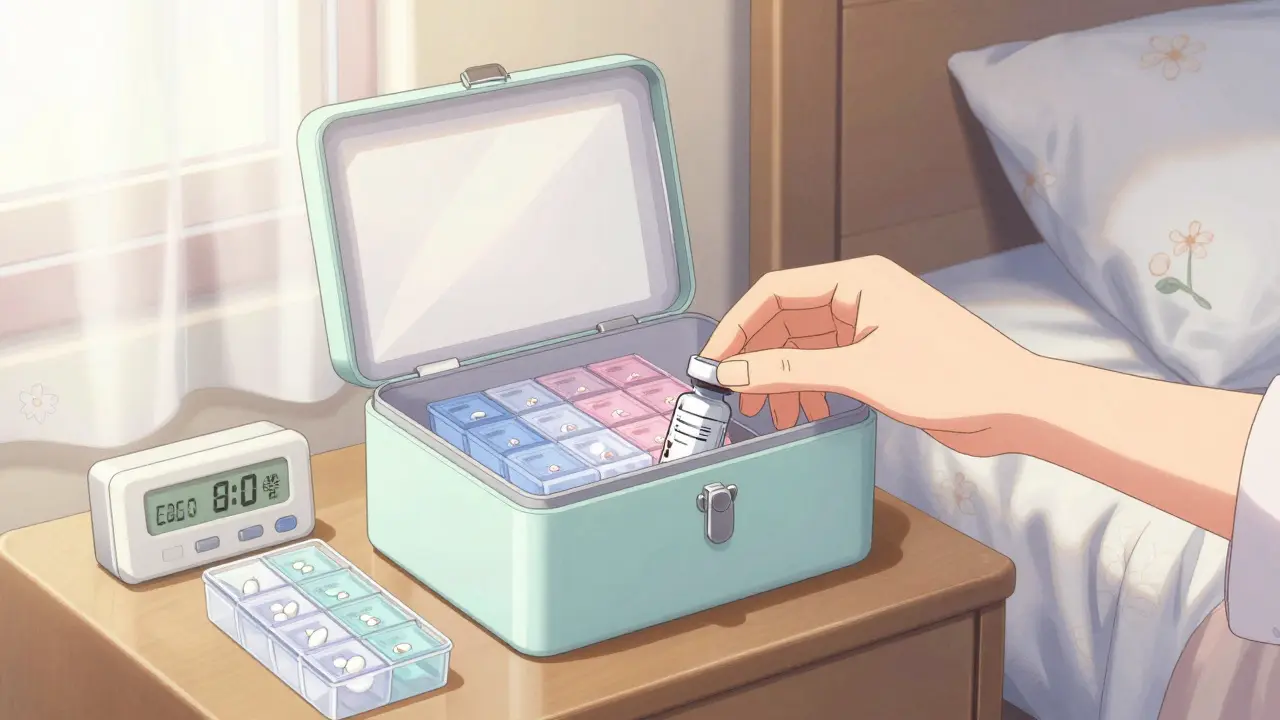
Storing medications safely in a shared living space isn’t just about keeping pills out of reach-it’s about preventing accidents, preserving effectiveness, and avoiding legal or health risks. Whether you’re living with aging parents, adult children, roommates, or in an assisted living facility, the way medicines are stored can mean the difference between safety and disaster.
Why Medication Storage Matters More Than You Think
Every year, over 60,000 emergency room visits in the U.S. are caused by accidental medication ingestion, according to the CDC. Many of those cases happen in homes where multiple people live under one roof. Children grab what looks like candy. Seniors mix up similar-looking bottles. Roommates accidentally take someone else’s painkiller. And in shared refrigerators, insulin or other temperature-sensitive drugs lose potency when stored on the door shelf where temperatures swing by 10°F or more. The Joint Commission found that 13% of hospitals received citations for improper medication storage between 2020 and 2021. That’s not just a hospital problem-it’s a household problem too. The same rules apply: if it’s a medication, it needs secure, labeled, temperature-appropriate storage.Know the Storage Rules for Different Medications
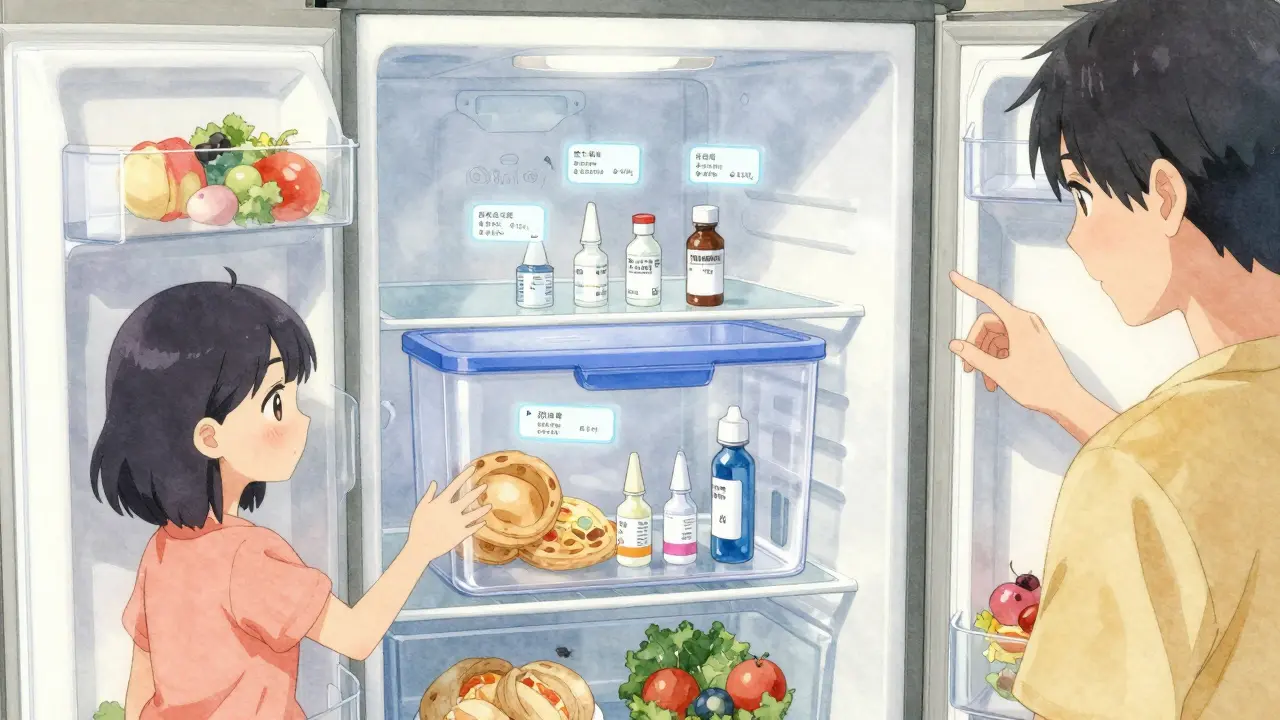
Not all pills are created equal. Some need cold. Others degrade in heat or light. The FDA updated its guidance in February 2024 for 47 commonly prescribed drugs, including insulin, antibiotics, and biologics. Here’s what you need to know:- Refrigerated meds (like insulin, certain antibiotics, and eye drops) must be kept between 36°F and 46°F. The center of the fridge is the only safe spot-never the door. Shelf storage causes up to 30% degradation in 24 hours, according to Johns Hopkins Pharmacy Services.
- Room temperature meds (like most pills and capsules) should be kept away from bathrooms, kitchens, or windows. Humidity and heat from showers or stoves can break them down. A bedroom drawer is better than a bathroom cabinet.
- Controlled substances (opioids, benzodiazepines, stimulants) require locked storage. In professional settings, this means a locked cabinet with audit logs. At home, a small, tamper-proof safe or lockbox is enough.
- Over-the-counter drugs (pain relievers, allergy meds) still need to be locked if children or vulnerable adults live in the home. Acetaminophen overdose is the leading cause of acute liver failure in the U.S.
Set Up a Dedicated Storage Zone
Forget using the kitchen counter or the medicine cabinet above the sink. You need a single, consistent location for all medications. In assisted living facilities, 100% of large homes have a dedicated medication room. In homes, you don’t need a whole room-but you do need a dedicated spot. Here’s how to build one:- Choose the location: A locked drawer in a bedroom, a high cabinet with a childproof lock, or a small wall-mounted safe. Avoid shared spaces like the living room or bathroom.
- Separate by type: Use small containers or pill organizers to group meds by function-daily pills, as-needed meds, refrigerated items. Label everything clearly with the person’s name and drug name.
- Lock it: Use a combination lock, key lock, or smart lockbox. Sales of home medication safes jumped 27% in 2024, according to NPD Group. A $30 lockbox is cheaper than an ER visit.
- Keep refrigerated items separate: If you must share a fridge, use a small, labeled, locked container inside. Never mix food and meds in the same drawer.
Label Everything-No Exceptions
The Joint Commission found that 12% of hospitals were cited for poor labeling. At home, it’s even worse. A SeniorHelpers survey found that 42% of medication incidents in multi-generational homes happened because someone grabbed the wrong bottle. Use permanent markers or printed labels. Include:- Full name of the person
- Drug name (brand and generic if different)
- Dosage and frequency
- Prescribing doctor’s name
- Expiration date
Document What’s Stored and When
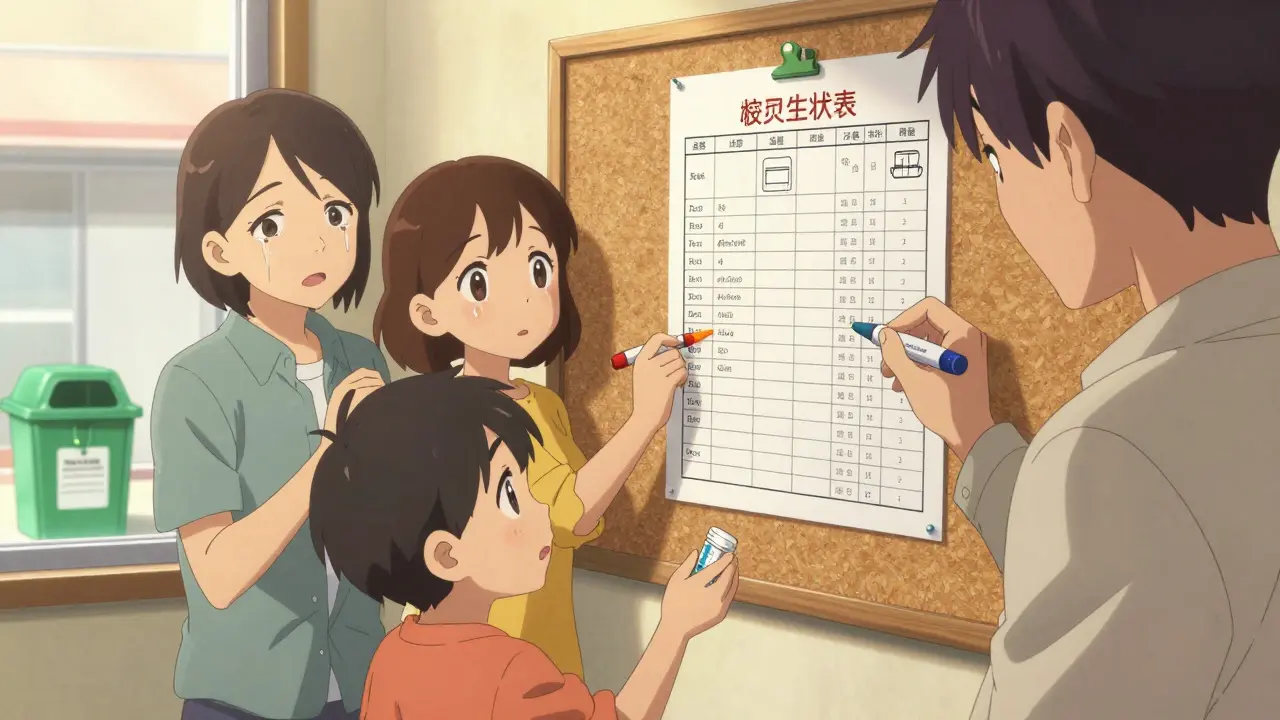
Professional care homes use Individualized Medication Administration Records (MARs) to track every dose. You don’t need that level of detail-but you do need a simple log. Create a printed or digital list that includes:- Medication name
- Who it belongs to
- Storage location
- Expiration date
- When it was last refilled
Get Rid of Expired and Unused Meds
Medications expire for a reason. After the expiration date, they lose potency. Some become toxic. A 2024 FDA study found that 15% of expired antibiotics failed to kill bacteria in lab tests. Every six months, do a medication cleanup:- Collect all pills, liquids, patches, and inhalers from every room.
- Check expiration dates. Discard anything past its date.
- Look for changes in color, smell, or texture. If it looks off, throw it out.
- Dispose safely. Don’t flush or trash them. Use a drug take-back program. In Australia, pharmacies like Chemist Warehouse and Priceline offer free disposal bins. If none are nearby, mix pills with coffee grounds or cat litter, seal in a plastic bag, and throw in the trash.
Address the Biggest Challenges
You’ll run into resistance. People hate being told how to store their meds. Space is tight. Everyone thinks they’re fine without locks. Here’s how to handle it:- Space is limited? Use stackable, slim lockboxes. They fit in a nightstand or closet corner.
- Someone refuses to lock their meds? Explain the risk. A 2025 SeniorHelpers survey showed 67% of families had at least one medication incident in the past year. Most involved children or seniors taking the wrong pill.
- Temperature control is messy? Buy a small fridge thermometer. Place it in the fridge next to the meds. If it goes above 46°F or below 36°F, move the meds to the center shelf.
- Multiple caregivers? Designate one person as the medication manager. They handle refills, logs, and disposal. Others don’t touch the storage area.
What Works in Assisted Living vs. Your Home
Assisted living facilities use bubble packs, locked carts, and digital tracking. They’re regulated. You’re not. But you can borrow their best practices:- Use pre-sorted pill boxes: Pharmacies like Chemist Warehouse offer blister packs with days of the week printed on them. No more guessing what to take when.
- Install a smart lockbox: New models like DosePacker’s smart storage units track who opens them and when. They’re expensive ($200+), but they work. For most homes, a $40 lockbox does the job.
- Train everyone: Even if you’re the only one managing meds, show others where things are stored and why. A quick 10-minute walkthrough prevents 90% of accidents.
What to Do If Something Goes Wrong
If someone takes the wrong pill:- Don’t panic. Call the Poisons Information Centre in Australia at 13 11 26 immediately. They’re free, 24/7, and trained for these cases.
- Have the medication bottle ready. Tell them the name, dose, and when it was taken.
- Do NOT induce vomiting unless instructed.
- If the person is unconscious, having trouble breathing, or seizing, call 000.
Final Checklist for Safe Medication Storage
Use this as your monthly reminder:- ☑ All meds are in one locked location
- ☑ Labels include name, dosage, and expiration
- ☑ Refrigerated meds are on the center shelf, not the door
- ☑ Expired or unused meds were removed in the last 6 months
- ☑ A written list of all meds and storage locations exists
- ☑ Everyone in the home knows where meds are kept and why they’re locked
- ☑ Emergency numbers (Poisons Info, GP, 000) are posted near the storage area
Medication safety isn’t about control. It’s about care. In shared spaces, the stakes are higher. One unlocked drawer, one mislabeled bottle, one warm shelf-those small oversights can have life-changing consequences. Don’t wait for an accident to happen. Set up your system today.
Can I store all my medications in the bathroom cabinet?
No. Bathrooms are too humid and hot, especially after showers. Heat and moisture break down pills and liquids, making them less effective or even dangerous. Store medications in a cool, dry place like a bedroom drawer or locked box instead.
Do I need a locked cabinet if I live alone?
If you live alone with no visitors or children, a locked cabinet isn’t legally required-but it’s still smart. It prevents accidental overdose if you’re confused, helps avoid mixing up meds, and protects against theft if someone breaks in. A simple lockbox is inexpensive and adds safety.
What’s the best way to dispose of old medications?
Never flush or throw pills in the trash without mixing them first. In Australia, take them to any Chemist Warehouse or Priceline pharmacy-they have free disposal bins. If that’s not possible, mix pills with used coffee grounds or cat litter, seal in a plastic bag, and put in your regular trash. This makes them unappealing and unusable.
Can I share my medication with a roommate or family member?
Never. Even if their symptoms seem the same, medications are prescribed based on weight, allergies, other drugs, and medical history. Sharing can cause serious harm or death. Always keep medications clearly labeled and locked to prevent accidental sharing.
How often should I check expiration dates?
Check every six months. Some medications lose potency quickly-especially liquids and insulin. Others last longer, but it’s not worth the risk. If you’re unsure, ask your pharmacist. Most will check your meds for free during a refill.
Are smart medication lockboxes worth the cost?
For families with multiple users, dementia, or substance use concerns, yes. They track who opens them and when, which helps prevent misuse. For most households, a $40 lockbox is enough. Smart boxes are useful if you’re managing meds for someone else and need accountability.
Let’s be real-storing meds in a drawer is *barely* compliance. If you’re not using a HIPAA-compliant, NIST-certified, encrypted smart lockbox with biometric access logs, you’re not just negligent-you’re endangering public health. The Joint Commission doesn’t joke around, and neither should you. That $30 lockbox? It’s a liability waiting to happen. Get the DosePacker Pro. Or don’t. But don’t come crying to me when your niece ingests your fentanyl patch because you ‘trusted’ her.
And for the love of god, label everything in 14-point Arial Black, not that cursive nonsense people scribble with Sharpies. If it’s not legible to a 70-year-old with macular degeneration, it’s not acceptable.
Also, who the hell keeps meds in the fridge door? That’s not storage-that’s a science experiment in degradation. The temperature variance alone could turn your insulin into syrup. Johns Hopkins would revoke your medical literacy license.
And yes, I’ve seen the FDA’s 2024 guidance. You’re welcome.
Oh sweet baby Jesus, Lori. You sound like a pharmaceutical auditor who got kicked out of a nursing home for being too intense.
Look-I get it. You want everyone to live like they’re in a hospital ward. But not everyone has $200 for a ‘smart lockbox’ or a spare bedroom to turn into a pharmacy. My mom takes three pills a day. We have a locked Tupperware in the top shelf of the closet. It’s labeled. It’s clean. It’s *enough*.
You don’t need a blockchain for your Tylenol. You need a human who cares. And maybe a little less jargon, a little more compassion.
Also-‘HIPAA-compliant lockbox’? Honey, that’s for clinics. Not your aunt’s basement. Breathe.
I appreciate the thoroughness of the original post-and the concern for safety, absolutely.
However, I must respectfully note that while the CDC data is alarming, the leap from ‘accidental ingestion’ to ‘mandatory biometric safes’ feels... disproportionate.
For many families, especially in multi-generational homes, the goal is trust-not containment.
A labeled drawer, a shared conversation, and a weekly check-in can be just as effective as a lockbox-and far less isolating.
Also: if you’re storing insulin on the fridge door, you’ve got bigger problems than medication safety-you need a new fridge.
Just sayin’. 😊
Ugh. This post reads like a corporate compliance manual written by someone who’s never held a pill bottle in their hand.
Let’s talk about the *real* problem: capitalism. Why the hell are we being sold $200 ‘smart’ lockboxes when a $5 lockbox from Target does the same damn thing? Why are pharmacies charging $12 to dispose of pills when the government could run a national take-back program? Why are we treating medication storage like it’s nuclear launch codes?
And don’t get me started on the ‘label everything’ mantra. If your grandma can’t read ‘Lorazepam 1mg’ because you used glitter pen, that’s not her fault-it’s yours.
Stop performing safety. Start practicing it.
Also: coffee grounds + pills = genius. Why isn’t this a TED Talk?
Bathroom bad. Fridge door bad. Lockbox good. Expired meds = trash. Label everything. Done. Why is this so hard? Also, why is everyone acting like this is rocket science? It’s pills. In a box. Locked. Chill.
The assertion that a $30 lockbox is ‘cheaper than an ER visit’ is statistically indefensible. While anecdotal evidence may support this claim, no peer-reviewed cost-benefit analysis has been published correlating the purchase of consumer-grade lockboxes with a statistically significant reduction in medication-related ER admissions.
Furthermore, the reference to ‘SeniorHelpers’ as a data source is problematic; it is not a peer-reviewed institution, nor is it affiliated with any recognized public health body.
One must also question the validity of the 70% reduction statistic-it lacks a control group, temporal boundaries, or methodological transparency.
While the intent is commendable, the post veers dangerously close to pseudoscientific alarmism dressed as practical advice.
Recommendation: Consult the American Pharmacists Association’s official guidelines, not a blog disguised as a policy document.
Y’all know the government is using these ‘medication safety’ rules to track us, right?
Lockboxes? Smart devices? Logs? That’s the feds testing biometric data collection on families. Next thing you know, they’ll be scanning your pill bottles with drones and tagging your meds with microchips. ‘For your safety.’
And why are they pushing ‘take-back programs’? So they can confiscate your pain meds and sell them on the black market to fund the border wall. I’ve seen the documents.
My grandma kept her pills in a cookie jar. She lived to 98. No lockbox. No labels. Just faith.
Trust your gut. Not the FDA. 🇺🇸🇺🇸🇺🇸💣💊
Man, I grew up in a house where meds were in the bathroom cabinet, and nobody died. My dad had his blood pressure pills next to the toothpaste. My mom kept her antidepressants under the sink. We all lived.
Now? Everyone’s acting like we’re living in a war zone. You don’t need a safe. You need to talk to your family.
My cousin in Manila? Her whole family shares one pillbox. No labels. No locks. But they know who takes what. And they look out for each other.
Maybe the real problem isn’t the storage-it’s that we’ve stopped trusting each other.
Just sayin’. 🇵🇭
Okay, but let’s not ignore the elephant in the room: most people don’t even know what’s in their own medicine cabinet. I found a 10-year-old bottle of Adderall in my sister’s nightstand last week. She didn’t even remember getting it. And she’s not even the one who was prescribed it.
So yes-label everything. Lock it. Log it. And if you’re too lazy to do that, you’re not just irresponsible-you’re a walking hazard.
Also: if you’re still using the bathroom cabinet, you’re part of the problem. And I’m not being dramatic. I’ve seen the ER reports. It’s not pretty.
And yes-I said it. Twice.
Fix it. Now.
Look-I get that safety matters. But let’s not turn this into a cult of perfection.
Some of us live in apartments with no extra drawers. Some of us have roommates who are also caregivers. Some of us are just trying to get through the week without a meltdown.
Start small. One labeled bottle. One locked drawer. One conversation.
You don’t need a smart box to be responsible. You just need to care.
And if you’re reading this and thinking ‘I should’ve done this sooner’-you’re already on the right path.
Take a breath. Do one thing today. That’s enough.
Love you all. 💙