
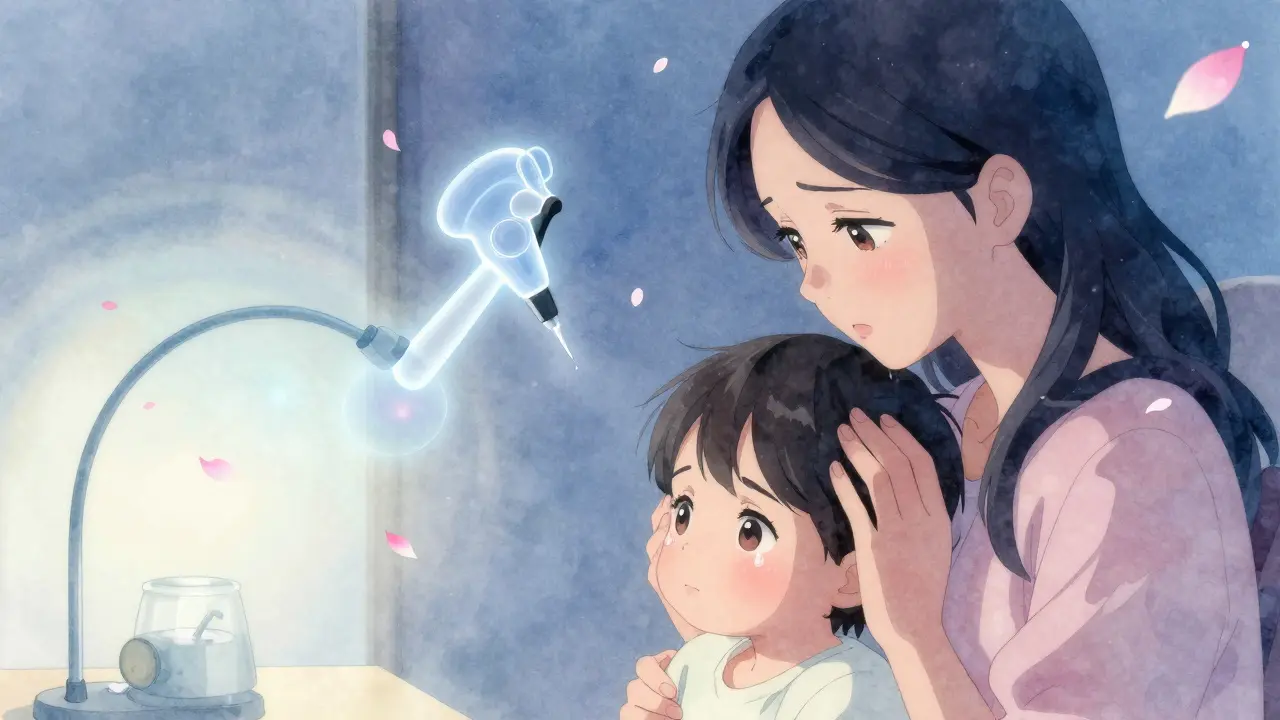
When your child grabs their ear, cries nonstop, and won’t lie down to sleep, it’s hard not to panic. Ear infections are one of the most common reasons parents rush to the doctor - especially for kids under three. But here’s the thing: ear infections don’t always need antibiotics. In fact, many clear up on their own. The real challenge isn’t just treating the infection - it’s knowing when to wait, when to treat, and when to consider something more permanent like tubes.
What Exactly Is an Ear Infection?
An acute ear infection, or acute otitis media (AOM), happens when fluid builds up behind the eardrum and gets infected. It’s not just water trapped in the ear canal - that’s swimmer’s ear. This is deeper. The middle ear becomes inflamed, the eardrum swells and bulges, and it hurts. Kids often show signs like fussiness, pulling at the ear, trouble sleeping, fever, or even drainage from the ear. Babies might just cry more than usual or refuse to eat because sucking makes the pressure worse.
Doctors diagnose it by checking three things: sudden onset of symptoms, fluid behind the eardrum (seen with an otoscope), and signs of inflammation - like a red, bulging eardrum or clear pain. Not every red eardrum means infection. Sometimes it’s just from crying or a cold. That’s why a proper exam matters.
Why Antibiotics Aren’t Always the Answer
For decades, antibiotics were the default. But overprescribing led to bigger problems: resistant bacteria, side effects like diarrhea and rashes, and unnecessary costs. Today, guidelines from the American Academy of Pediatrics (AAP) and the CDC say: don’t rush to antibiotics unless it’s necessary.
Here’s the truth: 60% to 80% of ear infections in kids get better without antibiotics. The body fights off the infection on its own in a couple of days. That’s why watchful waiting is now a standard option - and it’s backed by solid data.
Watchful waiting means giving your child pain relief and watching closely for 48 to 72 hours before deciding if antibiotics are needed. You’re not ignoring the problem. You’re giving the immune system a chance to work. Studies show that within 24 hours, most kids start feeling better, even without pills. By day three, nearly all are improving.
Who qualifies for watchful waiting?
- Children 6 to 23 months with an infection in only one ear and mild symptoms
- Children 2 years and older with either one or both ears affected, as long as symptoms aren’t severe
But if your child is under 6 months, has a fever over 102.2°F, severe ear pain lasting more than 48 hours, or fluid draining from the ear - antibiotics are needed right away. Same goes for babies with infections in both ears. Their immune systems aren’t strong enough to wait.
What Antibiotics Are Used - And When
If antibiotics are needed, amoxicillin is the first choice. It’s effective, safe, and cheap. For kids under 2 or with severe symptoms, doctors usually prescribe high-dose amoxicillin - 80 to 90 milligrams per kilogram of body weight per day, split into two doses. That’s higher than what many parents expect, but it’s what works best against stubborn bacteria.
How long? It depends on age:
- Under 2 years: 10 days
- 2 to 5 years: 7 days
- 6 years and older with mild symptoms: just 5 days
If your child is allergic to penicillin, alternatives like cefdinir, ceftriaxone (an injection), or clindamycin are used. But these are less ideal - they cost more, can cause more side effects, and aren’t as reliable.
Here’s something many parents don’t know: even when antibiotics are given, pain relief is just as important. Up to 69% of kids with ear infections have moderate to severe pain. Yet only about one-third get proper pain medicine. Acetaminophen or ibuprofen (for kids over 6 months) should be given regularly - every 4 to 6 hours - not just when the child screams. Don’t wait for the pain to get worse. Treat it early.
When Tubes Might Be Necessary
Some kids keep getting ear infections. If your child has had three infections in six months, or four in a year - with at least one in the last six months - it’s time to talk about tubes.
Tympanostomy tubes are tiny plastic or metal cylinders placed through the eardrum during a quick surgery. They let air into the middle ear and drain fluid, which reduces the chance of infection. The procedure takes less than 15 minutes, is done under light anesthesia, and kids usually go home the same day.
Tubes aren’t a cure-all. They reduce infections by about half in the first six months after insertion. After that, the benefit fades. But for kids who are constantly sick, in pain, or losing hearing because of fluid buildup, tubes can be life-changing.
There’s another reason for tubes: persistent fluid. If fluid stays behind the eardrum for more than three months and causes hearing loss (40 decibels or worse), tubes are strongly recommended. Hearing matters - especially for speech and language development in toddlers.
But tubes aren’t for every kid who gets a few ear infections. Some doctors still overuse them. Experts like Dr. Charles Bluestone warn that putting tubes in kids with just frequent infections - without hearing loss or structural damage - doesn’t always help. It’s a surgical decision, not a convenience one.
Tubes usually fall out on their own in 6 to 18 months. The eardrum heals behind them. Rarely, they leave a small hole or scar tissue, but serious complications are uncommon.
What Doesn’t Work - And Why
There’s a lot of misinformation out there. Decongestants and antihistamines? They don’t help ear infections. Studies show they offer no real benefit and can cause drowsiness, irritability, or even dangerous side effects in young kids. Same with nasal sprays, steam, or home remedies like garlic oil. They might feel comforting, but they don’t treat the infection.
And no, ear infections aren’t caused by baths or swimming. Water doesn’t get behind the eardrum in healthy kids. That’s a myth.
What does help? Vaccines. Since the pneumococcal conjugate vaccine (PCV13) became routine in 2010, ear infection rates have dropped by 12%, and recurrent infections by 20%. Keeping your child up to date on vaccines is one of the best ways to prevent these infections in the first place.

Why Do Some Doctors Still Prescribe Antibiotics Too Soon?
Even with clear guidelines, prescribing habits vary wildly. One study of over a million visits found antibiotic use ranged from 52% in children’s hospitals to 78% in private clinics - even when the child met the criteria for watchful waiting.
Why? Three big reasons:
- Parental pressure - 41% of doctors say parents expect antibiotics
- Time constraints - 68% of clinicians feel rushed during visits
- Diagnostic uncertainty - 33% aren’t sure if it’s truly an infection
The good news? Tools are helping. Safety-net prescriptions - where the doctor gives you an antibiotic prescription but tells you to fill it only if symptoms don’t improve in 48 hours - work well. When used, 76% of parents follow the plan. Electronic health record alerts that pop up when a doctor is about to prescribe unnecessarily? They cut inappropriate prescriptions by nearly 30%.
What Parents Can Do Right Now
If your child has an ear infection:
- Ask: Is it severe? Does my child have a high fever or intense pain lasting more than 48 hours?
- Ask: Is my child under 6 months or have both ears infected?
- If the answer is no - ask about watchful waiting. Request pain relief first.
- If antibiotics are prescribed, ask: What’s the dose? How long? What if it doesn’t help?
- Always give acetaminophen or ibuprofen regularly - don’t wait for crying to start.
- Call back if symptoms get worse after 48 hours, or if fever spikes.
- If infections keep coming, ask about hearing tests and whether tubes are appropriate.
Most kids outgrow ear infections by age five. Their Eustachian tubes grow longer and straighter, making it harder for fluid to get trapped. But until then, knowing the difference between urgent care and watchful waiting can save your child from unnecessary drugs - and you from unnecessary stress.
What’s Changing in the Guidelines
The latest AAP guidelines (2013) already shifted the bar. Before, doctors treated all kids under 2 with antibiotics. Now, they wait for those under 6 months or with severe symptoms. The next update, expected in 2024, may go even further: tightening tube criteria to require confirmed hearing loss, and expanding watchful waiting to more kids with bilateral infections.
Prescribing rates are already dropping. In 1995, 95% of ear infections got antibiotics. In 2022, it was 61%. That’s progress. The goal? 50% by 2030. We’re getting there - slowly, but surely.
Do all ear infections need antibiotics?
No. About 60% to 80% of ear infections in children clear up on their own within a few days. Antibiotics are only needed for severe cases, babies under 6 months, or if symptoms don’t improve after 48 to 72 hours of pain relief and observation.
How do I know if my child’s ear infection is severe?
Signs of a severe ear infection include a fever of 102.2°F or higher, ear pain lasting more than 48 hours, a toxic or very sick appearance, or fluid draining from the ear. In babies, this might mean constant crying, refusal to eat, or extreme fussiness. If you see any of these, see a doctor right away.
Can ear infections cause hearing loss?
Yes - but usually only if fluid stays behind the eardrum for more than three months. This is called otitis media with effusion. It can cause temporary hearing loss of 30 to 40 decibels, which may affect speech development in toddlers. If fluid persists, a hearing test is recommended.
Are ear tubes dangerous?
Ear tubes are very safe. The procedure is quick, done under light anesthesia, and complications are rare. Tubes usually fall out on their own in 6 to 18 months. The most common issue is a small scar on the eardrum, which rarely affects hearing. The bigger risk is overusing tubes for kids who don’t truly need them.
What can I do at home to help my child’s ear infection?
Give regular doses of acetaminophen or ibuprofen (for kids over 6 months) to control pain and fever. Keep your child hydrated. Use a humidifier if the air is dry. Avoid decongestants, antihistamines, and home remedies like oil drops - they don’t help and can be harmful. Monitor for worsening symptoms and call your doctor if fever spikes or pain doesn’t improve in 48 hours.
Will my child outgrow ear infections?
Yes. Most children outgrow frequent ear infections by age 5. As they grow, their Eustachian tubes become longer and more angled, making it harder for fluid and bacteria to get trapped. Vaccines like PCV13 have also helped reduce infection rates significantly since 2010.
This is such a clear breakdown-thank you for sharing. I wish every pediatrician gave this level of detail.
Doctors still push antibiotics like they're candy and parents just roll over because they're tired
It's not medical care it's convenience culture
Of course they say watchful waiting-big pharma doesn't profit from that
Ever wonder why the AAP guidelines changed right after the pneumococcal vaccine became mandatory?
It's not about kids it's about controlling the narrative
And don't even get me started on tubes-they're just another profit center
My cousin's kid got tubes at 18 months and now he's on hearing aids at 7
Coincidence? I think not
Man I wish I'd known all this when my daughter had her third infection at 14 months
We went straight for the antibiotics like everyone told us to
Turns out she was just overstimulated and had a cold
But the pain meds and waiting game? Total game changer
Now I tell every new parent I meet: don't panic, just listen to the body
It's smarter than you think
I’m so glad this post exists. My mom insisted on antibiotics every time-now I’m the one asking for watchful waiting and she thinks I’m a bad mom 😅
But my son hasn’t had a single infection since we started this approach. He’s 3 now. Just pain meds, rest, and patience. No drama. No side effects. Just… healing.
While the data presented is statistically sound, one must consider the socioeconomic implications of delayed intervention in households without reliable access to follow-up care.
The philosophical tension here is fascinating: autonomy versus paternalism in pediatric care. On one hand, we honor the child's developing immune system as an intelligent, adaptive organism. On the other, we are bound by societal expectations of immediate intervention-often rooted in anxiety, not medicine. The real tragedy isn't the overuse of antibiotics; it's the erosion of trust in natural biological processes. We've been conditioned to equate action with care, when sometimes, the most profound act of care is restraint. The Eustachian tube's anatomical evolution isn't just biology-it's a silent testament to resilience. And yet, we rush to cut, drain, and prescribe, as if nature itself is broken. Perhaps the most radical act in modern parenting is not doing anything at all.
While the article is commendably thorough, it fails to address the epistemological limitations of otoscopic diagnosis in non-specialist settings. The inter-rater reliability of eardrum assessment among general pediatricians hovers around 68%, which renders the entire watchful-waiting paradigm statistically precarious in community practice.
Actually, the 60-80% recovery stat is misleading-it's based on mild cases in high-income countries with good nutrition and low pollution. Try being a parent in rural Mississippi or rural India and see how 'watchful waiting' works when you can't even get ibuprofen without a prescription. This is rich-person medicine dressed up as science.
Love this post! 🙌
My niece got tubes last year and now she’s talking like a little professor 😊
Worth every minute of the surgery!
Just wanted to say thank you for writing this. I used to panic every time my son pulled his ear
Now I give him ibuprofen and wait 48 hours
He's 4 and hasn't had antibiotics since he was 1
And yes he's a little louder than other kids but he's healthy
And that's what matters
❤️
So you're saying we should just let kids suffer because 'their immune system will handle it'?
Wow.
That's the same logic that got us into this mess with vaccines.
Pathetic.